It is 5:52 pm. Dinner is at 6:00.
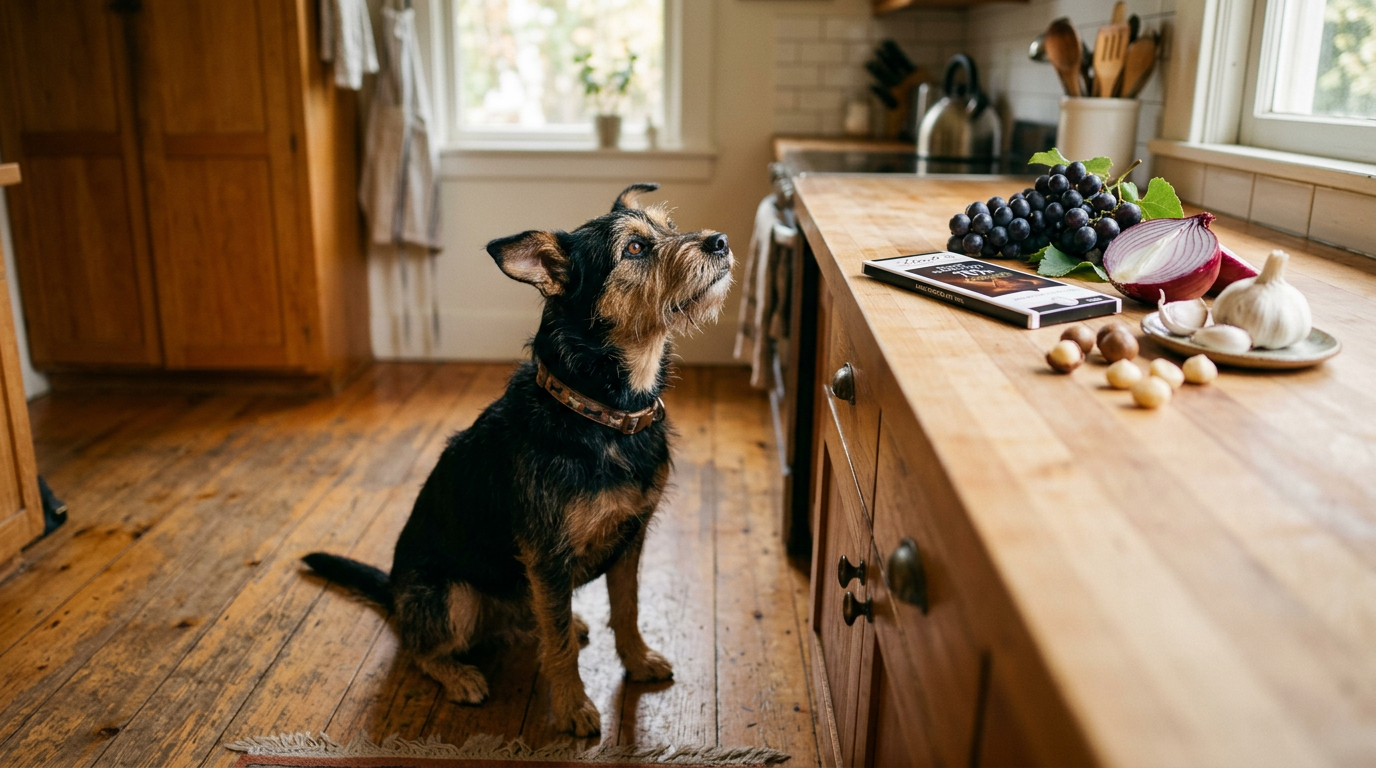
Your dog has known this since 5:15. He is sitting by the bowl in a position he learned at no training class, and he is staring. Not at the bowl — at you. With the look that holds the whole history of a dog unfed since puppyhood, although he had breakfast at seven and negotiated a piece of carrot at one.
You pour. It is gone in forty seconds. The dog lifts his head and looks again — this time with mild disbelief that that was all.
And then comes the question: am I giving him too little?
Probably not. But "probably" is a weak word for something you do twice a day for a dozen or so years. So let's work it out once, properly. It takes ten minutes and frees you from a guilty conscience at every bowl.
Why nobody will give you a single number
Because it doesn't exist. "How much food for a 20 kg dog" is a question like "how much fuel will a car use". It depends which car and where it's going.
A portion in grams depends on two things at once:
- how much energy your dog needs — weight, age, neutering, exercise,
- how much energy is in 100 grams of your food — and here the spread between bags runs to tens of percent.
The table on the pack knows only the second. It knows nothing about your dog, which is why it gives ranges wide enough to fit both a greyhound after training and a pug after a nap.
We'll work it out in three steps and then check the result on the only measuring device that counts: the dog.
Step 1: how many calories your dog needs
The starting point is the resting energy requirement — what the body uses simply to exist: breathing, digesting, keeping warm, wagging in its sleep.
The formula looks intimidating, but the calculator on your phone can handle it:
70 × (body weight in kg) to the power of 0.75
For convenience, ready-made results:
| Dog's weight | Resting requirement |
|---|---|
| 5 kg | approx. 235 kcal |
| 10 kg | approx. 395 kcal |
| 20 kg | approx. 660 kcal |
| 30 kg | approx. 900 kcal |
| 40 kg | approx. 1,115 kcal |
Notice one thing: a forty-kilo dog doesn't need four times more than a ten-kilo dog, only just under three times. Small dogs burn clearly more per kilogram than large ones. That is why the "so many grams per kilo of dog" rule doesn't work and never did.
Now the multiplier — because your dog doesn't just exist, he lives:
| Dog | Multiplier |
|---|---|
| Adult, neutered | × 1.6 |
| Adult, entire | × 1.8 |
| Little exercise (short walks, lots of sofa) | a further × 0.8 |
| Lots of exercise (running, sport, work) | a further × 1.3 |
| Senior | usually slightly less than an adult |
| Puppy | × 2 to × 3, depending on the stage of growth |
An example we'll carry through to the end. Fado: a Labrador-type mongrel, 20 kg, five years old, neutered, two proper walks a day.
660 kcal × 1.6 = approx. 1,060 kcal a day.
If Fado were the sofa type: 1,060 × 0.8 = approx. 850 kcal. The same dog, the same weight, a fifth less food. That is exactly what the table on the bag doesn't know.
An honest caveat: this is a starting point, not a verdict. Two dogs of the same weight and lifestyle can differ in their requirement by 20–30% either way. The formula tells you where to start. The dog will tell you whether you got it right.
Step 2: how many calories your food has
Turn the bag over and find "metabolisable energy" or kcal/100 g. Sometimes it is given in kcal/kg — then divide by ten.
As a guide:
- dry food: usually 340–420 kcal per 100 g,
- wet food: usually 80–130 kcal per 100 g, because three quarters of it is water.
The difference between 340 and 420 looks innocent. You are about to see that it isn't.
If the manufacturer doesn't give the calorie content, which happens especially with wet foods, check it in the Purrtner food ranking — it is shown for every food in our database.
Step 3: division
daily portion in grams = the dog's calories ÷ calories in 100 g of food × 100
Fado needs 1,060 kcal. See what happens with three different bags:
| Food | Fado's daily portion |
|---|---|
| 340 kcal/100 g | approx. 310 g |
| 380 kcal/100 g | approx. 280 g |
| 420 kcal/100 g | approx. 250 g |
The same dog. The same bowl. Sixty grams' difference a day between the first and the third food, which is over 21 kilograms a year.
Two conclusions follow. First: if you change food and pour "the same as always", you are almost certainly pouring the wrong amount. Second: a low-calorie bag runs out faster, so the price per kilogram says little. What counts is the price per day of feeding.
If you don't fancy powers at six in the evening, the Purrtner calculator does all three steps at once: you enter breed, age, weight, neutering and activity, choose a food and get grams per day. Free and without creating an account.
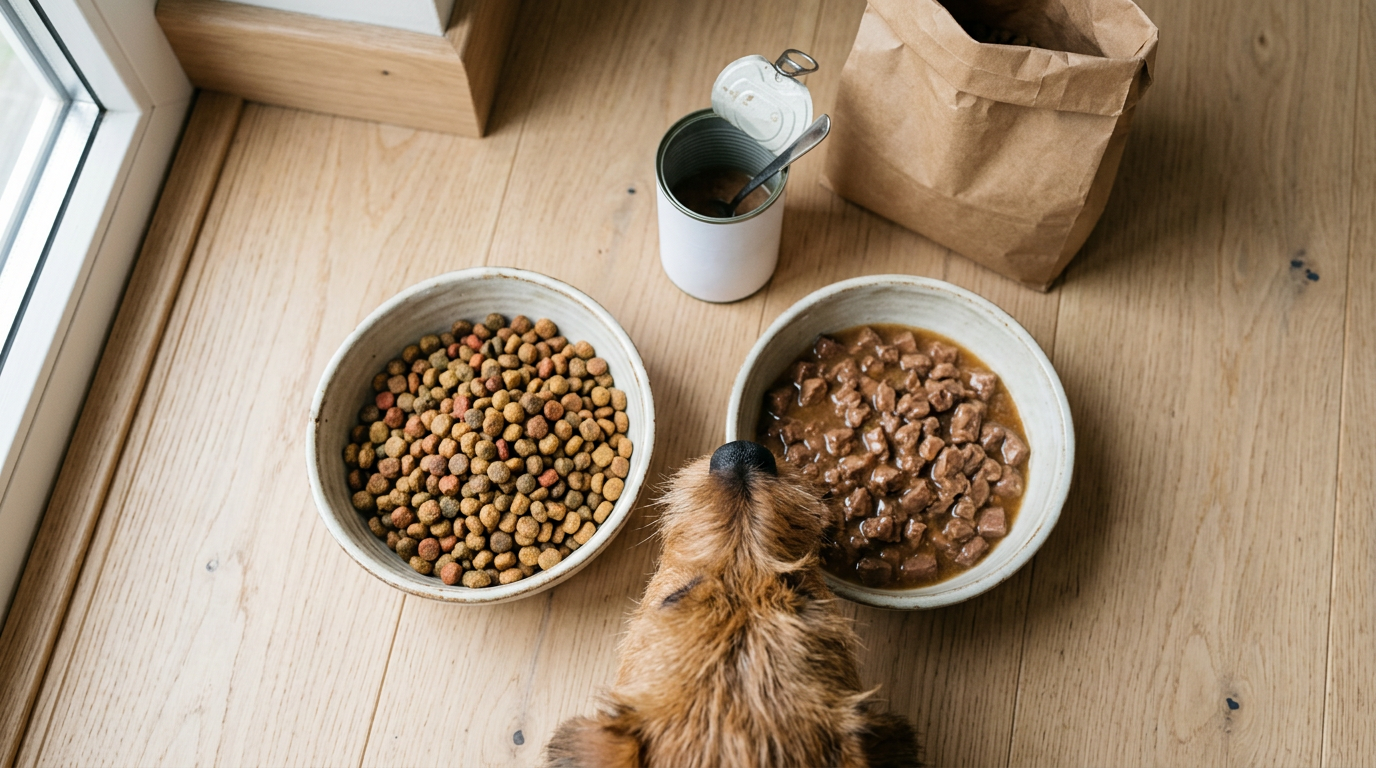
And if you feed both dry and wet
Then you divide the calories, not the bowl.
Say Fado is to get 70% of his energy from dry food and 30% from wet:
- dry (380 kcal/100 g): 740 kcal, which is approx. 195 g,
- wet (100 kcal/100 g): 320 kcal, which is approx. 320 g.
Yes, the wet comes out heavier, although it supplies less than half the energy of the dry. That is not an error; it is water. And that is why "half a bowl of this, half a bowl of that" ends with a dog that is either hungry or round — depending on which way you got it wrong.
Treats: the small print of this contract
1,060 kcal is everything Fado eats in a day. Not "food plus whatever he begs".
The rule is simple: treats up to 10% of daily energy. For Fado that is about 100 kcal — a slice of hard cheese and a few rewards on a walk, for example. And what you give outside the bowl, you subtract from the bowl.
How quickly "just one little piece" becomes a third of the day is covered in our article on the most common mistakes in feeding dogs.
How many times a day
Adult dog: two meals. One meal a day means long hours on an empty stomach followed by eating at the speed of a vacuum cleaner.
Puppy: three to four meals, because a small stomach can't fit the daily amount in two sittings.
Large and deep-chested breeds — Great Danes, shepherds, setters, pointers. Here splitting the food into at least two meals is not a matter of convenience. One large meal a day and very fast eating are among the factors that studies link with a higher risk of gastric dilatation and volvulus. That is a life-threatening emergency. A restless dog with a swelling abdomen who is trying to vomit and can't goes to the clinic immediately, not in the morning.
A puppy is separate maths
A puppy's requirement changes from month to month: at the start it can be three times the resting requirement, towards the end of growth — twice. A portion worked out in March is out of date in May.
Two things worth knowing:
More doesn't mean better. In large and giant breeds, overfeeding during growth doesn't produce a "bigger dog". It produces a dog that grows too fast for its own joints. A puppy should be lean: ribs easily felt under your hand, a waist visible from above.
Weigh every week or two and recalculate. The Purrtner calculator takes into account the stage of growth and the expected adult weight for the breed.
The check: the dog is the final authority
The formula gave you a number. Now you verify it.
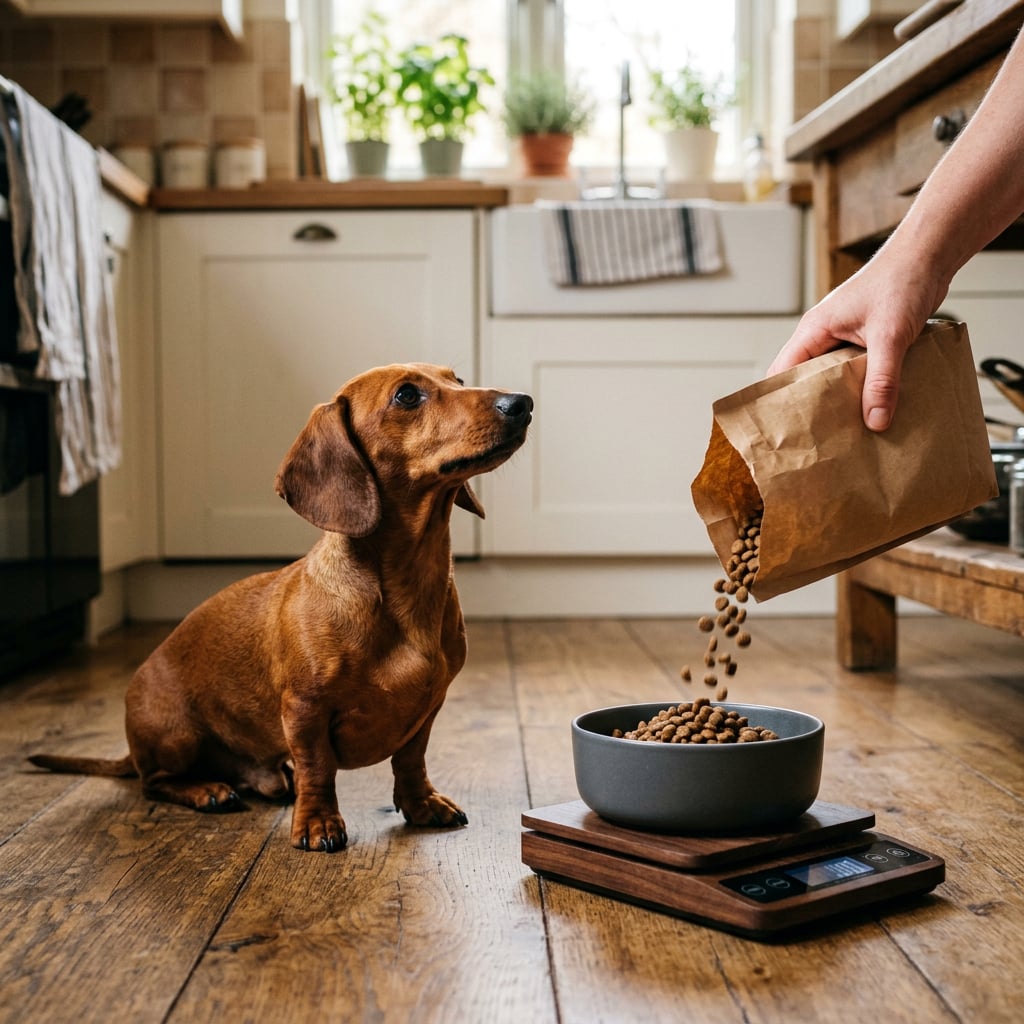
- Feed the calculated portion for 2–3 weeks. Measure with kitchen scales, not a cup.
- Weigh the dog before and after. A small dog in your arms on bathroom scales (you with the dog minus you). A large one at the vet's — most clinics will let you use the scales without an appointment.
- Do the rib test. Hands flat on the chest, no pressing. The ribs should be felt at once, under a thin layer.
- Adjust by 10%. Gaining — ten percent less. Losing when he shouldn't — ten percent more. Another 2–3 weeks, then the scales again.
After two or three such rounds you have a portion no manufacturer knows: one worked out for your dog.
If your dog is overweight, the portion is calculated from the target weight, not the current one. Otherwise you are feeding the excess weight so that it stays. For a larger weight loss, or a dog with a chronic illness, the plan is set by a vet.
When it isn't a question of portion
Go to the vet, not the calculator, if:
- the dog is losing weight on a normal portion, or gaining although nothing has changed,
- his appetite has suddenly clearly increased or dropped,
- he drinks and urinates much more than usual,
- he eats greedily and yet loses muscle and condition,
- she is a pregnant or nursing bitch, or the dog has kidney, pancreatic or heart disease or diabetes — here the amount is set by the vet.
Thyroid and adrenal disease, diabetes and parasites can all look like a "portion problem". No formula will catch them.
"But he's always hungry"
Back to 5:52 pm and that look.
It has to be said plainly: a dog's appetite is not a measure of his needs. The dog descends from an animal that ate when it caught something and didn't know when the next chance would come. The strategy "eat everything, immediately, and check whether there's more" was simply sensible for thousands of years. Your dog still uses it. He doesn't know he lives three metres from a cupboard with a twelve-kilo bag in it.
In some dogs genetics add to this. Roughly one Labrador in four carries a variant of the POMC gene that makes the dog feel hunger more strongly and take a keener interest in food. If you have a Labrador and suspect he was a vacuum cleaner in a previous life, it may not be character at all, but DNA.
And now the harder part. That look works because it hits a tender spot: food is the simplest way to tell a dog "I love you". Adding a handful takes a second and brings instant joy on both sides of the bowl.
Except that the bill for that handful arrives later. In a long-term study of Labradors, dogs fed a quarter less than their siblings from the same litters lived almost two years longer — a median of 13 years instead of just over 11 — and developed joint disease later.
Two years. Of walks, of greetings at the door, of sleeping at the foot of the bed.
So next time your dog finishes eating and looks at you reproachfully, try reading that look differently. Very often it doesn't mean "give me more". It means "do something with me". A ball, five minutes of searching the flat for a few kibbles taken from the daily portion, a scratch behind the ear. No extra calories, and it takes care of what was really being asked for.
And if you want dinner to last longer than forty seconds: a slow-feeder bowl or a snuffle mat turns the same portion into a ten-minute activity.
What to do this evening
- Find the kcal/100 g on the bag. Write it down.
- Work out your dog's requirement — from the table above or with the calculator.
- Weigh on kitchen scales what you "always" pour. Compare it with the result.
- Put a weigh-in for the dog in your calendar three weeks from now.
If point three surprises you — welcome to the club. Most owners belong to it.
And tomorrow at 5:52 pm your dog will sit down by the bowl looking like an orphan anyway. There is nothing you can do about that. But you will know that the bowl holds exactly what it takes for him to keep sitting there for many years to come.
This article does not replace a veterinary consultation. It concerns healthy dogs; in illness, pregnancy and major weight loss the amount is set by a vet.
Purrtner is free: portion calculator, a food ranking based on composition and reminders when the food is running low. Work out the portion for your dog — without creating an account.