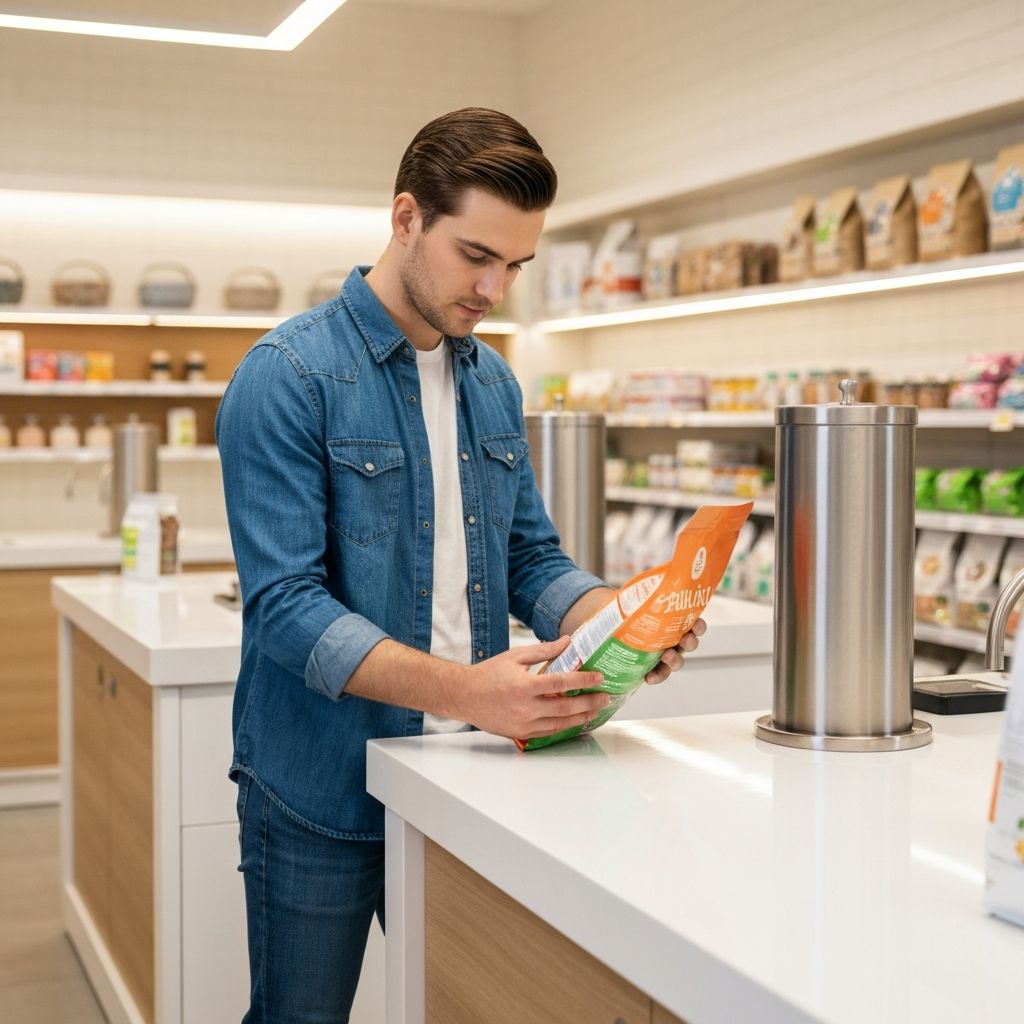
A pet food label is the only document in your home that is both regulated by law and written so that you won't understand it.
Front of the bag: a wolf against the mountains, the words "rich in fresh meat", a nice typeface. Back of the bag: in five-point type, in four languages, a string of words like "vegetable by-products", "minerals", "meat and animal derivatives (min. 4% chicken)". And it is that second text that tells the truth.
The good news: to understand it you don't need a degree in animal nutrition. You need twenty minutes and a few rules you are about to learn. After reading them you will walk into a shop and in thirty seconds assess a bag you used to stand in front of helplessly.
Let's start with where NOT to look
Before I tell you what matters, let me save you some time: you can ignore the entire front of the pack.
Words such as "premium", "super premium", "holistic", "natural", "traditional recipe" have no legal definition. Nobody verifies them. A manufacturer can write "holistic" on a food made mostly of maize and break no regulation.
The photo of a juicy steak on the bag means nothing either. The rule is: graphics sell, text informs. Turn the bag over.
Step 1: the first three ingredients — 80% of the information
Ingredients are listed in descending order of weight. The first is the heaviest, the last the lightest. It sounds trivial, but everything is hidden in it.
What a good start to the composition looks like:
"Dried chicken meat (30%), rice (20%), chicken fat…"
You know exactly: which animal, how much of it, what comes next.
What a bad start looks like:
"Cereals, meat and animal derivatives (min. 4% chicken), oils and fats…"
Three problems at once. Cereals in first place (so there is most of them). "Meat and animal derivatives" with no species named — it can be any animal, in any proportion, changed from batch to batch. And "min. 4% chicken" tells you that chicken is a marginal part of that whole category.
A practical rule: if a manufacturer knows its raw material and is proud of it, it will say which and how much. If it writes in generalities, that is usually because it buys whatever happens to be cheap.
Step 2: the fresh-meat trick almost everyone falls for
This is the most common marketing move in the whole industry and worth understanding once and for all.
Compare two foods:
- Food A: "fresh chicken 40%"
- Food B: "dried chicken meat 25%"
Which has more animal protein? Instinct says A. The truth: B.
Fresh meat contains about 70% water. During kibble production the water evaporates. Of 40% fresh chicken, roughly 12% remains in the finished food. Dried meat (meat meal) is already dehydrated — that 25% is 25% in the finished product.
Manufacturers declare percentages before processing, because they are allowed to. And they count on you weighing it up with the scales, not with your head.
How to get round it: if you see "fresh meat", divide the declared percentage by roughly three. That gives you the approximate content in the finished food.
Step 3: a glossary of suspicious phrases
A few phrases worth knowing how to decode:
"Animal by-products" — a broad category. It can mean valuable offal (liver, heart, kidneys — genuinely rich in nutrients), but it can also mean low-value parts. Without detail you don't know what you are buying. The phrase alone is not a verdict — the lack of specifics is closer to one.
"Cereals" (without naming which) — a sign that the composition may change between batches depending on raw material prices. For a dog with a sensitive digestive system that is a problem, because "the same food" doesn't always mean the same thing.
"Sugars" / "caramel" / "syrup" — added for colour and flavour. They have no business in dog or cat food.
"Extract of…" — often an addition in trace amounts, included so that something nice can be written on the front. Notice where it sits in the order of ingredients: if it's at the end, there is next to nothing of it.
"Antioxidants" without a name — legal, but worth knowing whether they are natural (tocopherols, i.e. vitamin E) or synthetic (BHA, BHT). Manufacturers proud of theirs choose the version with the name.
Step 4: analytical constituents — four numbers that don't lie
Here we get to hard data. This table is regulated and the manufacturer can't make things up in it.
| Parameter | Adult dog (dry) | Adult cat (dry) | What it tells you |
|---|---|---|---|
| Crude protein | 22–32% | 30–40% | A cat is an obligate carnivore — it needs clearly more |
| Crude fat | 10–20% | 12–22% | Energy, coat, vitamin absorption |
| Crude fibre | 2–5% | 2–5% | Above about 6–7% often means filler |
| Crude ash | up to about 8% | up to about 9% | High ash can signal a large share of bone-based raw materials |
| Moisture | up to 10% | up to 10% | Standard for dry foods |
The ranges are a starting point — a puppy, a nursing queen or a working dog have different needs.
One thing specific to cats that you need to know: a cat must get taurine from its food because, unlike a dog, it cannot produce enough of it. A deficiency leads to serious heart and vision problems. A good cat food has taurine listed. If you can't see it — put the bag back.
Step 5: the number everyone skips — kcal per 100 g
Remember this sentence: a food at 80 zł can be more expensive to use than a food at 130 zł.
If the cheaper one has 320 kcal/100 g and the dearer one 420 kcal/100 g, you have to feed a portion of the cheaper one that is over 30% larger. The bag disappears faster and you buy more every month.
The real cost of a food is counted not per kilogram but per day of feeding a specific animal. Nobody wants to do that sum by hand — so the Purrtner calculator does it for you: you give breed, weight, age and activity, choose a food, and get the daily amount in grams, the calories and how many days the pack will last.
Calorie content may be given as "metabolisable energy" or "ME". If the manufacturer doesn't give it at all — that in itself is information.
Step 6: does "grain-free" mean "better"? No
This is one of the most effective marketing slogans of the last decade and worth defusing.
"Grain-free" means exactly that: without grains. It doesn't mean "without carbohydrates". In many such foods the grains have been replaced with peas, lentils, chickpeas and potatoes — sometimes in quantities that turn a meat-based food into a legume-based one.
The FDA ran analyses for years on a potential link between grain-free diets rich in legumes and dilated cardiomyopathy in dogs. The question isn't finally settled, but the practical conclusion is simple: the absence of grains is not an automatic advantage, and it is sometimes an argument for raising the price.
A well-chosen grain (rice, oats) is a trouble-free source of energy for most dogs. Over thousands of years beside humans, the dog acquired several times more copies of the gene responsible for digesting starch than the wolf. He is not a wolf and doesn't have to eat like one.
The exception: a dog with a confirmed intolerance to a specific grain. But that is diagnosed by a vet with an elimination diet, not by Facebook.
Step 7: five red flags — if you see them, put the bag back
- The first ingredient is not a source of animal protein in a food advertised as meat-based.
- No species named — "meat" with no information about which animal.
- Sugar, caramel or colourings in the ingredient list.
- No calorie content on the pack.
- No taurine in a cat food — it isn't an extra, it's a necessity.
The thirty-second test in the shop
Next time you stand in front of the shelf, do this:
- Turn the bag over (you ignore the front).
- Read the first three ingredients. A specific animal with a percentage? Good. Generalities and cereals? Put it back.
- Check protein and fat in the analytical constituents — are they within the ranges in the table above?
- Find the kcal/100 g. Not there? Suspicious.
- Cat? Look for taurine.
Five steps, one bag, half a minute. The same time you used to spend looking at the wolf on the packaging.
Frequently asked questions
Does the composition of dog and cat food differ much? Yes, fundamentally. A cat is an obligate carnivore: it needs more animal protein, taurine and vitamin A in ready-made form. Feeding a cat dog food is harmful — not "worse", harmful.
What does "complete" mean? That the food contains the full set of nutrients and can be the only food. "Complementary" food (many treats and some wet foods) cannot — it is an addition, not a meal.
Is a high protein percentage always better? No. The source and digestibility count too. Plant protein from peas and protein from meat are not the same thing, even though they give the same number in the table.
Can I compare two foods by composition alone? Composition is the foundation, but the comparison is worth completing with calorie content and price per day of feeding. The Purrtner food ranking rates foods precisely on composition and shows prices side by side.
How do I know the food really suits my pet? After 6–8 weeks: shiny coat, skin without irritation, formed stools, stable weight, steady energy. The label is a forecast — the dog and the cat are the verification.
In the end
Pet food manufacturers spend millions convincing you that the choice is hard and that you have to trust them. The truth is less spectacular: the choice is simple; the information is just deliberately hard to get at.
Now you have it. Your dog will still try to eat your slipper, and your cat will still turn up its nose at what it adored yesterday — but at least they will be doing it on a diet you chose knowingly.
Purrtner is free — portion calculator, a food ranking based on composition, price comparison and a catalogue of more than 70 breeds. Set a free reminder and we will write to you before the bag runs out: with the daily amount and the cheapest offer.