Abyssinian
(Kot Abisyński)
Origin: Ethiopia (Abyssinia)
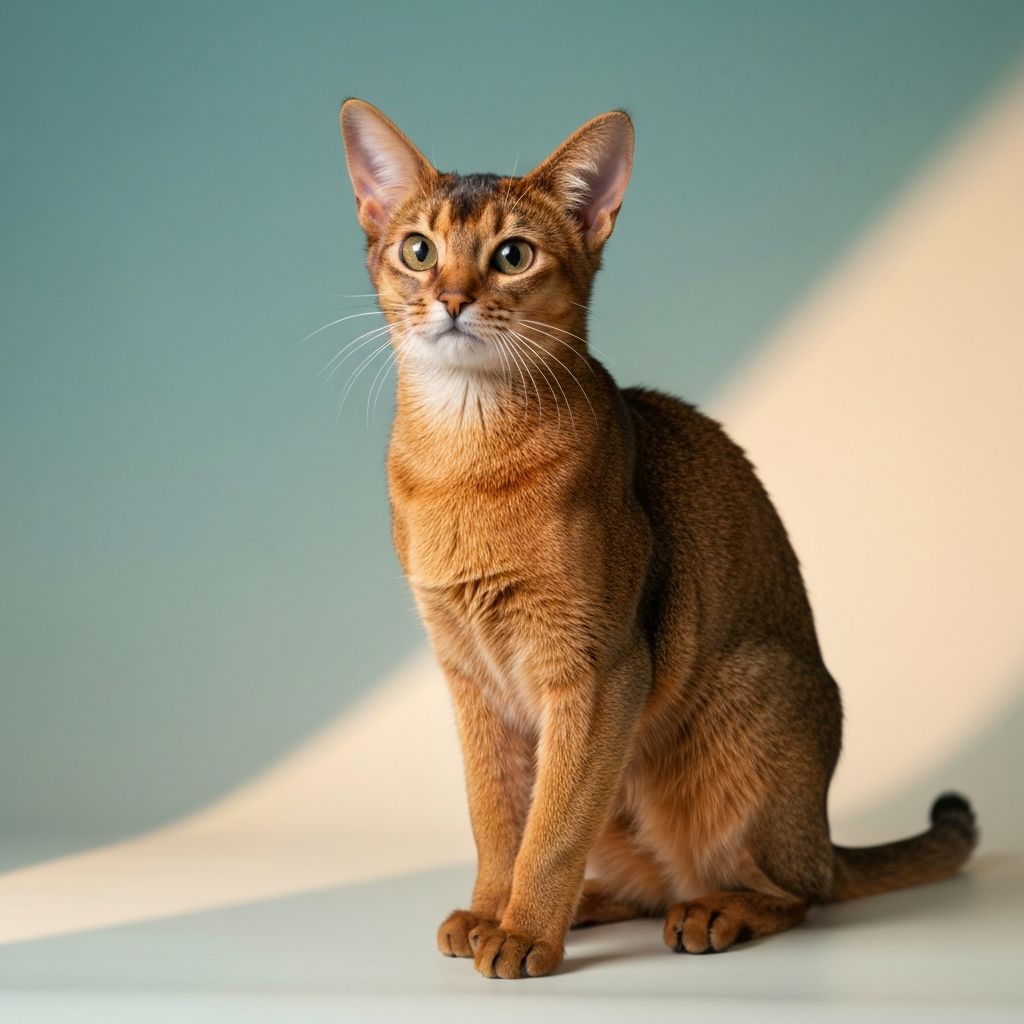
The Abyssinian looks like a little puma the color of heated brick and has one mode of operation: ON. It is the most curious cat in the world — and the worst candidate for a lap cuddler.
The Abyssinian does not walk around the house — it investigates it. Every cabinet must be opened, every bag inspected, every countertop gone around from above, because from above you simply see more. This is a cat the color of heated brick, each hair of which has several bands of different shades (the so-called ticking, as in a wild rabbit or a puma), which makes the whole coat look as if it were slightly glowing. And added to this, the slender, muscular silhouette of a miniature puma and great, alert ears set as if it were listening in on the universe. Because the Abyssinian really is listening in — on the world, on you, on the fridge, on everything. It has only one gear, and that gear is curiosity.
And it is a curiosity with a truly ancient lineage — or at least with the best legend in the feline world. The Abyssinian looks like a living copy of the cats from Egyptian paintings: the same slender silhouette, the same great ears and almond eyes that gaze out from the tombs of the pharaohs. For years it was believed to be a direct descendant of the sacred cats of ancient Egypt — and although geneticists today cool these romantic theories (the trails lead rather toward the shores of the Indian Ocean and Asia), the cat itself seems not to know this. It carries itself like a living museum exhibit that has just decided to step down from its display case and check what you have there in the cabinet under the sink. It reached Europe in the 19th century and took its name from Abyssinia, or old Ethiopia — and so it began its second career: conquering homes with the speed of lightning.
Because life with an Abyssinian is life with a well-oiled ball of energy. This is an acrobat that treats the furniture as an obstacle course and the highest point in the room as its natural command post. It opens doors, pulls out drawers, carries small objects in its mouth, and assists at literally every task of yours — not out of a need for cuddling, but out of a pure, insatiable need to know what you are up to again. This is not a cat that will sleep through an afternoon with you on the sofa. It is a cat that will check where all the cables lead, climb onto the wardrobe to investigate the ceiling, and come back to report that the terrain is secured. Boredom is its only real enemy — and a bored Abyssinian can, in half a day, rearrange the apartment according to its own concept.
And yet it would be a wrong to call it only a “force of nature,” because in this breed hides a surprising depth of feeling. The Abyssinian loves through co-participation: it does not nestle passively, it wants to be your accomplice. It is where you are — on the desk during work, on the edge of the bathtub during a bath, on the windowsill beside your morning coffee. It is sometimes called a “dog-cat,” because it clings to its human, follows them step by step, and sincerely participates in their day. This love does not consist of lying on your lap — it consists in the fact that whatever you do, you do it together. For someone who wants in a cat a partner curious about the world, and not an ornament, this is the best deal one can strike.
All this energy of course needs solid fuel — and here the Abyssinian's bowl is governed by clear rules:
- Plenty of energy and full-value protein: this is a cat of very high activity that really burns what it eats — the diet must keep up with its eternal movement
- Quality over quantity: good, meaty ingredients instead of fillers give fuel that drives a sprinter and does not settle in the flank
- Despite the temperament — portion control: very active does not mean immune to gaining weight, especially in neutered cats or those calmer with age
- Water always fresh, ideally moving: a fountain or a dripping tap encourages this curious cat to drink, which supports its kidneys
- Feeding as play: dispenser toys and hiding portions around the apartment are for this mind a real feast — they combine food with the hunt it so craves
Beyond the bowl, it is worth knowing a few matters important for this breed:
- Eyes: Abyssinians can be burdened with progressive retinal atrophy (PRA), which gradually worsens vision — with responsible breeders ask about the parents' genetic tests
- Blood: the breed has a predisposition to pyruvate kinase deficiency — an enzyme important for red blood cells; this too is a disease that can be checked with a DNA test
- Kidneys: Abyssinians have a tendency toward renal amyloidosis (the deposition of amyloid protein) — regular blood and urine tests help catch the problem early
- Movement is a necessity, not an add-on: scratching posts up to the ceiling, shelves, a cat playground, and a daily portion of shared play are with this cat the recipe for the health of body and psyche
- Company: the Abyssinian bears solitude and boredom badly — if you are often away, a second active cat can be the best gift for it
Because the Abyssinian is a spark in a cat's skin: curiosity, movement, and intelligence bound into one slender, glowing body that every day discovers your home anew, as if seeing it for the first time.
Give it a world full of things to investigate and be its accomplice in that discovery, and you will understand the most beautiful paradox of this breed: a cat that is interested in literally everything, out of all the things in the world, still chooses you.
Most common health issues
A hereditary deficiency of an enzyme important for red blood cells, which can lead to anemia (pallor, drowsiness, decline in condition). Detectable by a genetic test - which is why choosing a breeder who tests the parents is crucial. A complete diet supports overall condition, but the disease itself requires veterinary care.
A hereditary eye disease in which the retina gradually loses function, leading to deteriorating vision, usually first after dark. A genetic test is available for some breeds. It is worth observing how the cat copes in low light and mentioning it at visits. Antioxidants and omega fatty acids in the diet support overall eye health.
Health issues
2 most common conditions
Health issues
2 most common conditions
A hereditary deficiency of an enzyme important for red blood cells, which can lead to anemia (pallor, drowsiness, decline in condition). Detectable by a genetic test - which is why choosing a breeder who tests the parents is crucial. A complete diet supports overall condition, but the disease itself requires veterinary care.
A hereditary eye disease in which the retina gradually loses function, leading to deteriorating vision, usually first after dark. A genetic test is available for some breeds. It is worth observing how the cat copes in low light and mentioning it at visits. Antioxidants and omega fatty acids in the diet support overall eye health.
Nutritional needs
Cat hydration - why wet food matters
Cats naturally have a low thirst drive and often drink too little water. Their ancestors - desert cats - obtained water mainly from food. Wet food contains 70-80% water, which significantly supports hydration and helps prevent kidney and urinary tract problems.
Wet foods
Dry foods
≈ kcal calculated from the analysis — the manufacturer does not state calories