Balinese
(Kot Balijski)
Origin: USA
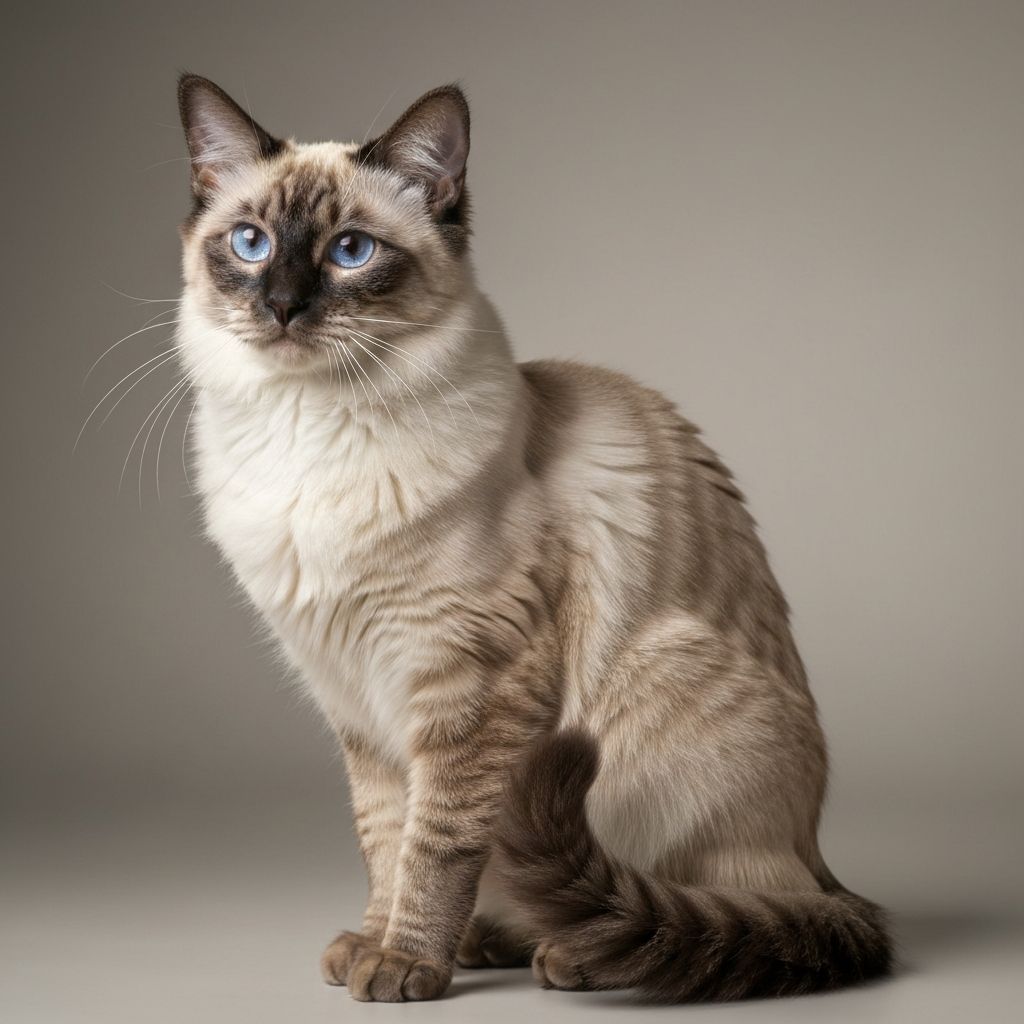
The Balinese is a Siamese that put on an evening gown: the same aristocratic silhouette and sapphire eyes, but swathed in silky fur, with the tail spread into a plume like a train.
The Balinese looks as if a Siamese had gone to a ball and put on an evening gown. It has the same slender, aristocratic silhouette, the same dark mask, and the same piercing, sapphire eyes — but a semi-long, silky coat flows over it, and it spreads its tail into a magnificent, feathery plume that trails behind the cat like a train. And although the name suggests an exotic island, the truth is far less well-traveled: the Balinese has nothing to do with Bali. It was named so because its fluid, graceful movements brought to breeders' minds the Balinese temple dancers. It is simply a long-haired Siamese to which someone drew an evening gown and gave a name worthy of the dance floor.
Interestingly, no one designed this gown — chance sewed it. The Balinese was born in litters of pure Siamese cats, in which from time to time, by a natural mutation, kittens with longer fur appeared. For years they were treated as a defect and passed over, until in the mid-20th century American breeders saw in these long-haired Siamese not a flaw but a stunning, new breed — and decided to fix it. So from a rejected caprice of genetics arose one of the most elegant cats in the world. All the rest is already pure Siamese: it is the same temperament and the same heart, only wrapped in silk.
And this means a character hard to overlook, because the Balinese is exceptionally quick and exceptionally sociable. This is a cat that wants to be a full-fledged participant in your life: it sits by you at work, assists in the kitchen, jumps onto your lap with a toy, and holds conversations with you — though its voice is noticeably gentler and more melodic than the Siamese's famous, piercing alto. The Balinese comments on the world in a soft, singsong half-whisper rather than a resonant demand. It is at the same time an acrobat and a clever schemer: it learns to open doors, plays fetch, solves puzzles, and climbs to the highest point in the room to keep an eye on everything. Boredom is its only real enemy — this breed's quick mind must have occupation.
Behind this elegance and intelligence goes, however, something that is the crux of this breed: a deep, almost dog-like attachment. The Balinese does not choose the whole family equally — it chooses its human and stays with them forever, following them step by step and slipping into bed to fall asleep as close as possible. It loves being needed and participating in everything; it bears badly, on the other hand, long solitude, which for such a sociable cat can be truly keen. A Balinese left alone for whole days does not become indifferent — it pines, quietly and faithfully, waiting at the door for the sound of your steps. This is a cat for someone who wants a devoted companion by their side, ideally in a pair with a second cat if the home often stands empty.
This silky athlete has at the bowl needs to match its energy and its exceptional fur:
- Plenty of full-value protein (32–42%): a slender, muscular silhouette without good protein loses muscle — the diet must keep up with its unceasing movement
- Omega-3 and omega-6 for the silk: this long, gleaming fur begins in the bowl — good fatty acids give it luster and condition, and the skin health
- Fuel for the active: this is an energetic breed that really burns calories — the quality of ingredients counts here more than in a calm couch dweller
- Fresh water always available, and wet food in the diet supports hydration and general condition
- Play through food: dispensers and interactive toys with food excellently occupy this quick mind, combining the meal with the longed-for hunt
Beyond the bowl, it is worth knowing a few matters important for this breed:
- Eyes: Balinese can be burdened with progressive retinal atrophy (PRA), which gradually worsens vision — it is worth observing how the cat manages after dark and mentioning it at visits; with a breeder ask about the parents' tests
- Amyloidosis: as with the Siamese, the breed has a predisposition to the deposition of amyloid protein in the organs — regular blood tests at the vet help catch the problem early
- Good news for allergy sufferers: Balinese produce less of the allergen Fel d 1 than most cats, so they can be better tolerated by allergic people — this is, however, no guarantee, so before adoption it is best to spend some time with the particular cat
- Coat without drama: despite its length, the Balinese's fur has almost no undercoat and rarely felts — combing two or three times a week is entirely enough
- Movement, heights, and company: this quick acrobat must be given scratching posts, shelves, and attention — a bored and lonely Balinese is an unhappy cat
Because the Balinese is a synthesis of two rarely combined things: dazzling, silky beauty and the character of the most faithful of companions — the whole soul of a Siamese, served in a version that looks as if it were gliding across the dance floor all the time.
Let it into your life, and you will quickly find that this feathery tail will accompany you everywhere — because the Balinese has already chosen whom it wants to dance with for its whole long life. You.
Most common health issues
A hereditary eye disease in which the retina gradually loses function, leading to deteriorating vision, usually first after dark. A genetic test is available for some breeds. It is worth observing how the cat copes in low light and mentioning it at visits. Antioxidants and omega fatty acids in the diet support overall eye health.
A disease in which the amyloid protein is deposited in organs (in cats most often in the liver or kidneys), over time disrupting their function. It can be hereditary. Regular blood tests at the vet help catch the problem early, and good-quality, easily digestible nutrition supports the burdened organs.
Health issues
2 most common conditions
Health issues
2 most common conditions
A hereditary eye disease in which the retina gradually loses function, leading to deteriorating vision, usually first after dark. A genetic test is available for some breeds. It is worth observing how the cat copes in low light and mentioning it at visits. Antioxidants and omega fatty acids in the diet support overall eye health.
A disease in which the amyloid protein is deposited in organs (in cats most often in the liver or kidneys), over time disrupting their function. It can be hereditary. Regular blood tests at the vet help catch the problem early, and good-quality, easily digestible nutrition supports the burdened organs.
Nutritional needs
Cat hydration - why wet food matters
Cats naturally have a low thirst drive and often drink too little water. Their ancestors - desert cats - obtained water mainly from food. Wet food contains 70-80% water, which significantly supports hydration and helps prevent kidney and urinary tract problems.