Bengal
(Kot Bengalski)
Origin: USA
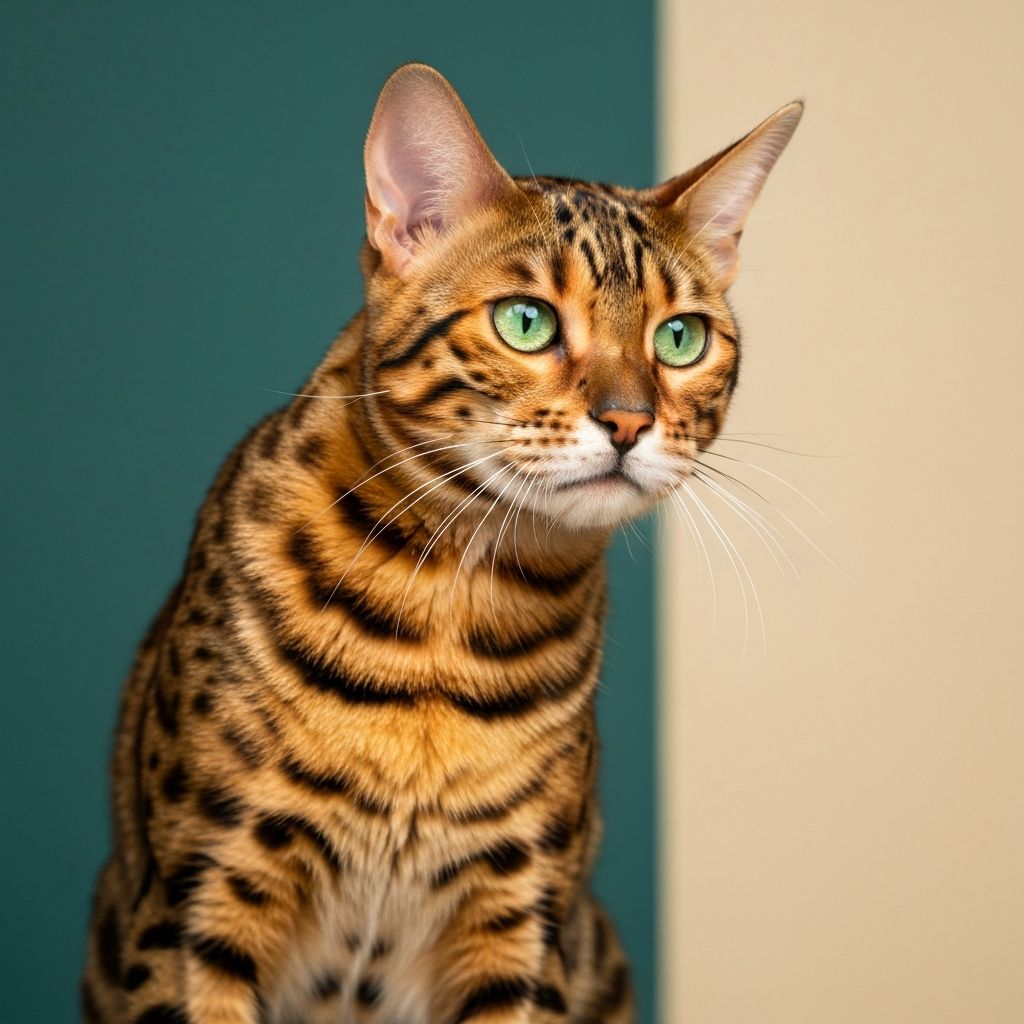
The Bengal looks like a little leopard that escaped from the jungle and moved into your living room — and, frankly speaking, it behaves exactly like that.
The Bengal is the only cat in the world that looks as if it had just leapt off a branch in the jungle — and it never lets you forget it. Those are rosettes and spots like a leopard's, the muscular body of a spring, and fur that in the sun literally glimmers, as if someone had sprinkled it with golden dust (this effect even has a name: glitter). But the Bengal is not only looks. It is the temperament of a small predator in the body of a domestic cat — energy, curiosity, and agency beside which an ordinary cat looks like its calmer cousin from the provinces. A Bengal you do not “have.” With a Bengal you live, keep up, and negotiate.
This wild style is, moreover, not a metaphor — it is literal. The breed arose from a cross of a domestic cat with the Asian leopard cat, a small, truly wild predator from the forests of Asia. In the 1960s and 70s the Californian breeder Jean Mill brought about a combination that was meant to give people a “little leopard for the living room” with a gentle, domestic character — and it worked. Today's Bengal is fully tame and attached to its human, but somewhere inside it still carries the record of the jungle: that is why it loves water, climbs up to the ceiling, and looks at the world with the gaze of a hunter that will not miss a thing. In short: this is not a cat that pretends to be a leopard. It is a leopard that learned to purr.
Because the Bengal is in constant motion and constant action. Water, which frightens off most cats, actually attracts it — it can dip a paw in the bowl, patrol the edge of the bathtub, and jump into the shower right after you, as if it were the best attraction of the day. Closed doors and drawers it treats as puzzles to be solved (and usually it solves them). It also has a weakness worthy of a magpie: trinkets, pens, hair ties, and single socks vanish into its secret hideouts — and when you finally find one of them, you will understand that all along you have been living with a professional. It retrieves, learns tricks, walks on a leash, and climbs to the highest point in the room to supervise its kingdom from there. This is a cat for someone who wants to have a force of nature at home — not an ornament on the sofa.
And here is the crux of the deal with a Bengal: all this wild energy must have somewhere to flow. A Bengal that is bored does not become sad — it becomes creative, and its creativity can be costly for the curtains, the shelves, and your sleep. This cat needs high shelves and cat highways under the ceiling, plenty of hunting play, food puzzles, and real time with you every day. A bored Bengal is a construction project in progress; a busy Bengal is the best roommate one could dream of. You make the difference.
And since we are speaking of a predator's nature — its wild heritage makes itself felt most strongly precisely at the bowl.
The Bengal's digestive system is set for meat, not for grains, and can at the same time be exceptionally sensitive:
- Plenty of full-value animal protein, a minimum of carbohydrates — this is a menu tailored for a predator, not for an average cat
- Sensitive intestines: Bengals are predisposed to IBD (inflammatory bowel disease) — with chronic vomiting or diarrhea it is worth discussing a raw, grain-free diet with the vet: some caretakers report the resolution of symptoms even within a day of the change
- Plenty of moisture in the diet: the Bengal easily dehydrates on dry food alone, so the basis is wet food or — after consultation — a raw diet — and running water (a fountain, a dripping tap) hits its weakness perfectly
- Introduce new foods slowly and singly — with such a delicate stomach, sudden changes rarely end well
- Portions to match very high activity: this is an athlete that burns a great deal of energy, but with constant snacking it too can gain weight
Beyond the bowl, it is worth remembering a few matters typical of the breed:
- Heart: the Bengal has a predisposition to hypertrophic cardiomyopathy (HCM) — periodic echo examination at the vet is wise prevention
- Eyes: the breed can be burdened with progressive retinal atrophy (PRA), which gradually worsens vision — it is worth observing how the cat manages after dark and mentioning it at visits
- Movement is health: for the Bengal, activity is not an option but a condition of balance — daily “hunts” with a toy keep both the body and the head in form
- Environment: scratching posts up to the ceiling, shelves, safe windows with a view — the richer its world, the calmer your home
Because the Bengal is a piece of wild nature that agreed to live with you — and it is exactly the kind of relationship it sounds like: a bit of an adventure, a bit of a challenge, a hundred percent a fascination. It has not domesticated itself completely. It chose to let you keep pace with it.
Give it a world worthy of that wild energy of its, and you will get something no other cat can give: a jungle within arm's reach, one that purrs on your lap in the evening — and looks at you with the eyes of a predator in which there is nothing but love.
Most common health issues
A hereditary eye disease in which the retina gradually loses function, leading to deteriorating vision, usually first after dark. A genetic test is available for some breeds. It is worth observing how the cat copes in low light and mentioning it at visits. Antioxidants and omega fatty acids in the diet support overall eye health.
The most common heart disease in cats - the heart muscle thickens, making it harder to pump blood. It can be hereditary; a DNA test is available for some breeds. It remains asymptomatic for a long time, so periodic heart echo examinations at the vet are the best prevention. Maintaining a proper weight and good hydration relieve the circulatory system.
Health issues
2 most common conditions
Health issues
2 most common conditions
A hereditary eye disease in which the retina gradually loses function, leading to deteriorating vision, usually first after dark. A genetic test is available for some breeds. It is worth observing how the cat copes in low light and mentioning it at visits. Antioxidants and omega fatty acids in the diet support overall eye health.
The most common heart disease in cats - the heart muscle thickens, making it harder to pump blood. It can be hereditary; a DNA test is available for some breeds. It remains asymptomatic for a long time, so periodic heart echo examinations at the vet are the best prevention. Maintaining a proper weight and good hydration relieve the circulatory system.
Nutritional needs
Cat hydration - why wet food matters
Cats naturally have a low thirst drive and often drink too little water. Their ancestors - desert cats - obtained water mainly from food. Wet food contains 70-80% water, which significantly supports hydration and helps prevent kidney and urinary tract problems.
Wet foods
Dry foods
≈ kcal calculated from the analysis — the manufacturer does not state calories