Birman
(Kot Birmański (Birman))
Origin: Burma (Myanmar) / France
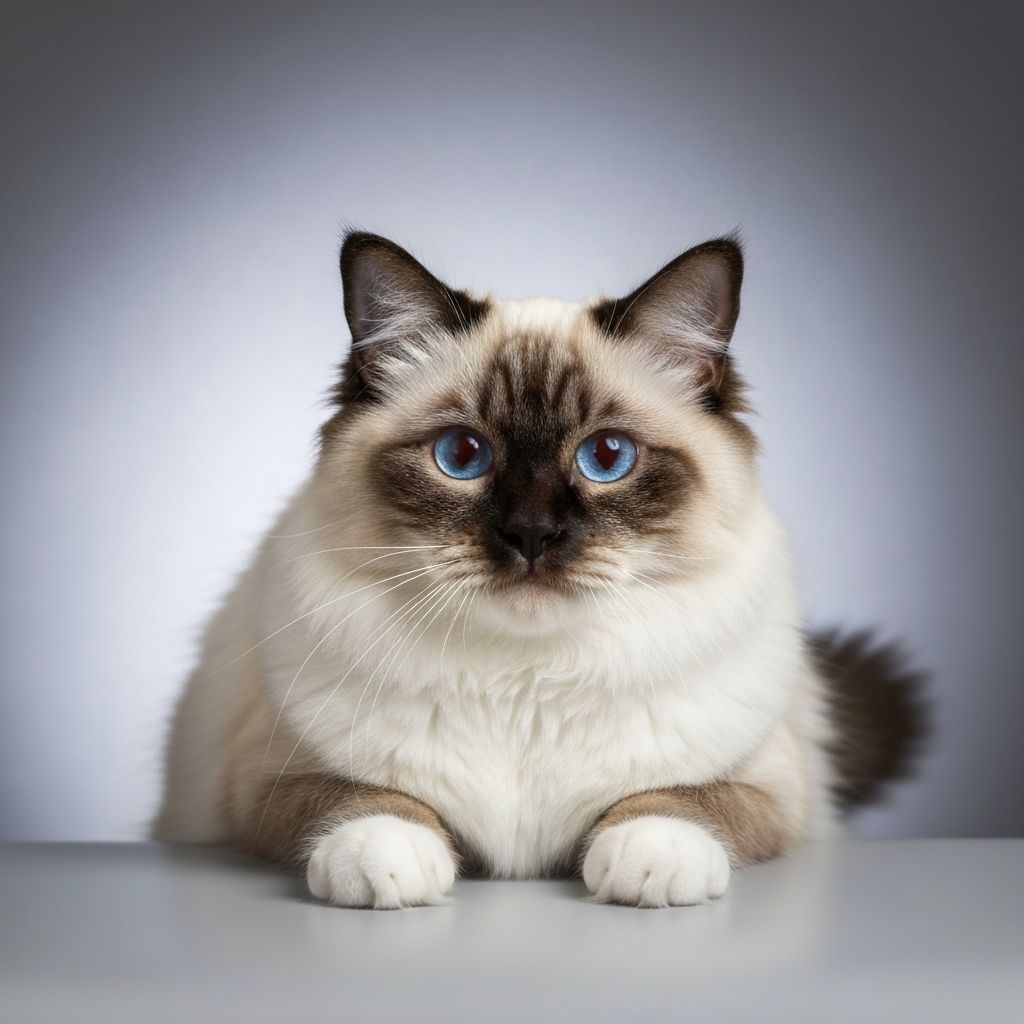
The Birman looks as if it had dipped four white paws in milk, and its eyes in the sky. Legend says a goddess gave it this beauty — as a reward for faithfulness to the very end.
You will recognize the Birman in a second by one detail: it has four snow-white paws, as if it had just walked through spilled milk and stopped exactly at the ankles. These white “gloves” — at the back turning into the characteristic, sharply pointed “spurs” — are the breed's hallmark and the condition of its perfection. The rest of the cat is equally painterly: silky, semi-long, cream fur with darker points on the face, ears, and tail, and above all this a pair of round eyes the color of a deep, unreal blue. The Birman simply looks like a being that someone designed with great care — and, as legend has it, someone really did.
Because no breed has a more beautiful tale of its origin. The story goes that in a temple in old Burma there lived a white cat named Sinh, the companion of an old priest. When one night assailants killed the priest, the cat leapt onto his body and looked into the eyes of the temple's golden goddess — and then its fur blazed with gold, its eyes turned sapphire like her gaze, and its paws, where they touched the holy old man, remained immaculately white as a sign of his pure soul. The next morning all the temple cats looked the same. This is of course a beautiful fairy tale, and the true beginnings of the breed are lost somewhere between Burma and France of the early 20th century — but when you look the Birman in those blue eyes, the tale of Sinh suddenly seems far more probable than any genetics.
In daily life the Birman behaves exactly as befits a temple cat: with a gentleness and calm that spread to the whole house. It is one of the most well-balanced cats there are — quiet (it speaks rarely, in a delicate little voice), well-mannered, and astonishingly cheerful. It loves people deeply, but without possessiveness: it will follow you from room to room, sit beside you during work, settle by you in the evening — calmly accompanying, demanding nothing in return. It tolerates well the presence of children and other animals, rarely falls into a feline frenzy on the curtains, and gives the impression of a cat that long ago reached inner balance and now magnanimously shares it with its surroundings. Around the Birman it simply becomes quieter and warmer.
And here is something worth understanding before this gentleness lulls your vigilance: the Birman's calm disposition is not the same as iron health.
This breed carries in its genes several serious predispositions, with which conscious care and a wise diet make an enormous difference:
- Heart: Birmans are predisposed to hypertrophic cardiomyopathy (HCM), the most common heart disease in cats — periodic echo examination at the vet is the best prevention, and a lean silhouette relieves the heart every day
- Kidneys: polycystic kidney disease (PKD) occurs in the breed — wet food and constant access to fresh water support the work of the kidneys, and ultrasound examination allows the problem to be detected early; with a breeder it is worth asking about the parents' test results
- Skin: Birmans can be skin-hypersensitive, which is why a diet rich in omega-3 and omega-6 acids helps keep that silky fur in form and eases the tendency toward irritations
- Weight and silhouette: a moderately active Birman rounds out easily — measured portions and good, meaty protein protect both the heart and the kidneys from additional burden
- Coat quality from the bowl: this semi-long, silky covering looks best when the diet is truly full-value — the Birman's beauty largely begins in the bowl
Beyond the bowl, the Birman asks for a few simple things that will keep it in health and beauty:
- Coat care: the semi-long fur has almost no undercoat, so it rarely felts — combing two or three times a week is entirely enough and can be for the Birman a favorite ritual of closeness
- Regular examinations: with predispositions to HCM and PKD, periodic monitoring of the heart and kidneys is the most important gift you can give it
- Gentle, steady movement: mild daily play maintains the silhouette and fitness without forcing acrobatics on this calm cat
- A calm environment: the Birman flourishes in a home of gentle rhythm — noise and chaos are not its world, harmony and predictability are
- Company: this is a cat attached to people that does not like long solitude — the presence of the family or another gentle animal serves it very well
Because the Birman is a combination that in the feline world occurs rarely: the beauty of a sacred image and the character of the calmest of household members. It will not conquer your home — it will quiet and warm it, day by day, with that gentle, blue-eyed presence of its.
Legend says the Birman received white paws for faithfulness that did not retreat even in the face of death. When this cat curls up beside you in the evening and fixes those sapphire eyes of its on you, you will feel where that tale came from — and why in this breed in particular it sounds like pure truth.
Most common health issues
The most common heart disease in cats - the heart muscle thickens, making it harder to pump blood. It can be hereditary; a DNA test is available for some breeds. It remains asymptomatic for a long time, so periodic heart echo examinations at the vet are the best prevention. Maintaining a proper weight and good hydration relieve the circulatory system.
A hereditary disease in which cysts form in the kidneys, gradually impairing their function. Detectable by ultrasound, and in some breeds by a genetic test - which is why it is worth asking the breeder about the parents' results. Early detection and a kidney-supporting diet (good hydration, wet food, phosphorus control) help preserve their function longer.
A neurological disorder (hyperesthesia syndrome) in which the skin of the back becomes oversensitive - the cat may suddenly lick or bite the area at the base of the tail, react with skin twitching or sudden agitation. A calm environment and stress reduction help; severe symptoms require veterinary diagnosis.
Health issues
3 most common conditions
Health issues
3 most common conditions
The most common heart disease in cats - the heart muscle thickens, making it harder to pump blood. It can be hereditary; a DNA test is available for some breeds. It remains asymptomatic for a long time, so periodic heart echo examinations at the vet are the best prevention. Maintaining a proper weight and good hydration relieve the circulatory system.
A hereditary disease in which cysts form in the kidneys, gradually impairing their function. Detectable by ultrasound, and in some breeds by a genetic test - which is why it is worth asking the breeder about the parents' results. Early detection and a kidney-supporting diet (good hydration, wet food, phosphorus control) help preserve their function longer.
A neurological disorder (hyperesthesia syndrome) in which the skin of the back becomes oversensitive - the cat may suddenly lick or bite the area at the base of the tail, react with skin twitching or sudden agitation. A calm environment and stress reduction help; severe symptoms require veterinary diagnosis.
Nutritional needs
Cat hydration - why wet food matters
Cats naturally have a low thirst drive and often drink too little water. Their ancestors - desert cats - obtained water mainly from food. Wet food contains 70-80% water, which significantly supports hydration and helps prevent kidney and urinary tract problems.