Burmese
(Kot Burmski)
Origin: Myanmar (Burma)
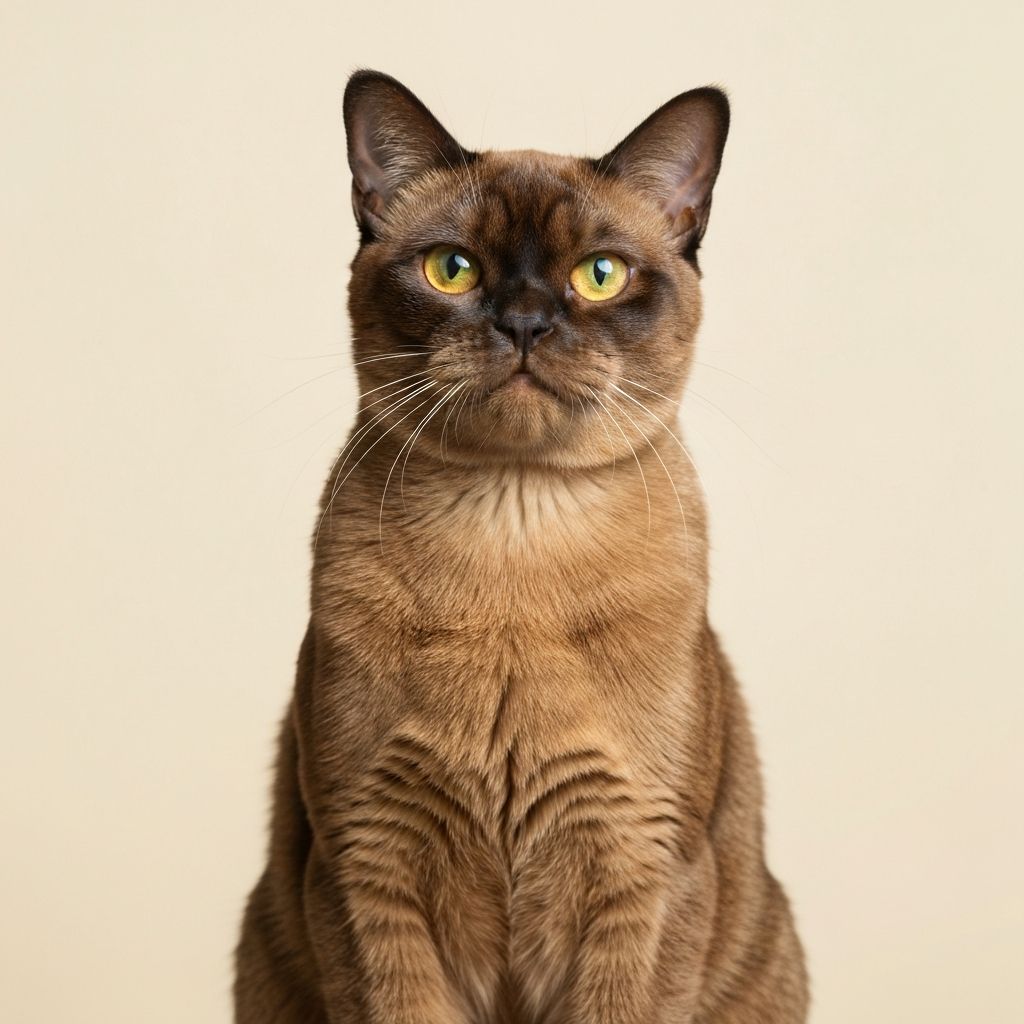
The Burmese looks as if cast from warm bronze, weighs like a brick wrapped in silk, and has one goal in life: to be as close to you as possible. Ideally, literally on you.
The Burmese does one thing better than any other cat: it is close. Not “in the same room” close — literally on you: on your lap, on the keyboard, on the pillow right by your head, wedged under the duvet at three in the morning because you shifted in your sleep and the position had to be corrected. This is a cat cast from warm, gleaming bronze that in the touch surprises everyone: under that short, satin fur hides a deceptive, improbably heavy body, on account of which the Burmese is called a “brick wrapped in silk.” You pick up something that looks dainty, and it weighs its own weight — and it immediately arranges itself as if your arms were the only place in the world it had been heading toward.
This talent for closeness has, moreover, quite a concrete beginning — and with a precise date. All modern Burmese descend from one single cat: a brown female named Wong Mau, who in 1930 was brought from Burma to the United States. It was from her, in a breeding program conducted with scientific precision, that the whole breed arose — the Burmese is therefore a cat with an exceptionally well-documented family tree, at the very top of which stands one traveler from Asia. And even earlier, in old Burma, cream-golden cats of this type were said to live in temples and monasteries as companions of the monks — and something of that monastic ability to be present here and now, fully and without haste, the Burmese has kept to this day.
Because although it is a very active, lively, and cat-wittily amusing cat, all its energy has one direction: you. The Burmese does not play by itself in a corner — the Burmese brings you a toy and expects a shared game. It greets you at the door, comments on your day in a soft, raspy little voice (much quieter than its Siamese cousin's), and follows you around the apartment like a well-mannered but very affectionate bodyguard. It adores playing fetch, jumps onto your shoulder to look at the world from your perspective, and sincerely believes that every activity — work, cooking, a bath — becomes better when it participates in it. It is one of the most “human” cats there are: it cannot stand solitude and really bears being ignored badly.
And here is the crux of the deal with a Burmese, without which all the rest does not hold together: this cat needs company like air. A Burmese left alone for whole days does not become “independent” — it becomes unhappy. This is a breed for someone who is at home, works remotely, or can ensure it constant company, at least a second cat for a pair. In return you get an absolutely unconditional and effusive love, a cat that nestles up without reserve and that into late old age keeps something of a puppy's joy at the sight of you. The Burmese does not love discreetly. The Burmese loves with its whole heavy, bronze body.
At the bowl this breed requires particular attentiveness, because behind the beauty hides a concrete, hereditary weakness of health — and diet is here the first line of defense:
- A predisposition to type 2 diabetes: this is the most important matter with this breed — the Burmese needs a diet low in sugars and carbohydrates, and high in full-value protein
- Weight under strict control: obesity directly increases the risk of diabetes, which is why measured portions and a lean silhouette are with the Burmese not aesthetics but prevention of the disease
- A low-glycemic, meaty diet: a minimum of grain fillers, a maximum of good protein — such a menu helps maintain a stable blood sugar level
- Wet food and fresh water: they support a proper weight and general metabolic condition
- Activity together with diet: this restless cat plays willingly, and regular play really helps keep weight and sugar in check
Beyond the bowl, it is worth remembering a few matters typical of the breed:
- Diabetes — know the symptoms: increased thirst, more frequent urination, weight loss despite appetite are signals for an urgent visit; early-detected diabetes in a cat can be well controlled, and sometimes reversible
- Hypokalemia: the Burmese inherits a tendency toward potassium deficiency, which manifests as muscle weakness (e.g., a wobbly gait or a “drooping” head) — this is a signal for quick diagnostics and supplementation under the vet's eye
- A dream coat: the short, satin fur practically requires no grooming — a touch of the brush once a week is entirely enough
- Warmth-loving: the Burmese likes warmth and softness, so a heated bed or your duvet are its favorite coordinates in the apartment
- Company is mental health: a lonely, bored Burmese cat suffers — constant company and shared play are for it as important as a good bowl
Because the Burmese is love in the most direct form a cat can take: warm, heavy, nestled up, and completely yours, from the first day to the last.
Invite it truly close — because that is exactly what it asks for its whole life — and you will get a cat that will deem every ordinary moment of yours better already by the mere fact that it can sleep through it wedged into your arm.
Most common health issues
Burmese cats are genetically predisposed to diabetes - a disease in which the body does not properly regulate blood sugar levels. Weight control and a low-carbohydrate diet (high-protein, wet food) that helps stabilize blood glucose are key. Increased thirst and urination are signals for an urgent visit to the vet.
Too low a level of potassium in the blood, which may manifest as muscle weakness, neck stiffness and a decline in condition. It requires diagnosis and management by a vet (blood tests, possible supplementation). A complete, well-balanced diet supports proper electrolyte balance.
Health issues
2 most common conditions
Health issues
2 most common conditions
Burmese cats are genetically predisposed to diabetes - a disease in which the body does not properly regulate blood sugar levels. Weight control and a low-carbohydrate diet (high-protein, wet food) that helps stabilize blood glucose are key. Increased thirst and urination are signals for an urgent visit to the vet.
Too low a level of potassium in the blood, which may manifest as muscle weakness, neck stiffness and a decline in condition. It requires diagnosis and management by a vet (blood tests, possible supplementation). A complete, well-balanced diet supports proper electrolyte balance.
Nutritional needs
Cat hydration - why wet food matters
Cats naturally have a low thirst drive and often drink too little water. Their ancestors - desert cats - obtained water mainly from food. Wet food contains 70-80% water, which significantly supports hydration and helps prevent kidney and urinary tract problems.