Chartreux
(Kot Kartuski)
Origin: France
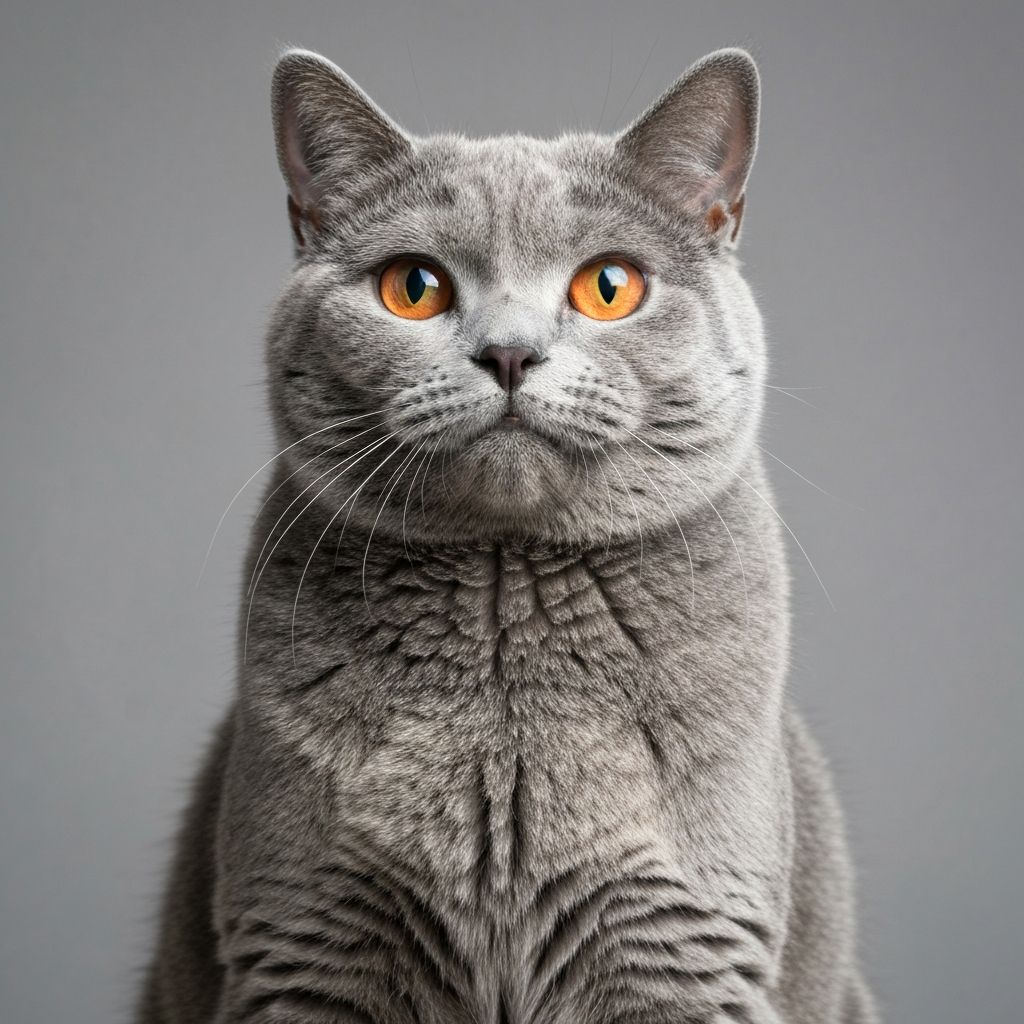
The Chartreux is a silent monk in fur the color of smoke: woolly, blue-gray fur, copper-gold eyes, and an eternal, gentle smile it has worn without interruption for five centuries.
The Chartreux looks as if it had been smiling at you for five centuries. Its face has delicately rounded contours and slightly raised corners, so that on the woolly, blue-gray face there is an eternal, gentle half-smile no other cat has. And above this smile shine eyes you will not confuse with any other blue cat: not green, but warm, copper-orange, like two gold coins tossed onto a background of smoke. Added to this, a stocky, surprisingly heavy body set on slender legs — a silhouette the French tenderly describe as a potato on toothpicks — and you already know that before you is a cat that looks exactly as its dignified name sounds.
Because the Chartreux is the pride of France, and its history reaches back to the Middle Ages and smells of monastic silence. Legend has it that these silent, smoke-blue cats lived among the monks of the austere Carthusian order — the same one that gave the world Chartreuse liqueur — and that the monks valued them doubly: for not disturbing the vows of silence, and for masterfully protecting the monastery larders from rodents. For centuries the Chartreux was in France a cat so obvious that it grew into the culture: it was the one President Charles de Gaulle chose as his companion, and the writer Colette immortalized her Chartreux in books with such tenderness that the breed entered French literature forever. It is hard to find a cat with a more dignified life story — and a cat that would carry it just as modestly.
Because despite such great class, the Chartreux is at bottom a quiet, faithful companion with a soul more dog-like than feline. It hardly meows at all — it is one of the quietest breeds in the world, communicating with you through a gaze of its copper eyes and a discreet chirp once in a while, as if it considered words to be for cats that have less to say. It attaches itself to one person with a devotion that moves: it follows you around the house with a calm, waddling step, settles in the same room, and observes your day in blissful, attentive silence. It is not intrusive or noisy — it is simply present, patient, and deeply loyal, like a friend who does not need to speak to let you know they are by you.
And beneath this monastic gentleness still slumbers a born hunter, about which the monks knew a thing or two. The Chartreux is one of the most effective feline hunters: quiet, patient, with a reflex you would not expect from such a calm and stocky cat. At home this nature turns into a passion for hunting games and observing the world from a favorite point by the window — for long hours, with a monk's concentration in meditation. The Chartreux is not a competitive acrobat like the eastern cats; it is a calm observer that prefers one precise, masterful strike of a paw to running along the walls. This balance between gentleness and a slumbering instinct makes it an exceptionally well-balanced cat: a cheerful, patient, and perfectly mannered household member.
This dignified Frenchman has at the bowl the needs of a calm, well-built cat of moderate activity:
- Solid, full-value protein: the Chartreux's stocky, muscular silhouette needs good meat so that the mass stays in the muscles and does not settle as fat
- Portion control: with moderate activity and a considerable stature, the Chartreux gains weight easily — measured portions are a basic, because under this dense, woolly fur, excess weight is easy to overlook
- Support for the kidneys and joints: a good-quality diet with proper hydration favors kidney health, and a sensible, lean weight relieves the sensitive joints and kneecaps
- Plenty of moisture: wet food and constant access to fresh water support the work of the kidneys — with this breed it is especially important
- High-quality ingredients: with a calm way of life, quality counts, not quantity — good meaty protein instead of fillers maintains the condition and beauty of this exceptional fur
Beyond the bowl, it is worth knowing a few matters important for this breed:
- Kidneys: Chartreux can be predisposed to polycystic kidney disease (PKD), which is why ultrasound examination allows the problem to be detected early, and with a breeder it is worth asking about the parents' test results
- Joints: patellar luxation (a slipping knee) occurs in the breed — if you notice that the cat limps for a few steps or tucks up a leg, show it to the vet; a lean weight really protects the joints
- Coat: the dense, woolly, double fur has a slightly oiling structure and requires regular brushing, especially in shedding season, when the Chartreux sheds a good deal of undercoat
- Calm and company: this is a cat that values a stable, calm home and the closeness of its human — noisy chaos is not its world, quiet presence very much so
- Moderate, regular movement: gentle daily hunting play maintains the silhouette and delights its hunter's soul without forcing acrobatics
Because the Chartreux is a living piece of French history that has moved into your home: five centuries of monastic silence, aristocratic class, and quiet, dog-like faithfulness, enclosed in woolly, smoke-blue fur and furnished with that unchanging, gentle smile.
Sit beside it in silence, and you will understand why the monks valued it so: the Chartreux does not need words to give you the feeling that you are in the best possible company. It is enough for it to look at you with those copper eyes — and go on smiling, just as its ancestors have been smiling for the last five hundred years.
Most common health issues
The kneecap slipping out of its proper groove, which sometimes causes the cat to limp for a few steps or 'hop' on three legs. A lean silhouette genuinely relieves the joints, and omega-3 fatty acids and glucosamine support their condition. Severe symptoms should be consulted with a vet.
A hereditary disease in which cysts form in the kidneys, gradually impairing their function. Detectable by ultrasound, and in some breeds by a genetic test - which is why it is worth asking the breeder about the parents' results. Early detection and a kidney-supporting diet (good hydration, wet food, phosphorus control) help preserve their function longer.
Health issues
2 most common conditions
Health issues
2 most common conditions
The kneecap slipping out of its proper groove, which sometimes causes the cat to limp for a few steps or 'hop' on three legs. A lean silhouette genuinely relieves the joints, and omega-3 fatty acids and glucosamine support their condition. Severe symptoms should be consulted with a vet.
A hereditary disease in which cysts form in the kidneys, gradually impairing their function. Detectable by ultrasound, and in some breeds by a genetic test - which is why it is worth asking the breeder about the parents' results. Early detection and a kidney-supporting diet (good hydration, wet food, phosphorus control) help preserve their function longer.
Nutritional needs
Cat hydration - why wet food matters
Cats naturally have a low thirst drive and often drink too little water. Their ancestors - desert cats - obtained water mainly from food. Wet food contains 70-80% water, which significantly supports hydration and helps prevent kidney and urinary tract problems.