Cornish Rex
Origin: United Kingdom (Cornwall)
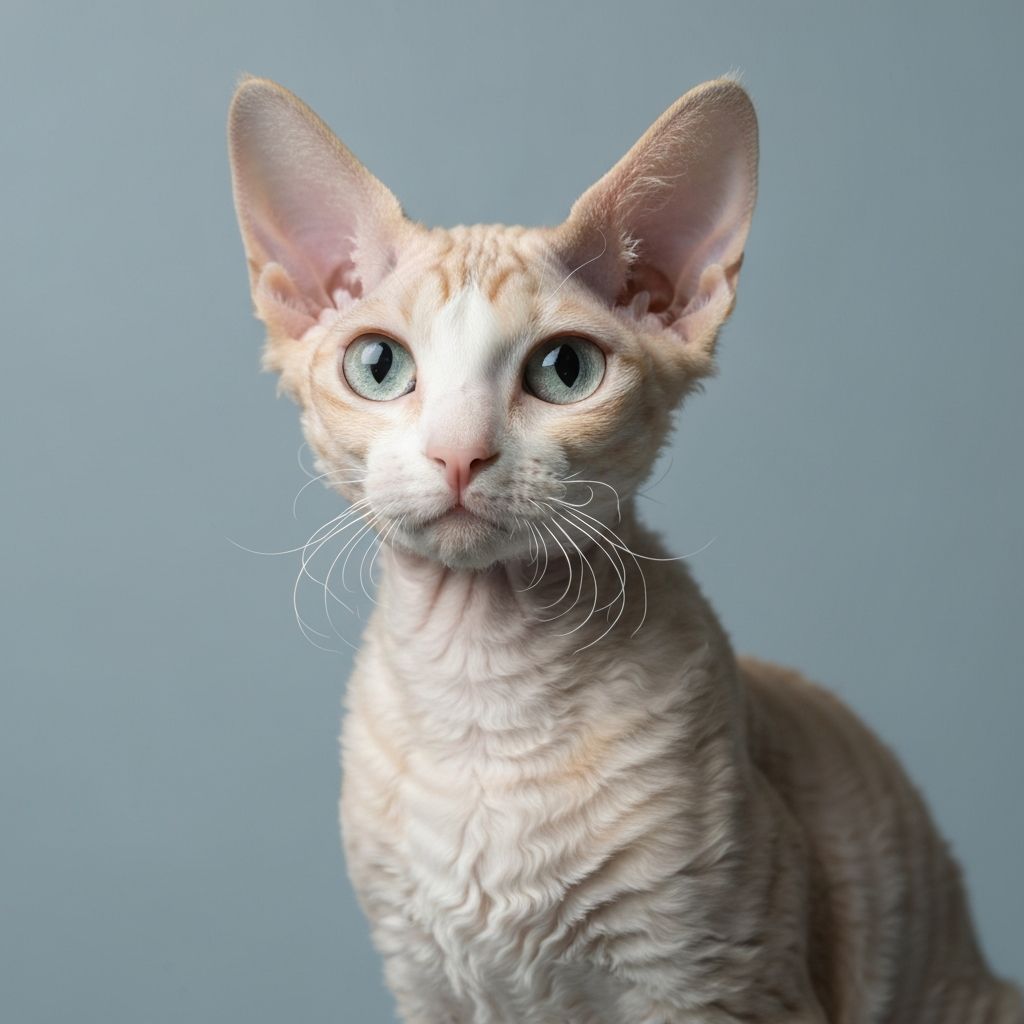
The Cornish rex has the silhouette of a greyhound, fur in curls like astrakhan, and energy that does not go out for fifteen years. It looks like a dandy and behaves like a child on sugar.
The first thing you do when you touch a Cornish rex is to check with your fingers once more, because you do not believe it. Where other cats have fur, it has something like warm velvet or a clipped rabbit's belly — fur so short, soft, and waved into regular ripples that it resembles astrakhan. The secret lies in the fact that the Cornish rex wears only undercoat: it lacks both top layers of fur that every other cat has, and it is precisely they that would leave the roughness. This unusual covering at the same time reveals its whole silhouette — and there is something to look at: an arched back, a tucked-in belly, and long, slender legs, through which the Cornish looks like a little greyhound crouched to leap. The end effect is peculiar: a cat cut like a cover model that does not for a second behave like a cover model.
This racing build and this unusual fur appeared in exactly one place and time: in 1950 on a farm in English Cornwall. In the litter of an ordinary farm cat there was one cream-curly tomcat, clearly different from its siblings — it was named Kallibunker, and it is from him that all Cornish rexes in the world descend. A curiosity that says everything about this breed: the Cornish and Devon rex have entirely different, independent mutations that happened in neighboring counties barely a decade apart — nature twice, separately, hit upon the idea of a curly cat. The Cornish was first — by a whole decade. And it seems it still remembers this, because it carries itself as if the whole world were still waiting for it to give the signal to start.
Because the Cornish rex does not walk — the Cornish rex whizzes. That greyhound build is no ornament: it is the fastest, most agile acrobat among domestic cats, one that takes corners along the walls, jumps onto the highest shelf without a run-up, and can catch a thrown toy in midair like a medal-winning goalkeeper. For the Cornish, gravity is more of a loose suggestion than a law: the countertop, the fridge, the door frame, and the top of the bookcase are for it one traffic route, which it covers before you manage to shout “no.” It adores, meanwhile, playing fetch, solving puzzles, and designing its own, breakneck obstacle courses across the whole apartment. And the best part is that it never passes: the Cornish stays a kitten in spirit for life: a ten-year-old cat of this breed can play with the same boundless joy as a four-month-old kitten. Boredom is for it an unbearable state — this cat needs movement, challenges, and entertainment like fuel.
And yet it would be a mistake to see in it only a sportsman, because all this vigor goes hand in hand with an exceptionally warm heart. The thin fur makes the Cornish constantly seek warmth — and the warmest thing in the whole home is you. That is why this athlete, barely finished with its obstacle course, lands on your lap, wedges itself under a sweater, or arranges itself on your neck like a living scarf and turns into a cushion vibrating with a purr. This is a deeply attached and sociable cat that wants to be a participant in your life, not its spectator — and that bears solitude poorly. The Cornish rex loves with its whole self: first it will amuse you by running along the walls, and then it will warm you, nestled up without reserve. Sport and tenderness in one slender body.
This eternal sportsman has at the bowl needs to match its activity — and its exceptional fur:
- High metabolism: the sparse fur insulates poorly, so the Cornish burns more to maintain body warmth, and needs more calories than its small silhouette indicates
- Protein 34–44% and fats 16–22%: this very active breed builds muscle and energy from them — this is a sprinter's menu, not a couch dweller's
- Regular, smaller meals: a constant supply of fuel better feeds its eternal movement than one large portion
- Control and quality: despite the burning, the Cornish can overeat — good, meaty ingredients and sensible portions keep it in form
- Fresh water always available, supporting the fast metabolism and hydration
Beyond the bowl, it is worth knowing a few matters important for this breed:
- Kneecaps: the Cornish rex can be burdened with patellar luxation (a slipping knee) — if you notice that the cat limps for a few steps or “hops” on three legs, show it to the vet
- Heart: a predisposition to hypertrophic cardiomyopathy (HCM) — periodic heart echo is wise prevention
- Warmth is a basic: thin fur means sensitivity to cold — warm beds, blankets, and sunny spots are for the Cornish a real need, not a luxury
- Skin and ears: the lack of a covering makes the skin somewhat oilier, and the large ears collect earwax faster — gentle care from time to time becomes a routine
- Movement and heights: this acrobat must be allowed to let off steam — scratching posts up to the ceiling, shelves, and running courses are not a whim but a condition of a happy cat
Because the Cornish rex is the rarest of feline duos: the soul of a marathon mischief-maker and the heart of the most affectionate homebody, enclosed in one elegant, velvet body that never forgot how to play.
You get in it two cats for the price of one: a private circus at heights by day and a living, purring hot-water bottle nestled into your neck by night. Your only job is to keep up with it while the sun shines. When it goes out, it will take over the shift — and warm you as if it were its only duty in the world.
Most common health issues
The most common heart disease in cats - the heart muscle thickens, making it harder to pump blood. It can be hereditary; a DNA test is available for some breeds. It remains asymptomatic for a long time, so periodic heart echo examinations at the vet are the best prevention. Maintaining a proper weight and good hydration relieve the circulatory system.
The kneecap slipping out of its proper groove, which sometimes causes the cat to limp for a few steps or 'hop' on three legs. A lean silhouette genuinely relieves the joints, and omega-3 fatty acids and glucosamine support their condition. Severe symptoms should be consulted with a vet.
Health issues
2 most common conditions
Health issues
2 most common conditions
The most common heart disease in cats - the heart muscle thickens, making it harder to pump blood. It can be hereditary; a DNA test is available for some breeds. It remains asymptomatic for a long time, so periodic heart echo examinations at the vet are the best prevention. Maintaining a proper weight and good hydration relieve the circulatory system.
The kneecap slipping out of its proper groove, which sometimes causes the cat to limp for a few steps or 'hop' on three legs. A lean silhouette genuinely relieves the joints, and omega-3 fatty acids and glucosamine support their condition. Severe symptoms should be consulted with a vet.
Nutritional needs
Cat hydration - why wet food matters
Cats naturally have a low thirst drive and often drink too little water. Their ancestors - desert cats - obtained water mainly from food. Wet food contains 70-80% water, which significantly supports hydration and helps prevent kidney and urinary tract problems.