Devon Rex
Origin: United Kingdom (Devon)
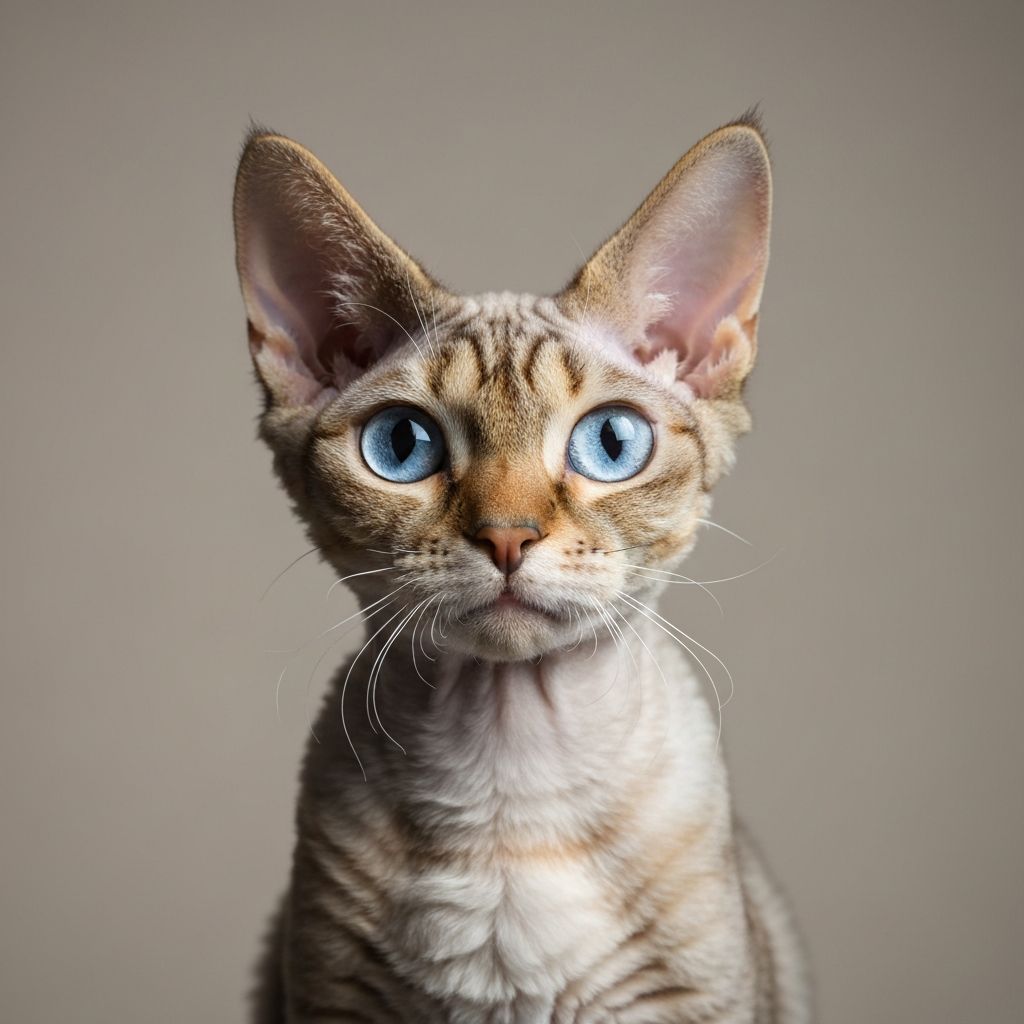
The Devon rex looks like an elf that escaped from a fantasy film set: great antenna-ears, mischievous eyes, and fur arranged in waves. Its character is elfish too — mischievous to the core.
The Devon rex looks as if nature designed it after hours, for pure pleasure: a triangular, elfish face, enormous ears set like two satellite dishes listening in on the cosmos, great mischievous eyes — and fur no one else has: short, soft, and arranged in gentle waves, as if the cat had just come from the hairdresser with a perm. It looks like a creature from a fairy tale. And it behaves like a creature from a fairy tale — the kind in which the main character is a charming mischief-maker and no one has ever managed to be truly angry at it.
This fairy tale began, moreover, quite recently and very concretely: in 1960 in the English county of Devon. Near an old mine there roamed at the time a wild, curly tomcat that no one could catch — but one of the local cats evidently knew him more closely, because in her litter appeared a kitten curly like his father. It was named Kirlee, and it is from him, from one little curl from Devon, that the whole breed descends. There is something perversely beautiful in this: the son of an elusive vagabond from below the mine became the progenitor of cats that today cannot bear five minutes without a human.
Because the Devon rex is a mischief-maker that chose people as its accomplices. Its favorite place in the world is your shoulder — it sits on it like a parrot on a pirate's shoulder and from that height supervises everything you do. And it does everything with you: it helps you write (across the keyboard), helps you read (lying on the book), helps you cook (in the capacity of an inspector). At the table, meanwhile, it reveals its greatest talent: the Devon does not steal food quietly, like an ordinary cat. The Devon requisitions — openly, from the plate, before everyone's eyes, with the expression of an official conducting a routine inspection. Experienced Devon caretakers eat dinner with one hand; with the other they shield the plate. And they laugh while doing it, because at that little face it really is impossible to be angry.
And all this mischief is lined with an affection that can surprise. The Devon rex is an extremely human cat: it needs contact, touch, and company more than many a dog. That sparse fur warms more weakly, so the Devon delightedly warms itself up beside you — under a sweater, under the duvet, in the crook of your elbow — and its small, warm body then vibrates with a purr disproportionately great for its size. Solitude it bears dreadfully: this is a cat that must have its herd, human or at least feline. In return it gives something hard to describe and easy to love: the unceasing, faithful, slightly crazy presence of a little elf that has decided you are the most interesting phenomenon in the universe.
At the bowl the Devon surprises with its appetite — and it has solid, physiological reasons for it:
- High metabolism: that sparse, curly fur warms more weakly, so the Devon burns more and needs more calories than its small stature suggests
- Protein at the level of 34–44%: this very active breed builds muscle and energy from it — protein quality is here a basis, not a luxury
- Regular meals: several smaller portions a day steadily fuel its eternal movement — the Devon is not a cat for one great bowl
- Control all the same: a small cat quickly overdoes it, and its cheeky requisitioning talents at the table must be counted into the daily balance (best: do not give in)
- Fresh water always under paw — a fast metabolism likes good hydration
Beyond the bowl, it is worth knowing a few matters important for this breed:
- Devon rex myopathy: the breed can be burdened with a hereditary muscle weakness whose symptoms appear early, between the 3rd week and the 6th month of life — which is why a responsible breeder and observation of the kitten are so important; a genetic test for carrier status exists
- Heart: a predisposition to hypertrophic cardiomyopathy (HCM) — periodic heart echo is sensible prevention
- Warmth: thin fur means sensitivity to cold — warm beds, blankets, and access to sunny spots are for the Devon basics of comfort
- Skin and ears: sparse fur absorbs natural sebum more weakly, so gentle wiping of the skin and regular cleaning of those great ears are worth writing into the routine
- Movement and company: very high energy plus dreadful tolerance of solitude — the Devon needs play, climbing, and someone beside it; boredom and emptiness are its only real enemies
Because the Devon rex is nature's joke told with tenderness: an elf with great ears that could have become a wild vagabond like its father from below the mine — and instead became the most clingy mischief-maker of the feline world.
It is enough that you once let it sit on your shoulder. From that moment you will settle all matters together — you and your little, curly accomplice, who looks at the world from your height and does not intend ever to come down from it.
Most common health issues
The most common heart disease in cats - the heart muscle thickens, making it harder to pump blood. It can be hereditary; a DNA test is available for some breeds. It remains asymptomatic for a long time, so periodic heart echo examinations at the vet are the best prevention. Maintaining a proper weight and good hydration relieve the circulatory system.
A hereditary myopathy (muscle weakness) characteristic of this breed, which can appear even in young cats and cause weakness, difficulty holding up the head or swallowing. Detectable by a genetic test - which is why choosing a breeder who tests the parents is important. Care and nutrition guided by a vet support the cat's quality of life.
Health issues
2 most common conditions
Health issues
2 most common conditions
The most common heart disease in cats - the heart muscle thickens, making it harder to pump blood. It can be hereditary; a DNA test is available for some breeds. It remains asymptomatic for a long time, so periodic heart echo examinations at the vet are the best prevention. Maintaining a proper weight and good hydration relieve the circulatory system.
A hereditary myopathy (muscle weakness) characteristic of this breed, which can appear even in young cats and cause weakness, difficulty holding up the head or swallowing. Detectable by a genetic test - which is why choosing a breeder who tests the parents is important. Care and nutrition guided by a vet support the cat's quality of life.
Nutritional needs
Cat hydration - why wet food matters
Cats naturally have a low thirst drive and often drink too little water. Their ancestors - desert cats - obtained water mainly from food. Wet food contains 70-80% water, which significantly supports hydration and helps prevent kidney and urinary tract problems.