Exotic Shorthair
(Kot Egzotyczny)
Origin: USA
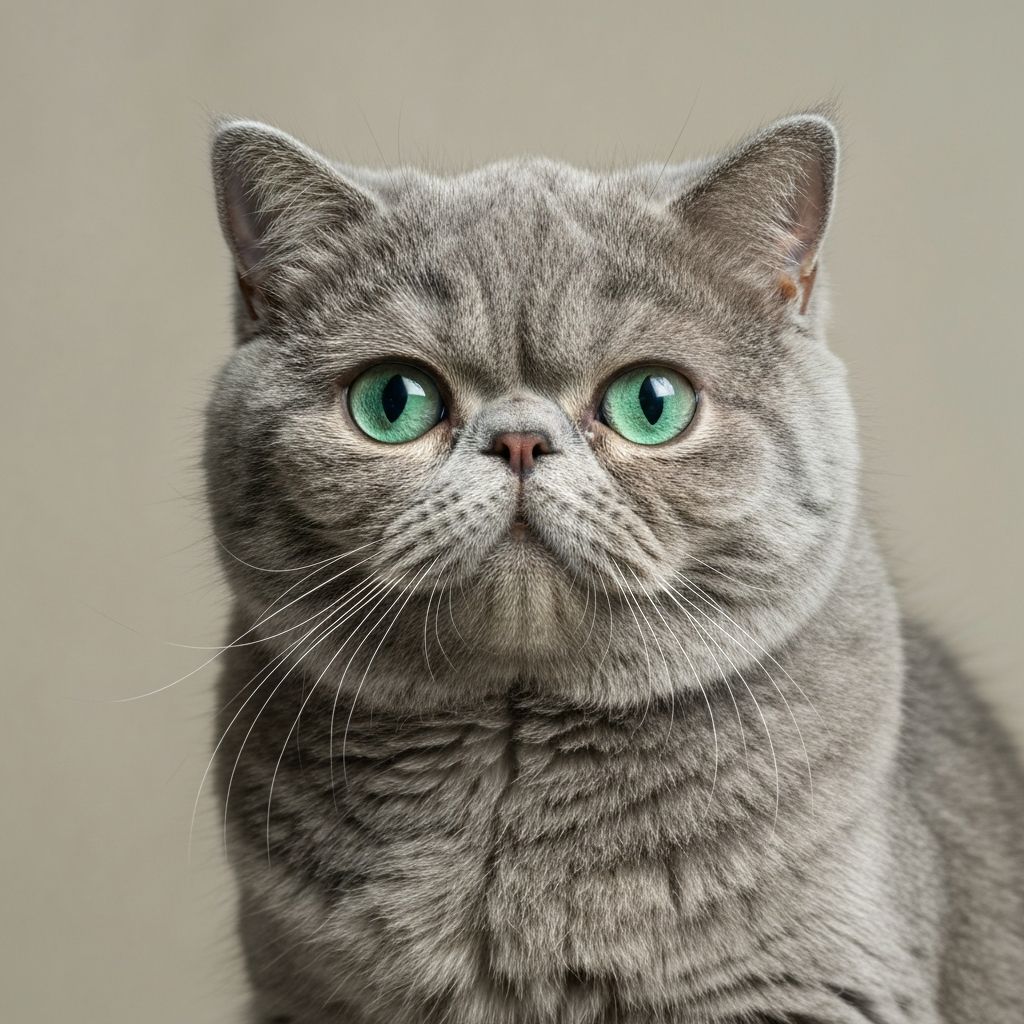
The exotic shorthair is a Persian that went to the hairdresser and had everything cut short. All the beauty stayed, the hour of daily combing vanished — and out of it came the greatest plush toy in the world.
The exotic shorthair looks like a teddy bear that came to life at night and stayed at home for good. A round head, great round eyes, a merged-in little face, and short, dense fur so soft and springy that your hand sinks into it as into a cushion — this is a Persian's face set on a cat you do not need to comb for hours. Because that is the whole idea of this breed in one sentence: all the Persian beauty, zero of the Persian coat work. Someone took the most beautiful couch dweller in the world and loaded it with a “no maintenance required” mode. The effect is so endearing that it is hard to pass by indifferently — and that is exactly the problem, because the exotic knows this perfectly well.
The best part is that this breed arose entirely by accident. In the 1960s in the States, breeders of American shorthairs merely wanted to refresh their breed's coat and type by pouring in a little Persian blood. Instead they got something no one had planned: stocky, short-haired cats with a disarming Persian face. It was supposed to come out “an improved American” — it came out entirely new and so adorable that it was decided to make a separate breed of it. The exotic is therefore proof that nature's best ideas can be a typo in someone else's breeding plan. A happy typo that purrs.
In daily life the exotic is a master of controlled laziness with the heart of a rascal. True, it adores lying — on the sofa, on your lap, on the warm laptop right on the keyboard you happen to be trying to use — but it is not a passive piece of furniture. This is Persian phlegm with an admixture of a mischievous, American spark: it can suddenly leap up to play, bring a toy, knock over a cup of water “for research purposes,” and then return to the sofa with an expression that says it was you who put something in the wrong place. It speaks rarely, very quietly, and those great eyes provide a mute commentary on reality all day long — from blissful contentment to deep astonishment that the bowl is again gleaming empty. It is at the same time gentle, patient, and agreeable: it tolerates children, other animals, and household hubbub excellently, none of which it takes too personally.
And beneath all this plush calm beats a heart devoted without reserve to one thing — you. The exotic is a shadow-cat, only in the comfortable version: it does not follow you nervously, it simply slides up to you. It sits in the same room, watches what you are doing, and at the first opportunity lands as close as possible — ideally touching you with its side, to be sure you will not vanish anywhere. It is not intrusive or possessive; it is simply faithfully, calmly present, like someone for whom it is enough to be within your reach. This affection of its does not shout. It simply warms — quietly, heavily, and daily.
For this beauty, however, one pays with concrete attention at the bowl, because the exotic inherits from the Persian not only the face but also the weak points:
- Kidneys in first place: like Persians, exotics are predisposed to polycystic kidney disease (PKD) — wet food and constant access to fresh water support the work of the kidneys, and ultrasound examination allows the problem to be detected early; with a breeder ask about the parents' test results
- A flat face = harder eating: the shortened jaw makes grasping food difficult, which is why specially shaped kibble or good-quality wet food really eases its meal
- A tendency to excess weight: low activity means low caloric requirement — measured portions are with this little sluggard a basic, because under the dense fur, gaining weight is easy to overlook
- Moisture in the diet: wet food not only eases eating but also supports hydration and the kidneys — with this breed it is a double benefit
- Quality over quantity: good, meaty protein maintains the silhouette and condition better than cheap food with an excess of fillers
Beyond the bowl, the exotic asks for a few small things that with its beauty make a difference:
- Eyes: a flat face and large eyes favor tearing — gently wiping the eye area is best written into the daily routine
- Fur worth its weight in gold: this is the breed's main bonus — the short fur requires only a brushing once or twice a week instead of daily combing out as with a Persian
- Heat: a brachycephalic build tolerates warmth worse — on hot days ensure it coolness and calm, because the shortened face makes cooling by breathing difficult
- Movement for a sluggard: short, regular play is the best way to keep this couch dweller from rounding out excessively — sometimes you simply have to invite it to it
- Regular kidney examinations: with a predisposition to PKD, periodic monitoring at the vet is the most important element of a long, healthy life
Because the exotic shorthair is a Persian soul in more comfortable packaging: all that princely beauty and all that calm, but without the daily grooming ritual that with a Persian can be a second job. You get a masterpiece that almost services itself.
Save it a place on the sofa and prepare for one thing: it will choose the spot beside you anyway. Because out of all the things in the world the exotic could comfortably lie on, most of all it still likes to lie by you.
Most common health issues
A hereditary disease in which cysts form in the kidneys, gradually impairing their function. Detectable by ultrasound, and in some breeds by a genetic test - which is why it is worth asking the breeder about the parents' results. Early detection and a kidney-supporting diet (good hydration, wet food, phosphorus control) help preserve their function longer.
A set of breathing problems resulting from the shortened structure of the skull and muzzle (flattened face). It may manifest as snoring, wheezing and reduced tolerance of exercise and heat. It is worth providing coolness and calm on hot days, avoiding excess weight (which worsens breathing) and choosing food with a kibble shape that makes it easier to pick up.
Health issues
2 most common conditions
Health issues
2 most common conditions
A hereditary disease in which cysts form in the kidneys, gradually impairing their function. Detectable by ultrasound, and in some breeds by a genetic test - which is why it is worth asking the breeder about the parents' results. Early detection and a kidney-supporting diet (good hydration, wet food, phosphorus control) help preserve their function longer.
A set of breathing problems resulting from the shortened structure of the skull and muzzle (flattened face). It may manifest as snoring, wheezing and reduced tolerance of exercise and heat. It is worth providing coolness and calm on hot days, avoiding excess weight (which worsens breathing) and choosing food with a kibble shape that makes it easier to pick up.
Nutritional needs
Cat hydration - why wet food matters
Cats naturally have a low thirst drive and often drink too little water. Their ancestors - desert cats - obtained water mainly from food. Wet food contains 70-80% water, which significantly supports hydration and helps prevent kidney and urinary tract problems.