Korat
(Kot Korat)
Origin: Thailand
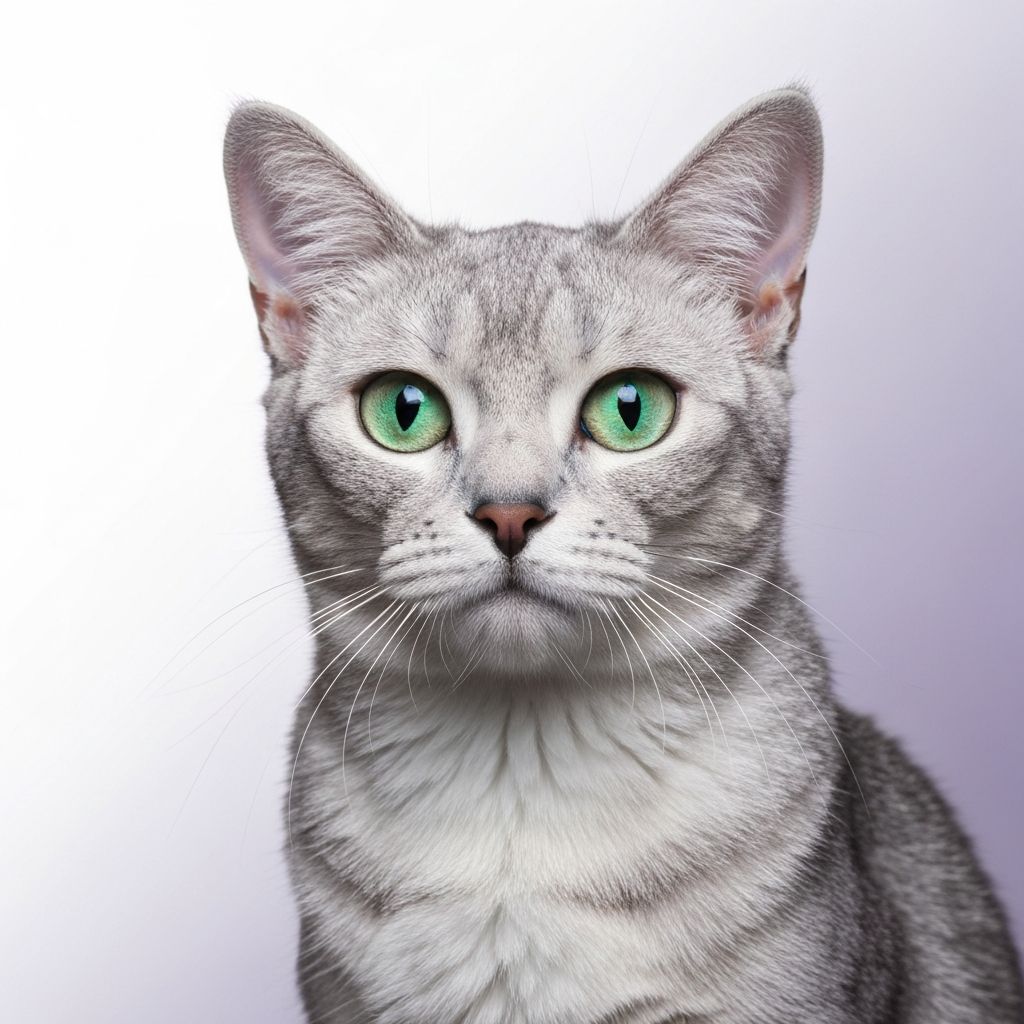
The Korat is a living talisman of luck from Thailand: fur of polished silver, a heart-shaped head, and enormous green eyes the color of a young leaf. For centuries it had no price — it could only be received as a gift.
The Korat is the only cat in the world that for centuries was handed to people as a living talisman of luck — and it is enough to look at it once to understand why. It has fur the color of polished silver, each hair tipped with a silvery glow that makes the cat seem to shine gently in the half-dark. But it is not the fur that stops you in your tracks, but the face: the Korat's head is heart-shaped, literally, and set in this heart-shaped face are enormous, vivid-green eyes the shade of a young leaf — disproportionately large, piercing, and astonishingly human in expression. The Thai say of them that they are the color of young rice, and consider them a source of the luck the cat brings to its home.
Because the Korat is not a breed bred in salons — it is an ancient treasure of Thailand whose history reaches back hundreds of years. In old Siam it was known under the name Si-Sawat and considered a cat so lucky that no money at all was taken for it: a Korat could only be received as a gift, ideally in a pair, because giving a young couple two such cats at their wedding was meant to ensure them prosperity, wealth, and a long, harmonious life. Farmers carried them in processions to bring rain to the fields, and their silver fur symbolized abundance, while their green eyes — the lushness of the harvest. The image of the Korat and a description of its beauty even found their way into the ancient Thai cat book Tamra Maew, written down hundreds of years ago. This is a cat that for most of history could not be bought — it could only be received, and that as one of the most precious gifts that existed at all.
And something of this exceptionality has remained in the Korat's character to this day, because it is a cat that treats its bond with its human deadly seriously. It attaches itself strongly, selectively, and for life — to its people it clings with enormous tenderness, while strangers it observes with distance until they earn its trust. It has at the same time extraordinarily developed senses: it hears, sees, and senses more than other cats, on account of which it can be sensitive to noise and sudden chaos, and flourishes best in a calm, predictable home. This is an intelligent, quiet, and surprisingly affectionate cat — the kind that climbs onto your lap not for warmth but for closeness, and looks into your eyes with that green, wise gaze of its as if it really understood what you are thinking.
Beneath this gentleness hides, however, a lively, stubborn personality that knows what it wants. The Korat is moderately active but very engaged: it adores play, fetch, and climbing, willingly learns tricks, and accompanies you in every household task — except that it does everything on its own, calm terms. It has that Thai dignity that cannot stand being ignored: it can gently but firmly demand attention and bears long solitude badly. In return it offers a devotion so deep that many Korat caretakers speak of it not as an animal, but as a quiet, wise friend that happens to walk on four legs.
This silver treasure of Thailand has at the bowl the needs of a well-balanced, moderately active cat:
- Full-value animal protein: the Korat's shapely, muscular silhouette needs good meat to maintain condition and strength without needless fat
- Portion control: with moderate activity, excess weight comes easily — measured meals protect the silhouette and general health of this smallish cat
- Quality over quantity: a small cat with a refined appetite feels best on a diet of good, meaty ingredients instead of cheap fillers
- Fresh water always available, and wet food in the diet supports hydration and general condition
- Calm at the bowl: the sensitive Korat likes to eat in a quiet, safe place, away from noise and household traffic
Beyond the bowl, the most important thing for this breed is one crucial health matter:
- GM1 and GM2 gangliosidosis: the Korat is genetically predisposed to these two serious, hereditary storage diseases of the nervous system — fortunately an accurate DNA test exists that detects them, which is why the absolute basic is to buy a kitten only from a breeder who tests the parents and presents their results
- Diet and the nervous system: no diet cures these diseases, but good-quality, full-value feeding supports the general condition of a healthy cat's nervous system
- Senses and calm: the Korat has sharpened senses and a sensitive nature — a stable, quiet home is not a whim but a real condition of its wellbeing
- Moderate movement: regular, gentle play maintains the silhouette and occupies this cat's quick mind without exposing it to stress
- Company: the Korat bears solitude badly and feels best where it is a constant part of the family's life
Because the Korat is something more than a beautiful, silvery breed — it is a living fragment of the Thai belief that luck can be given to someone as a gift. For hundreds of years it was sold for no money precisely because it was considered too precious to have a price.
When such a cat looks at you with its great, green eyes from that heart-shaped face, you will feel exactly what the Thai have felt for centuries: that something truly lucky has come your way in life. Because a Korat is not bought — a Korat is received. And you have just got one.
Most common health issues
A rare but serious hereditary storage disease of the nervous system, leading to progressive neurological disorders. Fortunately, an accurate DNA test exists - which is why choosing a breeder who tests the parents and presents the results is the absolute foundation. The disease cannot be treated with diet, but responsible breeding almost completely prevents it.
A hereditary lysosomal disease of the nervous system, related to GM1, also leading to progressive neurological symptoms. Detectable by the same genetic test as GM1 - which is why the breeder's testing of the parents is crucial. The best protection is a conscious choice of a breeding line free of the mutation.
Health issues
2 most common conditions
Health issues
2 most common conditions
A rare but serious hereditary storage disease of the nervous system, leading to progressive neurological disorders. Fortunately, an accurate DNA test exists - which is why choosing a breeder who tests the parents and presents the results is the absolute foundation. The disease cannot be treated with diet, but responsible breeding almost completely prevents it.
A hereditary lysosomal disease of the nervous system, related to GM1, also leading to progressive neurological symptoms. Detectable by the same genetic test as GM1 - which is why the breeder's testing of the parents is crucial. The best protection is a conscious choice of a breeding line free of the mutation.
Nutritional needs
Cat hydration - why wet food matters
Cats naturally have a low thirst drive and often drink too little water. Their ancestors - desert cats - obtained water mainly from food. Wet food contains 70-80% water, which significantly supports hydration and helps prevent kidney and urinary tract problems.