Maine Coon
Origin: USA (Maine)
The Maine coon is the largest domestic cat in the world — a gentle giant created by the harsh winters of Maine, who carries a great heart in an even greater coat, and who talks to people… with a chirp.
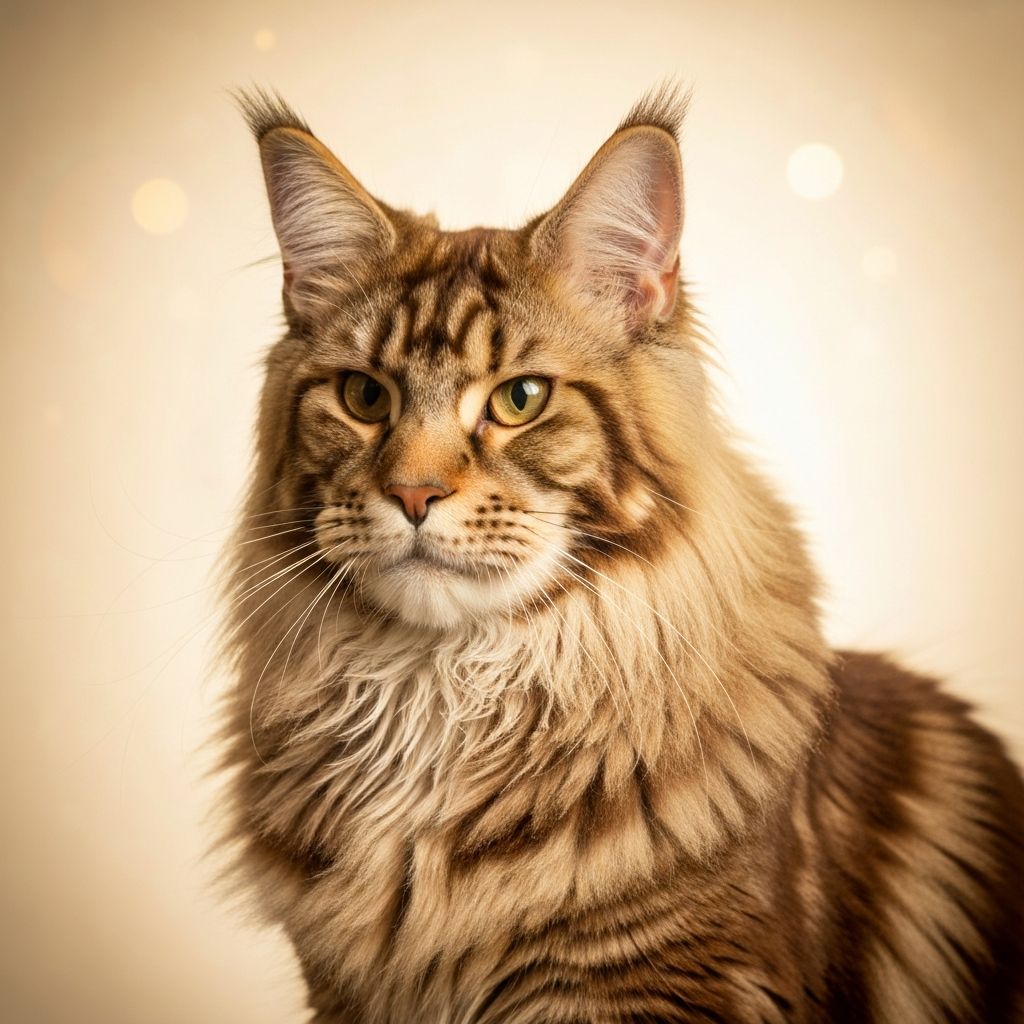
Nature has a sense of humor: to the largest domestic cat in the world it gave the voice of a little bird. The Maine coon — often weighing eight, nine, and sometimes even ten kilograms — instead of the classic meow produces a quiet chirp and melodic trills, with which it greets you at the doorway and comments on the world outside the window. This breed did not arise in any cattery or according to any plan — it was created by the harsh winters of the American state of Maine, where on farms and ships only cats that were large, clever, and superbly dressed could survive. Hence its whole arctic outfit: lynx-like tufts on the ears, broad paws like snowshoes, a water-resistant coat, and a magnificent, bushy tail that on frosty nights it wraps around itself like a scarf. Legends have grown up around its origins — one that it descends from the raccoon (hence the “coon” in the name and the ringed tail; biology says a firm “no,” but the legend is doing just fine), another that it comes from the fluffy cats of Marie Antoinette, sent across the ocean when the queen was preparing to flee to America. The truth is simpler and more beautiful: this is a cat built by winter — and warmed by people.
Life with a Maine coon is a daily communion with a majesty not entirely aware of its own dimensions. This cat grows unhurriedly and on a grand scale — it reaches its full size only around the third or fourth year of life, so when its peers long ago closed the subject of growing up, it is still growing “just a little while longer.” Size, however, comes with no surrender of feline privileges whatsoever: the windowsill, the shoebox, or your lap are in its estimation places that fit just right, and if some part of the cat did not fit in the box, then that is the box's problem, not the cat's. On top of this comes a weakness hard to suspect in a cat: water. The Maine coon can come running at the sound of a turning tap — not to flee, but to supervise this fascinating phenomenon up close — and it treats the water bowl partly as a drinking fountain, partly as a laboratory in which dipping a paw is a mandatory point of research. And then those conversations: it really does answer. It chirps in greeting, trills questioningly when you speak to it, and to the birds outside the window it can present a series of sounds in the face of which it is hard to keep a straight face.
The greatest thing about the Maine coon, however, is not the body, but the way in which this giant loves. It does not impose, does not make scenes, and forces nothing — it simply is. You move to the kitchen? A moment later a soft thud is heard and ten kilograms of tenderness appears beside you. You are working? It will settle close enough to keep an eye on you, and tactfully enough — usually — not to step onto the keyboard. And it is gentle in a way that disarms: patient with children, forbearing toward dogs, delicate toward smaller cats, as if it understood perfectly that with its strength, gentleness is the best testimony of a great heart. And that great heart must be cared for quite literally — because it is precisely the heart that tends to be the tenderest spot of this magnificent breed.
A giant that grows for years needs wise fuel — feeding a Maine coon has a few golden rules:
- Slow maturing, a longer growth diet — the Maine coon matures for as long as 3–4 years (a rarity among cats!), so kitten/junior food is used with it longer, always without overfeeding
- Taurine — the amino acid of the heart: a good-quality complete food enriched with taurine is a daily, quiet protection for its heart muscle
- Full-value protein for a powerful skeleton and muscles, and a lean silhouette — every excess decagram burdens the joints, which already carry a record (for a cat) mass
- Fresh water, ideally running — a fountain for this water lover is a pleasure and an investment in the kidneys and urinary tract in one
Beyond diet, with the Maine coon it is worth remembering a few matters:
- Heart: hypertrophic cardiomyopathy (HCM) is the most serious subject of the breed — a specific genetic mutation is known, so choose catteries that test their cats (DNA tests), and with your own cat consider a preventive heart echo; with a sick heart the appetite tends to be weaker — warming the food to body temperature and serving smaller, more frequent portions helps
- Joints: hip dysplasia occurs in cats too — in such a large animal, a lean weight and attentiveness to changes in movement really do make a difference
- Coat: despite its length surprisingly easy to care for, but regular brushing (especially during shedding) will spare you both mats and trouble
- Equipment to scale: a solid, tall scratching post and a spacious litter box are not a whim but the basic comfort of a cat of this format
The Maine coon combines the grandeur of nature with a gentleness it could teach — and, contrary to appearances, it is not a demanding cat. It wants to be close, to have a scratching post built with a scale worthy of its user, a regular brushing, and a bowl of water beside which it can conduct its research. The rest is simply a shared life — ideally in the same room in which you happen to be.
And in the evening, when this giant settles beside you — because on you it simply would not fit — lays a great, soft paw on your hand, and purrs with that deep, powerful rumble, into which from time to time it weaves a quiet, tender chirp, you will feel it without any words: a cat built by the harshest winters has itself become the warmest place in your home. Because the largest domestic cat in the world has only one thing greater than itself — the heart it gave to you.
Most common health issues
The most common heart disease in cats - the heart muscle thickens, making it harder to pump blood. It can be hereditary; a DNA test is available for some breeds. It remains asymptomatic for a long time, so periodic heart echo examinations at the vet are the best prevention. Maintaining a proper weight and good hydration relieve the circulatory system.
Rare in cats but more common in large breeds like the Maine Coon - it is an abnormal formation of the hip joint that may cause stiffness and pain with age. A lean weight is crucial (it relieves the joints), and omega-3 fatty acids and glucosamine support their condition. Severe symptoms should be consulted with a vet.
Health issues
2 most common conditions
Health issues
2 most common conditions
The most common heart disease in cats - the heart muscle thickens, making it harder to pump blood. It can be hereditary; a DNA test is available for some breeds. It remains asymptomatic for a long time, so periodic heart echo examinations at the vet are the best prevention. Maintaining a proper weight and good hydration relieve the circulatory system.
Rare in cats but more common in large breeds like the Maine Coon - it is an abnormal formation of the hip joint that may cause stiffness and pain with age. A lean weight is crucial (it relieves the joints), and omega-3 fatty acids and glucosamine support their condition. Severe symptoms should be consulted with a vet.
Nutritional needs
Cat hydration - why wet food matters
Cats naturally have a low thirst drive and often drink too little water. Their ancestors - desert cats - obtained water mainly from food. Wet food contains 70-80% water, which significantly supports hydration and helps prevent kidney and urinary tract problems.