Neva Masquerade
Origin: Russia (Saint Petersburg)
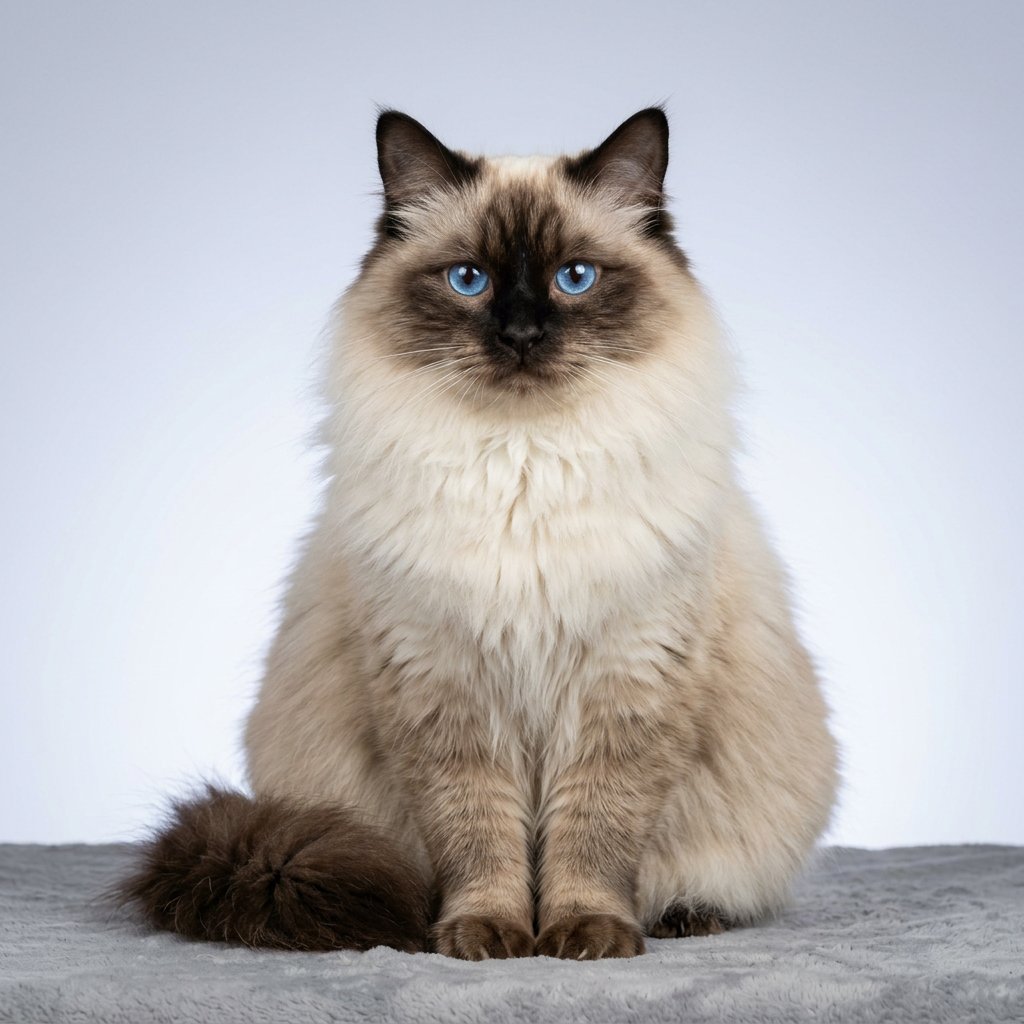
Everything we love fades with time. The Neva Masquerade is the exception: she is born white, and cold and time paint her mask — with every winter you spend together she shows more clearly.
Everything we love fades with time: photographs, favourite jumpers, holiday memories. The Neva Masquerade is the only known exception. She comes into the world almost white and spends the first weeks of her life incognito. Only then does a dark mask begin to grow on her face, ears, paws and tail — and it is painted by the cold, because pigment forms only where the body is a touch cooler. That is why a Neva from a chilly flat wears a darker mask than a Neva from beside the radiator, and why she is the only member of the household on whom you can see how you heat your home. Her eyes are always blue: the same gene that invented the mask left two pieces of clear sky in them. And underneath — up to nine kilos of Siberian cat with three layers of fur and a lumberjack's shoulders. The overall effect is as if a lumberjack from beyond the Urals had been invited to a masked ball and felt at home there from the first waltz.
This masquerade has been going on in Russia for longer than anyone has called it that. As early as the end of the eighteenth century the naturalist Peter Simon Pallas described village cats with a black mask — reputedly the descendants of cats that had wandered in from the East with merchant caravans and settled among the Siberians for good. She got her name two hundred years later. At the end of the 1980s, at a show in the city on the Neva, cat lovers presented her to the public and christened her after the river and after a ball: Neva Masquerade. It takes imagination, in grey Leningrad, in the days of queues for everything, to name a cat in honour of a masked ball. And it has to be said they got it right. To this day some federations see her as a separate breed and others as a Siberian cat in festive costume. She herself has nothing to say on the matter. At a masked ball you don't ask about identity.
In any case, a Neva rarely has much to say at all. Researchers who compared her with the classic Siberian noticed two things: she has a more modest repertoire of sounds and she copes worse with being left alone. The one explains the other. She doesn't talk to you with her voice but with her eyes — and for that she needs to have you within sight. So she sits where she can see you: on the back of the armchair, on the corner of the desk, on the washing machine while you hang out the laundry. She can also be less ethereal than her name suggests: when nine kilos in a ballroom mask land on your chest at six in the morning, it is hard to imagine a more elegant way of having the breath knocked out of you. But mostly she simply watches. And when you lift your head and your eyes meet, she does the thing that psychologists from two British universities described in a serious scientific journal as the cat's smile: slowly, very slowly, she closes her eyes and opens them again. Two blue lights in a dark mask go out for a second. Just for you. Answer in kind — she will understand.
There is more to this mask than a joke. People put on masks so that for one night they can be someone else. Her mask works the other way round: it hides nothing, and with every year it shows more. A kitten is as white as a blank page. A one-year-old Neva already has features. A five-year-old — because that is how long it takes for this cat to truly grow up — wears her mask in full colour. And an old one is darker than ever, as though every winter spent sitting on your windowsill had left its mark on her. People fear that time takes away those they love. With her it is different. With her, time draws them in.
Your part in this story is simple: to make sure there are as many of those winters as possible.
And that starts in the bowl:
- Wet food every day and water in several places around the home. Polycystic kidney disease has been described in the breed, and a well-hydrated cat means kidneys that work more easily
- Animal protein first: those shoulders and those leaps come from muscle, and muscle comes from meat
- She grows until her fifth year, so for the first years she needs a diet for a cat that is still building itself — nourishing, but without overfeeding
- The scales once a month. Under three layers of fur you can't see excess weight until there is a lot of it, and every surplus kilogram is extra work for the heart
- Omega-3 and omega-6 fatty acids for the skin and coat: her fur will show the quality of the bowl sooner than any test
Beyond the bowl, a few things are worth remembering:
- Heart: as in Siberian cats, hypertrophic cardiomyopathy occurs. A periodic heart scan can catch it before it causes symptoms
- Kidneys: ask the breeder about kidney ultrasound results for the parents, and have your own cat's blood and urine tested once a year
- Being alone: she copes with it worse than most cats. If you work away from home, consider a second cat, or rituals that will fill her day
- Coat: for most of the year it looks after itself, but in spring and autumn she sheds it by the handful — then it's the brush every day
- Allergies: many allergic people tolerate her better than other cats, because the breed usually produces less of the main cat allergen. That is no guarantee, so check it on a specific cat before you decide
A Neva Masquerade never takes off her mask: not to sleep, not for guests, not for you. She doesn't have to. Everything she has to say, she says with those two pieces of sky watching you from the other end of the room.
One day, many winters from now, you will take her on your lap and notice that she is darker than you remember. Don't worry. It isn't old age. It is all the winters you have shared, which have stayed on her for good — the one thing in the world that love doesn't fade but deepens in colour. And then she will do what she always does: look at you and slowly, very slowly, blink.
Most common health issues
The most common heart disease in cats - the heart muscle thickens, making it harder to pump blood. It can be hereditary; a DNA test is available for some breeds. It remains asymptomatic for a long time, so periodic heart echo examinations at the vet are the best prevention. Maintaining a proper weight and good hydration relieve the circulatory system.
A hereditary disease in which cysts form in the kidneys, gradually impairing their function. Detectable by ultrasound, and in some breeds by a genetic test - which is why it is worth asking the breeder about the parents' results. Early detection and a kidney-supporting diet (good hydration, wet food, phosphorus control) help preserve their function longer.
Health issues
2 most common conditions
Health issues
2 most common conditions
The most common heart disease in cats - the heart muscle thickens, making it harder to pump blood. It can be hereditary; a DNA test is available for some breeds. It remains asymptomatic for a long time, so periodic heart echo examinations at the vet are the best prevention. Maintaining a proper weight and good hydration relieve the circulatory system.
A hereditary disease in which cysts form in the kidneys, gradually impairing their function. Detectable by ultrasound, and in some breeds by a genetic test - which is why it is worth asking the breeder about the parents' results. Early detection and a kidney-supporting diet (good hydration, wet food, phosphorus control) help preserve their function longer.
Nutritional needs
Cat hydration - why wet food matters
Cats naturally have a low thirst drive and often drink too little water. Their ancestors - desert cats - obtained water mainly from food. Wet food contains 70-80% water, which significantly supports hydration and helps prevent kidney and urinary tract problems.