Norwegian Forest Cat
(Norweski Kot Leśny)
Origin: Norway
The Norwegian forest cat came down into your living room straight from Nordic myths — literally: its ancestors pulled the chariot of the goddess Freya. The descent it made, of course, head down.
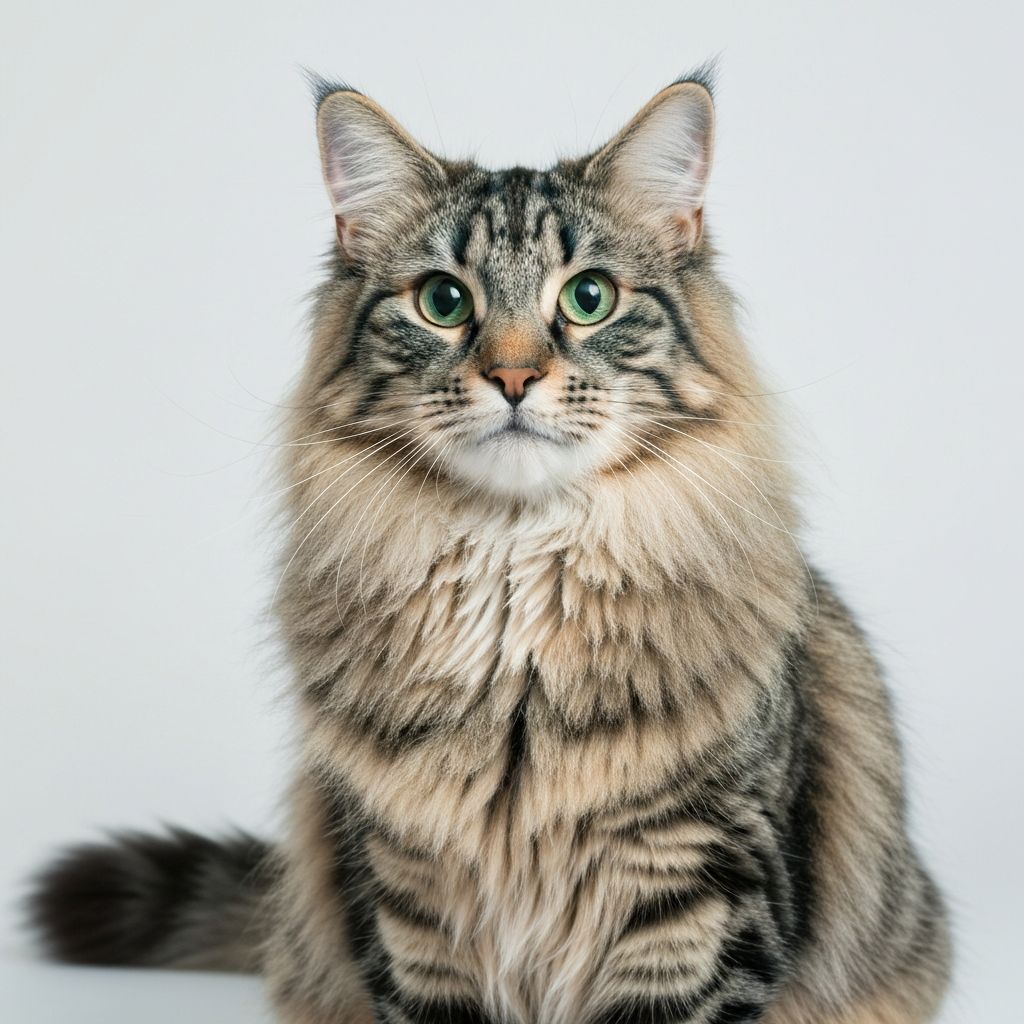
The Norwegian forest cat does a thing that breaks feline laws of physics: it comes down a tree head first, in a spiral, like a squirrel — it is the only domestic cat whose structure of claws and paws allows it at all. When you watch this great, furry being with a lion-like ruff on its chest and a tail plume worthy of a bonfire flow down the trunk face to the ground, you understand why Norwegians were for centuries convinced that this was no ordinary animal. This was the skogkatt — the cat from the fairy tale.
And few breeds have a record written with such a pen. When the Vikings set out across the seas, it was precisely these cats that sailed with them on the decks of the longships — they guarded the supplies and went ashore everywhere the sails reached. In Nordic myths the chariot of Freya, goddess of love, was pulled by two mighty cats — and Norwegians never had any doubt which breed was meant. There is also the tale of Thor: the god of strength was once unable to lift a certain great cat off the ground — and to this day in Norway they suspect which one. And when the legend began to blur, man took matters into his own hands: the breed was recreated from real forest cats of the fjords, and King Olav V declared the Norwegian the official cat of Norway. A goddess's harness and a king's decree — few can put so much on a CV.
At home the Norwegian carries its forest lineage with complete ease. Its coat is double-layered and water-resistant — rain runs off it as off a well-impregnated tent — and to complete the set, furry breeches on the hind legs and that magnificent ruff, in which it looks as if it were going to a feast of jarls. It climbs everywhere and onto everything: the scratching post is for it the ground floor, it is planning a mezzanine, and the top of the wardrobe it treats as a private fjord with a view over the whole household. Snow throws it into a puppy's delight, cold does not move it, and after a whole day of expedition this mountain of fur soundlessly lands in the evening on the sofa and starts up a purr with the power of a small ship's engine.
Because the most beautiful thing about the Norwegian is one thing you cannot see in photos: for hundreds of years this cat needed no one. It obtained its own food, found its own shelter, coped on its own with a winter that in Norway can break trees. And precisely for that reason its affection weighs more than many another's: the Norwegian needs nothing from you — so everything it gives you is pure choice. When such a cat lays its head on your lap, it is not the transaction of a hungry animal. It is the decision of someone who could live without you, and chose life with you.
At the bowl the Norwegian has the needs of a large, slowly maturing cat with expedition-class fur:
- Omega-3 and omega-6 are the foundation: this dense, double, water-resistant coat begins in the bowl — without good fats even the best coat loses both its shine and its properties
- It matures in the Nordic manner, without haste — it reaches full size only around the 30th month of life, so a young Norwegian needs a food supporting slow, gradual growth
- Full-value protein for a large body: the mass is to be in the muscles that carry its climbs
- Portions to match moderate activity: this is a sprinter and a climber, not a marathon runner — and excess weight in such a large cat immediately burdens the hips
- Fresh water always available, because a large cat also means large kidneys to service
Beyond the bowl, it is worth knowing a few matters typical of the breed:
- GSD IV: Norwegians can be carriers of a rare, recessively inherited glycogen storage disease type IV — a genetic test exists, and a good breeder shows the parents' test results without being asked
- Hips: as in many large cats, dysplasia occurs — a lean silhouette and sensible descents (an intermediate shelf instead of a flight from the wardrobe to the parquet) really spare them
- Heart: a predisposition to hypertrophic cardiomyopathy (HCM) — periodic heart echo is a sensible routine
- Coat: for most of the year surprisingly self-servicing, but in spring the Norwegian sheds its whole winter coat at once — in shedding season the brush works daily, and the vacuum cleaner valiantly
- Heights: shelves, scratching posts up to the ceiling, and safe windows — a cat that comes down head first must have somewhere to come down from
Because the Norwegian forest cat is a rare arrangement: strength that chose gentleness, and independence that chose home. The goddess harnessed to her chariot precisely such cats — and there is something to that.
When this forest legend, of its own free will, settles beside you in the evening and switches on its ship's engine, you will feel exactly what the Norwegians of a thousand years ago felt: that something out of a fairy tale has visited you. With this difference — that your fairy tale stays for good.
Most common health issues
The most common heart disease in cats - the heart muscle thickens, making it harder to pump blood. It can be hereditary; a DNA test is available for some breeds. It remains asymptomatic for a long time, so periodic heart echo examinations at the vet are the best prevention. Maintaining a proper weight and good hydration relieve the circulatory system.
In large, heavy cats like the Norwegian Forest Cat, the hip joint can be abnormally formed, which may cause stiffness and pain with age. A lean weight is crucial (it relieves the joints), and omega-3 fatty acids and glucosamine support their condition. Severe symptoms should be shown to a vet.
Health issues
2 most common conditions
Health issues
2 most common conditions
The most common heart disease in cats - the heart muscle thickens, making it harder to pump blood. It can be hereditary; a DNA test is available for some breeds. It remains asymptomatic for a long time, so periodic heart echo examinations at the vet are the best prevention. Maintaining a proper weight and good hydration relieve the circulatory system.
In large, heavy cats like the Norwegian Forest Cat, the hip joint can be abnormally formed, which may cause stiffness and pain with age. A lean weight is crucial (it relieves the joints), and omega-3 fatty acids and glucosamine support their condition. Severe symptoms should be shown to a vet.
Nutritional needs
Cat hydration - why wet food matters
Cats naturally have a low thirst drive and often drink too little water. Their ancestors - desert cats - obtained water mainly from food. Wet food contains 70-80% water, which significantly supports hydration and helps prevent kidney and urinary tract problems.