Oriental Shorthair
(Kot Orientalny Krótkowłosy)
Origin: United Kingdom
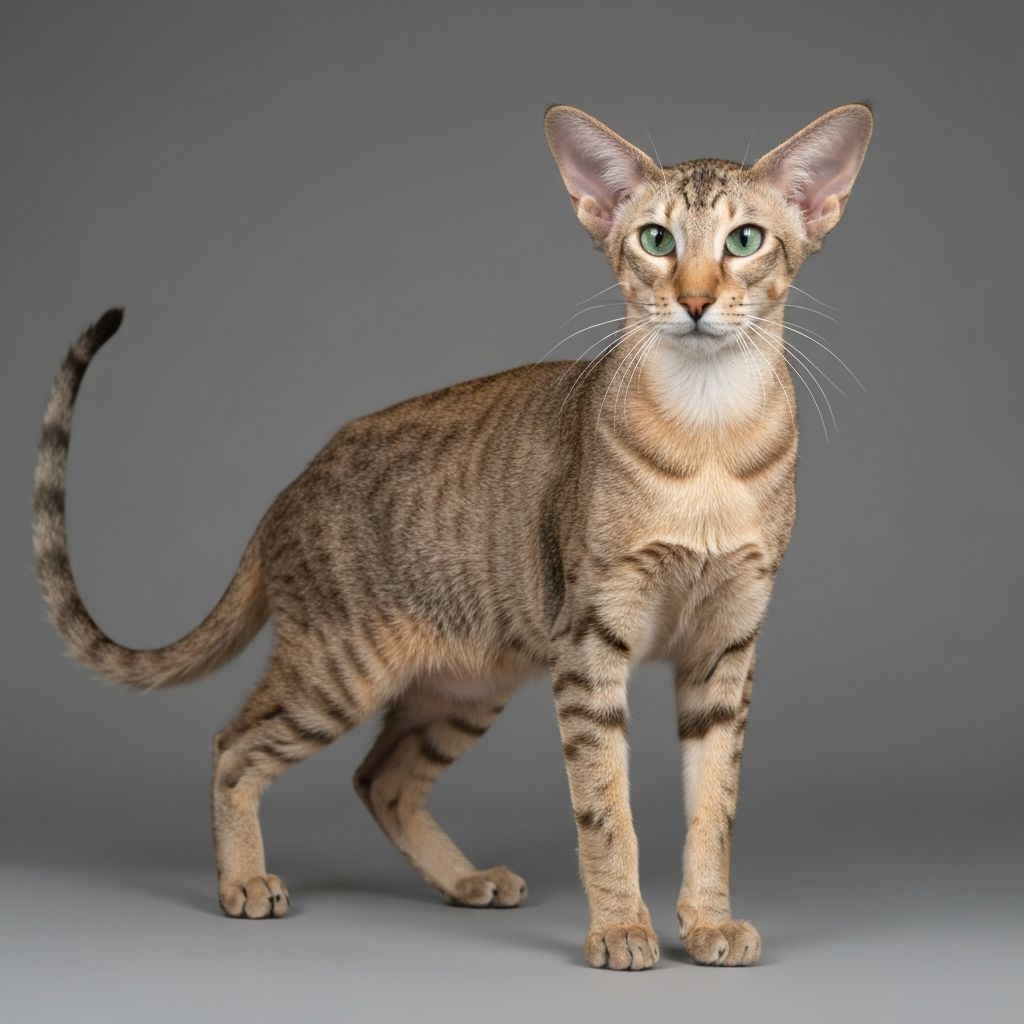
The oriental shorthair is a slender elegant with ears like antennas and a voice that cannot be ignored. It comes in several hundred colors — but every one of them adores you just as much.
The oriental shorthair looks as if someone had drawn a cat with a ruler alone, and then added ears from a completely different, much larger fairy tale. Everything in it is slender and elongated: a ballerina's legs, a slimmed body, a wedge-shaped face — and atop all this a pair of ears so enormous that the cat gives the impression of having listened in on something all its life. Those ears are its trademark and its radar: the oriental hears your steps, the rustle of packaging, and the opening fridge from the other end of the apartment, and appears at your side before you manage to do anything about it.
And on top of this, nature painted it in almost every possible way. Because the oriental is not one gown, but a whole wardrobe: the breed comes in several hundred varieties of coloring and pattern — from solid black, through blue and chocolate, to stripes and spots in countless combinations. And here lies its lineage: the oriental is a close relative of the Siamese, built exactly the same, only without the characteristic dark mask. When after the Second World War British breeders began to cross the Siamese with other cats, they obtained the same elegant, talkative silhouette in a whole palette of colors — and so from one pattern a cat of hundreds of faces was born. One could say the oriental is a Siamese that was allowed to put on every color in the world.
Its character is, moreover, as vivid as its appearance — it is the extreme extrovert of the feline world. The oriental knows no concept of distance: it participates in everything, comments on everything, and wants to be in the very middle of every event in the home. It is at the same time extraordinarily talkative — it conducts an unceasing dialogue with you, loudly reporting its reflections and expecting an answer. It is also an acrobat and an intellectual in one: it jumps onto the highest shelves, opens cabinets, learns to play fetch, and solves puzzles faster than you manage to devise them. Boredom is its enemy number one — an oriental without occupation will find entertainment on its own, and its ideas rarely coincide with your vision of order.
Beneath this energy and talkativeness hides, however, something that makes this breed truly exceptional: boundless devotion. The oriental attaches itself to its human with a force one would hardly suspect in a cat — it chooses you as its person and stays with that choice for better or worse. It follows you step by step, sleeps wedged into your side, slips under the duvet, and sincerely believes that every moment spent apart is a moment wasted. That is why solitude wounds it keenly: an oriental left alone for whole days does not get bored — it pines, loudly and sincerely. This is a cat for someone who wants a real companion by their side, ideally in a pair with a second cat if the home often stands empty.
This slender athlete has at the bowl needs to match its eternal energy:
- Plenty of full-value protein (32–42%): this slimmed, muscular silhouette without good protein loses muscle — the diet must keep up with its unceasing movement
- Fuel for the active: this is one of the most energetic breeds, one that really burns calories — the quality of ingredients is here more important than in a lazy couch dweller
- Dental health under watch: orientals are prone to periodontal disease, which is why it is worth relying on a diet and habits supporting the mouth (regular tooth brushing, food of the right structure)
- Play through food: interactive toys and food dispensers are for this quick mind an ideal — they combine the meal with the hunt the oriental unceasingly craves
- Fresh water always available, and wet food in the diet supports hydration and general condition
Beyond the bowl, it is worth knowing a few matters important for this breed:
- Amyloidosis: orientals are predisposed to the deposition of amyloid protein in the organs, particularly in the liver — regular blood tests at the vet allow the problem to be caught early
- Teeth: a tendency toward periodontal disease makes oral hygiene and vet monitoring with this breed not an add-on but a basic
- Warmth: a slender body and thin fur hold heat poorly — the oriental will love warm beds, blankets, and your duvet, which it will regard as joint property
- Movement and heights: this acrobat must be given space — scratching posts up to the ceiling, shelves, and a climbing course are a condition of a happy, calm cat
- A head for work: intelligent and sensitive, it needs company and stimulation — an oriental that is bored and lonely is an unhappy cat, and it makes its unhappiness known loudly
Because the oriental shorthair is one of the most colorful characters of the feline world, literally and figuratively: elegant as a model, talkative as a best friend, devoted like no other — and available in every color you could dream up.
Choose it any gown from those several hundred — the most important thing is still what is underneath: a cat that will regard you as the center of its world and does not intend to withdraw from that position for a moment.
Most common health issues
A disease in which the amyloid protein is deposited in organs (in cats most often in the liver or kidneys), over time disrupting their function. It can be hereditary. Regular blood tests at the vet help catch the problem early, and good-quality, easily digestible nutrition supports the burdened organs.
A tendency to periodontal disease and tartar buildup, common in breeds with an elongated muzzle. Regular tooth brushing, food that supports oral hygiene and vet check-ups help prevent pain and tooth loss.
Health issues
2 most common conditions
Health issues
2 most common conditions
A disease in which the amyloid protein is deposited in organs (in cats most often in the liver or kidneys), over time disrupting their function. It can be hereditary. Regular blood tests at the vet help catch the problem early, and good-quality, easily digestible nutrition supports the burdened organs.
A tendency to periodontal disease and tartar buildup, common in breeds with an elongated muzzle. Regular tooth brushing, food that supports oral hygiene and vet check-ups help prevent pain and tooth loss.
Nutritional needs
Cat hydration - why wet food matters
Cats naturally have a low thirst drive and often drink too little water. Their ancestors - desert cats - obtained water mainly from food. Wet food contains 70-80% water, which significantly supports hydration and helps prevent kidney and urinary tract problems.