Persian
(Pers)
Origin: Iran (Persia)
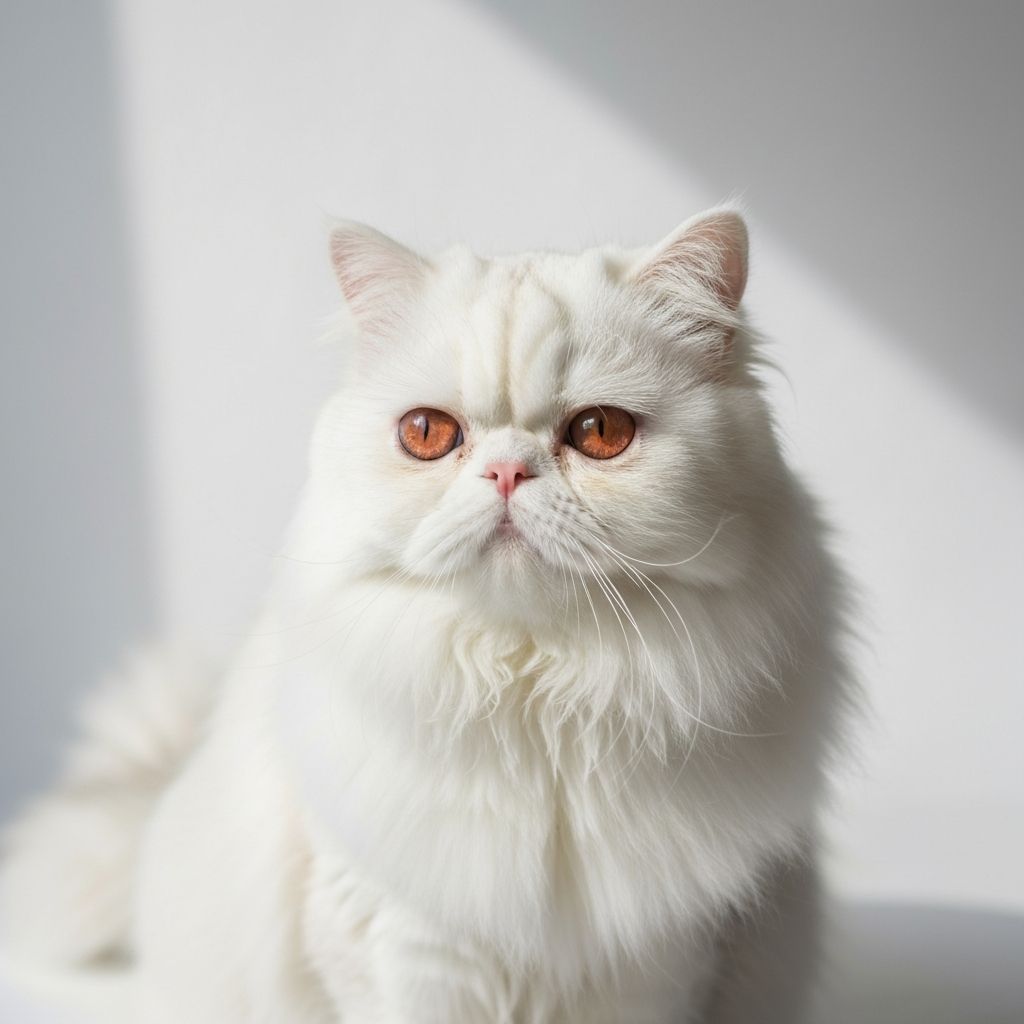
The Persian looks at the world with the expression of someone who has read all the books and been enchanted by none. And then it sits down beside you — and that is its five-star review.
The Persian has the most expressive face in the feline world: it looks like someone who has read all the books, watched all the sunsets, and come to the conclusion that essentially nothing is capable of surprising it anymore. This expression of a jaded critic is, however, only a facade of dignity — because the Persian is not at all bored with the world. It has simply decided that the world does not require running. Everything truly important happens, after all, at the level of the cushion: a ray of sun, a good armchair, your presence. Why climb onto the cabinets, when the summits of this home come to it by themselves anyway.
This calm has four hundred years of career behind it. The first Persian cats were brought to Europe in the 17th century by the Italian traveler Pietro della Valle — he was returning from Persia with a caravan in which, besides silks and stories, traveled cats with fur the West had never seen. Two centuries later Queen Victoria fell in love with them, and with her all the salons of Europe — and so the Persian took the throne of the most popular breed in the world, on which it spent most of the 20th century. For four hundred years, moreover, it has performed exactly the same profession: it ennobles rooms by its mere presence.
In daily life the Persian is an observer of the master class. In the home's life it participates like a theater critic — from an armchair, with full concentration and the expression of a reviewer who has not yet decided how many stars to award today. It speaks rarely, quietly, and to the point, like someone with no need to shout anyone down. And that famous fur it wears like haute couture: in layers, with dignity, and with full awareness that such a wardrobe requires a valet. That valet is you — and it is a full-time job, not a hobby: daily combing is with the Persian simply part of the agreement, because without it this magnificent robe turns in a few days into mats that hurt.
And here is a thing easy to overlook behind all that dignity: the Persian's silence is not indifference. It is its language. The Persian does not run after you around the house — it waits for you. It chooses an armchair beside yours and turns it into a lifelong observation point of your life. It does not demand, does not insist, does not make scenes — it simply is, softly and continuously, and its calm has that strange property of lowering the blood pressure of the whole house. Whoever has once had a Persian knows: this is not a cat you pet for its sake. It is a cat you pet for your own.
At the bowl the Persian needs more attention than its calm way of life would suggest — for one serious reason: as many as 40% of Persian cats and related breeds inherit polycystic kidney disease (PKD), a disease in which cysts slowly grow in the kidneys.
It sounds alarming, but knowledge gives a real advantage here:
- Ultrasound examination is the basic method of detecting PKD — it is worth doing it in advance and repeating it in accordance with the vet's recommendations, and with a breeder to ask about the parents' test results
- If PKD is detected: a specialized renal diet with reduced phosphorus content really slows the progress of the disease and prolongs life
- Plenty of moisture: wet food and readily drunk water are daily relief for the kidneys — a wide, flat bowl with always-fresh water does its job
- A flat face = harder eating: the Persian has a shortened jaw and grasps kibble differently than other cats — choose a food with an adapted kibble shape, or wet food served in a flat dish
- Hairballs: with this amount of fur, a diet supporting passage (fiber, special formulas) plus daily combing is a duo that spares it many unpleasantnesses
- Portions to match a calm way of life — the Persian is an aesthete, not a sportsman, and its bowl should remember that
Beyond the bowl, the Persian has a few daily grooming rituals that with this beauty are obligatory:
- Eyes: a flat face favors tearing — gently wiping the eye area is best written into the daily routine, like brushing teeth
- Combing: daily, methodically, down to the skin — this is also the best moment of closeness, which the Persian sincerely celebrates
- Heat: a brachycephalic build tolerates warmth worse — in summer a cool room and calm are not a luxury but a need
- Play in the aristocrat's version: a short session with a feather daily maintains the silhouette and the spirit — the Persian will play willingly, only without acrobatics
Because the Persian is a cat for people who understand that the most precious things happen slowly. It will not take your home by storm — it will quiet it. Evening by evening, armchair by armchair, over a dozen or more years.
In a world that constantly shouts, the Persian is the most convincing argument for silence. Sit down beside it. It was waiting for exactly this — very patiently and very much in the Persian manner.
Most common health issues
A hereditary disease in which cysts form in the kidneys, gradually impairing their function. Detectable by ultrasound, and in some breeds by a genetic test - which is why it is worth asking the breeder about the parents' results. Early detection and a kidney-supporting diet (good hydration, wet food, phosphorus control) help preserve their function longer.
A set of breathing problems resulting from the shortened structure of the skull and muzzle (flattened face). It may manifest as snoring, wheezing and reduced tolerance of exercise and heat. It is worth providing coolness and calm on hot days, avoiding excess weight (which worsens breathing) and choosing food with a kibble shape that makes it easier to pick up.
Health issues
2 most common conditions
Health issues
2 most common conditions
A hereditary disease in which cysts form in the kidneys, gradually impairing their function. Detectable by ultrasound, and in some breeds by a genetic test - which is why it is worth asking the breeder about the parents' results. Early detection and a kidney-supporting diet (good hydration, wet food, phosphorus control) help preserve their function longer.
A set of breathing problems resulting from the shortened structure of the skull and muzzle (flattened face). It may manifest as snoring, wheezing and reduced tolerance of exercise and heat. It is worth providing coolness and calm on hot days, avoiding excess weight (which worsens breathing) and choosing food with a kibble shape that makes it easier to pick up.
Nutritional needs
Cat hydration - why wet food matters
Cats naturally have a low thirst drive and often drink too little water. Their ancestors - desert cats - obtained water mainly from food. Wet food contains 70-80% water, which significantly supports hydration and helps prevent kidney and urinary tract problems.