Ragamuffin
Origin: USA
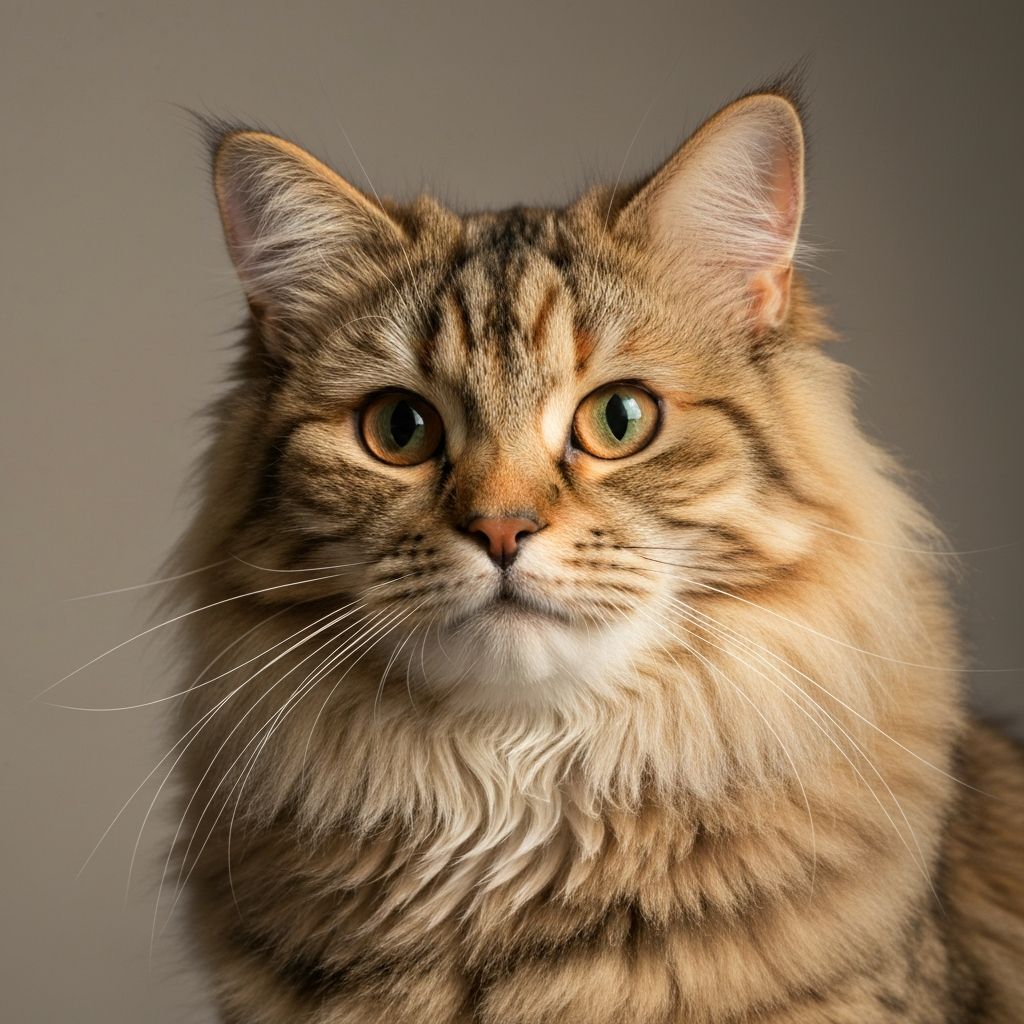
Ragamuffin means “ragged one” — the most perverse name in the feline world. This silky giant with eyes like hazelnuts does not wait for you to love it: it comes, climbs onto your lap, and stays there until you decide it was always so.
The Ragamuffin bears a name that means “ragged one,” “tatterdemalion” — and it is the most perverse name in the whole feline world, because it is hard to find a cat less ragged than it. This is a large, fluffy giant with semi-long, silky fur, a round, sweet face, and great hazelnut-shaped eyes that look at you with an expression of unceasing, gentle goodwill. But do not be fooled by that angelic little face: the Ragamuffin is a cat that takes matters into its own paws. You come into the house — it is already at the door. You sit down — you already have nine kilograms of a determined companion on your lap. You work — it has just lain down on the keyboard and looks at you as if it were doing you a favor. Only someone who did it out of spite could call such a self-assured opportunist a “tatterdemalion.” And that is exactly how it was.
Because the Ragamuffin was born of rebellion — and its history is one of the most dramatic tales in the world of cats. In the 1960s the breeder Ann Baker created the Ragdoll breed and covered it with a patent so iron-clad and restrictive that some breeders could not endure its rigors. In the early 1990s a group of them decided to leave and go their own way — but because the very name “Ragdoll” was legally reserved, they were not allowed to use it. In a gesture of defiance they gave their new breed a provocatively perverse name: Ragamuffin, that is, ragged one. This act of feline rebellion turned out to be a bull's-eye — the breeders broadened the gene pool, thanks to which the Ragamuffin gained vigor, health, and a whole palette of colorings its ancestor never had. From an act of protest was born one of the most affectionate cats that ever lived with a human.
Because although the Ragamuffin is gentle to the limit — patient with children, forbearing toward other animals, completely devoid of aggression — its affection is not passive. This is not a cat that waits for you to pet it; it is a cat that will exact that petting. It follows you from room to room like a great, fluffy shadow, pushes its head under your hand the moment you lower it, and has a habit of jumping into every occupied spot, as if its presence were an obvious element of every activity of yours. The Ragamuffin does not ask for attention — it organizes it: discreetly, stubbornly, and with the unshakable certainty that the best place in the whole house is exactly the one you happen to be occupying. Its greatest pleasure is being carried in your arms like a baby, belly up — and it demands that position with disarming consistency.
But this boundless trust has its price and its condition: the Ragamuffin is so gentle and so incautious that it completely cannot cope in the outside world. It does not have a shred of the vigilance of a street cat — a strange dog or a car it would treat with the same naive warmth as a household member. That is why the Ragamuffin must be an exclusively indoor cat, and its trust imposes on you a real duty: to become its entire safe world. In return you get a companion that has chosen you as its whole world and exacts that choice every day — treading on your heels, occupying your lap, and greeting you at the doorway as if you had returned from a war, every single time.
This gentle giant has at the bowl the needs of a large, calm cat that matures slowly:
- A big cat, solid protein: the Ragamuffin grows to as much as 9 kg and needs a food rich in full-value protein so that this impressive mass stays in the muscles and not in fat
- Portion control: a calm, moderately active giant gains weight easily — measured meals protect its heart and joints from additional burden
- Omega-3 and omega-6 for the silky fur: this semi-long, gleaming covering looks best when the diet is rich in good fatty acids
- Slow maturing: like many large breeds, the Ragamuffin reaches its full mass only after a few years — a young cat needs a diet supporting gradual, healthy growth
- Plenty of moisture: wet food and constant access to fresh water support hydration and the work of the kidneys, which with this breed are worth caring for especially
Beyond the bowl, it is worth knowing a few matters important for this breed:
- Heart: Ragamuffins can be predisposed to hypertrophic cardiomyopathy (HCM), the most common heart disease in cats — periodic echo examination at the vet is wise prevention
- Kidneys: the breed has a predisposition to polycystic kidney disease (PKD), which is why ultrasound examination allows the problem to be detected early, and with a breeder it is worth asking about the parents' test results
- Coat: semi-long and silky, but with little undercoat, so it rarely felts — combing two or three times a week is usually enough
- A safe home: secured windows and balcony are a necessity, because the trusting Ragamuffin completely fails to judge the dangers of the outside world
- Company: this is a cat that bears solitude badly and feels best as an inseparable companion — if you are often away, a second gentle cat can be a real support for it
Because the Ragamuffin is the most beautiful proof that tenderness can be born of rebellion: a cat named a ragged one in defiance, which grew into one of the gentlest, most loving companions a human can have.
Take it once in your arms, belly up, and feel how it relaxes with a trust that in the feline world usually has to be long earned — and it will give you all of it, from the first day. This tatterdemalion carries within it the greatest treasure a cat can offer: a heart that gives itself without reserve and without any conditions. Your task is only one — to be worthy of it.
Most common health issues
The most common heart disease in cats - the heart muscle thickens, making it harder to pump blood. It can be hereditary; a DNA test is available for some breeds. It remains asymptomatic for a long time, so periodic heart echo examinations at the vet are the best prevention. Maintaining a proper weight and good hydration relieve the circulatory system.
A hereditary disease in which cysts form in the kidneys, gradually impairing their function. Detectable by ultrasound, and in some breeds by a genetic test - which is why it is worth asking the breeder about the parents' results. Early detection and a kidney-supporting diet (good hydration, wet food, phosphorus control) help preserve their function longer.
Health issues
2 most common conditions
Health issues
2 most common conditions
The most common heart disease in cats - the heart muscle thickens, making it harder to pump blood. It can be hereditary; a DNA test is available for some breeds. It remains asymptomatic for a long time, so periodic heart echo examinations at the vet are the best prevention. Maintaining a proper weight and good hydration relieve the circulatory system.
A hereditary disease in which cysts form in the kidneys, gradually impairing their function. Detectable by ultrasound, and in some breeds by a genetic test - which is why it is worth asking the breeder about the parents' results. Early detection and a kidney-supporting diet (good hydration, wet food, phosphorus control) help preserve their function longer.
Nutritional needs
Cat hydration - why wet food matters
Cats naturally have a low thirst drive and often drink too little water. Their ancestors - desert cats - obtained water mainly from food. Wet food contains 70-80% water, which significantly supports hydration and helps prevent kidney and urinary tract problems.