Ragdoll
Origin: USA
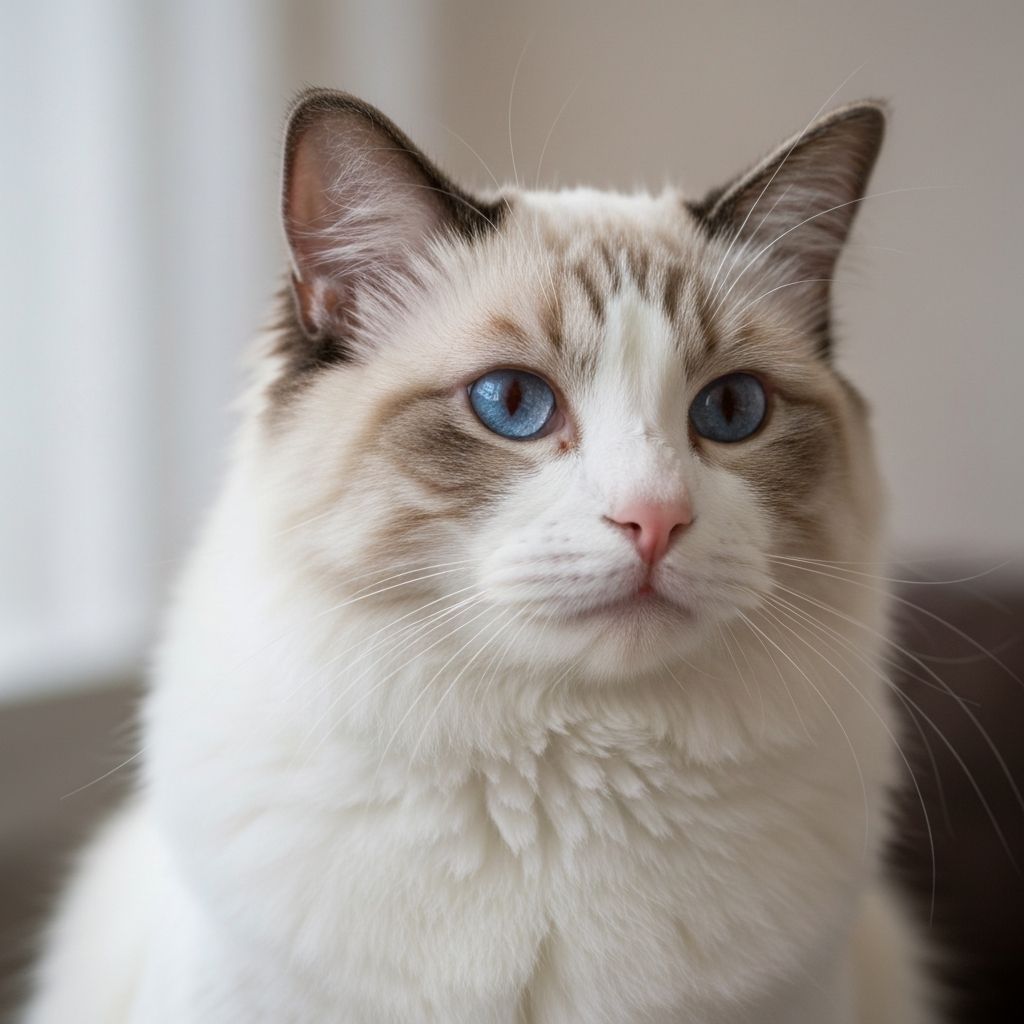
The ragdoll has one superpower: the moment you take it in your arms, it switches off gravity and spreads out in your arms like a warm blanket. Hence the name — rag doll.
The ragdoll does something in greeting that almost no cat in the world does: when you take it in your arms, it simply gives up. The muscles soften, the paws hang, the whole great body spreads out in your arms like a warm blanket — and it was from this limp “flop” that the breed took its name: ragdoll, a rag doll. Other cats in such a situation negotiate, squirm, or politely stiffen. The ragdoll surrenders its entire weight to you from the first second, as if it wanted to say: do as you see fit, I trust you. And that sentence is the key to this whole breed.
For a cat with the soul of an angel, the ragdoll has a surprisingly colorful record. The breed arose in the 1960s in California, with the breeder Ann Baker, from a white cat named Josephine — and its beginnings were accompanied by so many legends that they would suffice for a TV series. Baker even claimed that her cats felt no pain, and — perhaps most extraordinary of all — she reserved the name “Ragdoll” like a trademark: it is probably the only cat breed in history that someone tried to patent like a brand of jeans. The marketing was eccentric, but the cat itself turned out to be a masterpiece: large, gorgeous, with blue eyes and a character that conquered the world faster than any legends.
Because the ragdoll really is different. It greets you at the door like someone who has been waiting all day (because it has). It assists at every household task: it supervises the dishwashing, roots for the cooking, reviews the folding of laundry from a reclining position on the freshly folded laundry. Strangers it treats as friends it simply has not met yet. And those great, blue eyes look at the world with an expression of gentle astonishment that anyone could have bad intentions. This is a cat that does not know the concept of suspicion — and that makes it at once wonderful and utterly defenseless.
And here let us return for a moment to that legend, because it must be set straight once and for all: the ragdoll feels pain exactly the same as any other cat. It simply does not defend itself. That famous limpness is not numbness, but trust taken to the limit — the ragdoll assumes in advance that in your hands nothing bad can happen to it. Such trust is an honor, but also an obligation: this is a cat exclusively for life indoors, because its gentleness knows nothing of the street, strange dogs, or busy intersections. The outside world plays a game whose rules the ragdoll does not even know. You are its rules.
This obligation reaches deeper too — literally to the heart. Ragdolls belong to the breeds in which a specific gene mutation responsible for familial hypertrophic cardiomyopathy (HCM), the most common heart disease in cats, has been identified. The good news: breeders can test their cats with a genetic test — ask about the parents' results — and conscious care makes an enormous difference.
At the bowl it looks like this:
- A big cat, big needs: the ragdoll grows to as much as 9 kg and needs a food rich in full-value protein to keep that mass in muscle, not in fat
- A calm temperament = easy excess weight: measured portions protect it from the extra kilograms that burden the heart and favor diabetes
- Plenty of moisture in the diet: wet food and fresh water are the best prevention of bladder stones, to which the breed can be prone
- And if the heart is already sick: frequent, small meals instead of two large ones, food warmed to body temperature, and a calm corner for eating — a cat with HCM easily loses its appetite, and diet, though it will not cure the disease, can really improve the quality of its life
Beyond the bowl, the ragdoll is surprisingly low-maintenance for a cat of this beauty:
- Heart under care: periodic echo examination in breeds predisposed to HCM is the best investment; rapid breathing, apathy, or fatigue require an urgent visit
- A miracle coat: semi-long, silky, almost without undercoat — brushing once or twice a week is enough, because mats hardly form
- It grows slowly: it reaches its full glory after a few years, so do not worry that it is “still growing” — that is simply its plan
- Company: this is a cat that bears solitude very badly — if you are often away, a second cat can be the best gift
- A safe home: secured windows and balcony, because its trust in the world really knows no exceptions
Because the ragdoll is a cat that reverses the usual feline order: it does not make you earn anything, does not put you to the test, has no probation period. All the trust it has, it gives you on the first day — and for a dozen or more years it does not once check whether it has perhaps made a mistake.
Your role is exactly as in that greeting scene: in your arms it surrenders its entire weight to you, literally and figuratively. Hold it well. It does not for a moment doubt that you are holding.
Most common health issues
The most common heart disease in cats - the heart muscle thickens, making it harder to pump blood. It can be hereditary; a DNA test is available for some breeds. It remains asymptomatic for a long time, so periodic heart echo examinations at the vet are the best prevention. Maintaining a proper weight and good hydration relieve the circulatory system.
A tendency to form deposits (stones, crystals) in the urinary tract, which can cause painful or difficult urination. Good hydration is most important: wet food, constant access to fresh water, sometimes a fountain. A diet supporting proper urine pH helps reduce recurrences - the choice is worth discussing with a vet.
Health issues
2 most common conditions
Health issues
2 most common conditions
The most common heart disease in cats - the heart muscle thickens, making it harder to pump blood. It can be hereditary; a DNA test is available for some breeds. It remains asymptomatic for a long time, so periodic heart echo examinations at the vet are the best prevention. Maintaining a proper weight and good hydration relieve the circulatory system.
A tendency to form deposits (stones, crystals) in the urinary tract, which can cause painful or difficult urination. Good hydration is most important: wet food, constant access to fresh water, sometimes a fountain. A diet supporting proper urine pH helps reduce recurrences - the choice is worth discussing with a vet.
Nutritional needs
Cat hydration - why wet food matters
Cats naturally have a low thirst drive and often drink too little water. Their ancestors - desert cats - obtained water mainly from food. Wet food contains 70-80% water, which significantly supports hydration and helps prevent kidney and urinary tract problems.