Russian Blue
(Kot Rosyjski Niebieski)
Origin: Russia
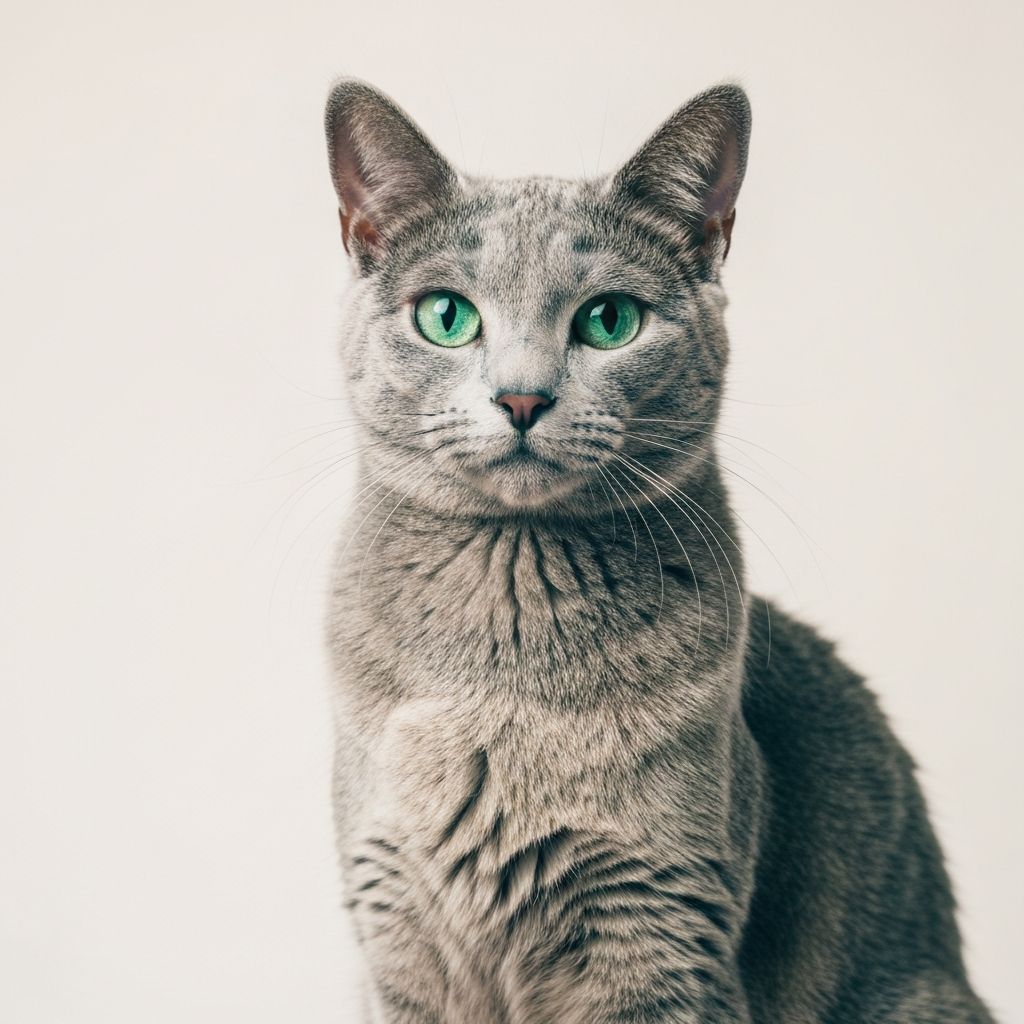
The Russian blue wears a coat dusted with silver, eyes like two emeralds, and a Mona Lisa smile. Your guests may go years without knowing it exists at all.
The Russian blue looks as if it had walked through the morning frost and carried a little of it on itself: its short, dense coat in the color of blue ash has silvery tips that shimmer with every movement. Added to this are eyes the color of a juicy emerald and gently raised corners of the mouth, through which it seems to wear an eternal, subtle Mona Lisa smile — no one quite knows what it means, and that, it seems, is exactly the point. There is, however, a certain catch: all this beauty only you will see. For guests the Russian blue can be a Schrödinger's cat — theoretically it exists, practically no one has ever seen it, because at the sound of the doorbell it dissolves into thin air faster than anyone can take off their shoes.
Its history begins where frost is an everyday matter: in Arkhangelsk, a port on the White Sea in the far north of Russia. It was from there that in the 19th century British sailors took these silver cats onto ships — and so the “Archangel cats” reached England, where they enchanted everyone from the first glance. In Russia itself an even more beautiful legend surrounded them: they were said to live at the tsar's court and keep watch by the cradles of the tsar's children, driving away evil spirits. And in modern times? Fans of the breed stubbornly point out that a certain famous cartoon cat — the one that for eighty years has been unsuccessfully chasing a certain mouse — wears fur in exactly the color of Russian blue. From the tsar's cradles to cinema chases: quite a decent career for a cat that cannot stand publicity.
Because at home the Russian blue is a precise and discreet being. It has an internal clock more accurate than your phone: dinner time is dinner time, and every delay is noted with a look that says more than many a report. It is a pedant of cleanliness — the litter box must gleam, or you will hear about it as a matter of urgency (though quietly, because it lodges even its complaints in a voice soft as silk). It adores playing fetch and can for hours analyze the flight of a feather with the seriousness of a chess player — as long as there is no audience. And when it sits on the windowsill in the sun, the silver on the tips of its fur turns it into a sculpture beside which it is hard to pass indifferently.
And here is the whole truth about this breed, which strangers take for shyness: the Russian blue is not shy. It is private. It keeps its feelings like family silver — not for show, not for everyone, exclusively for the household. To the world it remains a legend no one has seen; to you it is a cat that waits at the window every evening, greets you at the door with a quiet purr, and falls asleep at your side with that mysterious smile of its. All its affection, carefully hidden from the rest of the world, belongs in full to you. And that is a privilege you really do feel.
At the bowl this elegant minimalist has fairly concrete requirements — and one weakness:
- Protein at the level of 30–38% and fat 12–16% — these are the proportions that keep its slender, muscular silhouette in form
- The weakness: appetite. The Russian blue can eat beyond its needs and round out with grace — measured portions instead of a full bowl are with it an iron rule
- The urinary tract under protection: the breed has a predisposition to bladder stones, so wet food and constantly fresh water are daily prevention, not an add-on
- Routine at the bowl too: fixed feeding times are for this clockmaker cat an element of its sense of security
- Treats counted into the daily balance — it begs discreetly, but effectively
Beyond the bowl, the Russian blue is among the most gratifying cats to care for:
- Health: it is one of the healthiest and longest-lived breeds — with good care it can keep you company for 15–20 years
- Good news for allergy sufferers: Russian blues produce less of the allergen Fel d 1 than most cats — they are not fully “hypoallergenic,” but many allergic people tolerate them noticeably better
- Coat: short, double, practically maintenance-free — a brushing once a week more for pleasure than out of need
- Calm and predictability: noisy parties and chaos are not its climate — the more stable the home's rhythm, the bolder and happier the cat
- Play daily, but intimately: fetch, a feather, puzzles — this cat's intelligence likes to have occupation, only not necessarily an audience
Because the Russian blue is a rare luxury in times when everything is on display: a being that reserved all its beauty and all its heart exclusively for those closest to it.
And that famous smile of its? The world has spent a hundred and fifty years puzzling over what it actually means. You will know from the first evening: it means you have just come home.
Most common health issues
Excess body weight, which in cats increases the risk of diabetes, joint disease and heart disease. Portion control, regular play and monitoring the silhouette are key: the ribs should be palpable under gentle pressure, and the waist visible from above. After neutering, calorie needs drop, so portions should be recalculated.
A tendency to form deposits (stones, crystals) in the urinary tract, which can cause painful or difficult urination. Good hydration is most important: wet food, constant access to fresh water, sometimes a fountain. A diet supporting proper urine pH helps reduce recurrences - the choice is worth discussing with a vet.
Health issues
2 most common conditions
Health issues
2 most common conditions
Excess body weight, which in cats increases the risk of diabetes, joint disease and heart disease. Portion control, regular play and monitoring the silhouette are key: the ribs should be palpable under gentle pressure, and the waist visible from above. After neutering, calorie needs drop, so portions should be recalculated.
A tendency to form deposits (stones, crystals) in the urinary tract, which can cause painful or difficult urination. Good hydration is most important: wet food, constant access to fresh water, sometimes a fountain. A diet supporting proper urine pH helps reduce recurrences - the choice is worth discussing with a vet.
Nutritional needs
Cat hydration - why wet food matters
Cats naturally have a low thirst drive and often drink too little water. Their ancestors - desert cats - obtained water mainly from food. Wet food contains 70-80% water, which significantly supports hydration and helps prevent kidney and urinary tract problems.