Siberian
(Kot Syberyjski)
Origin: Russia (Siberia)
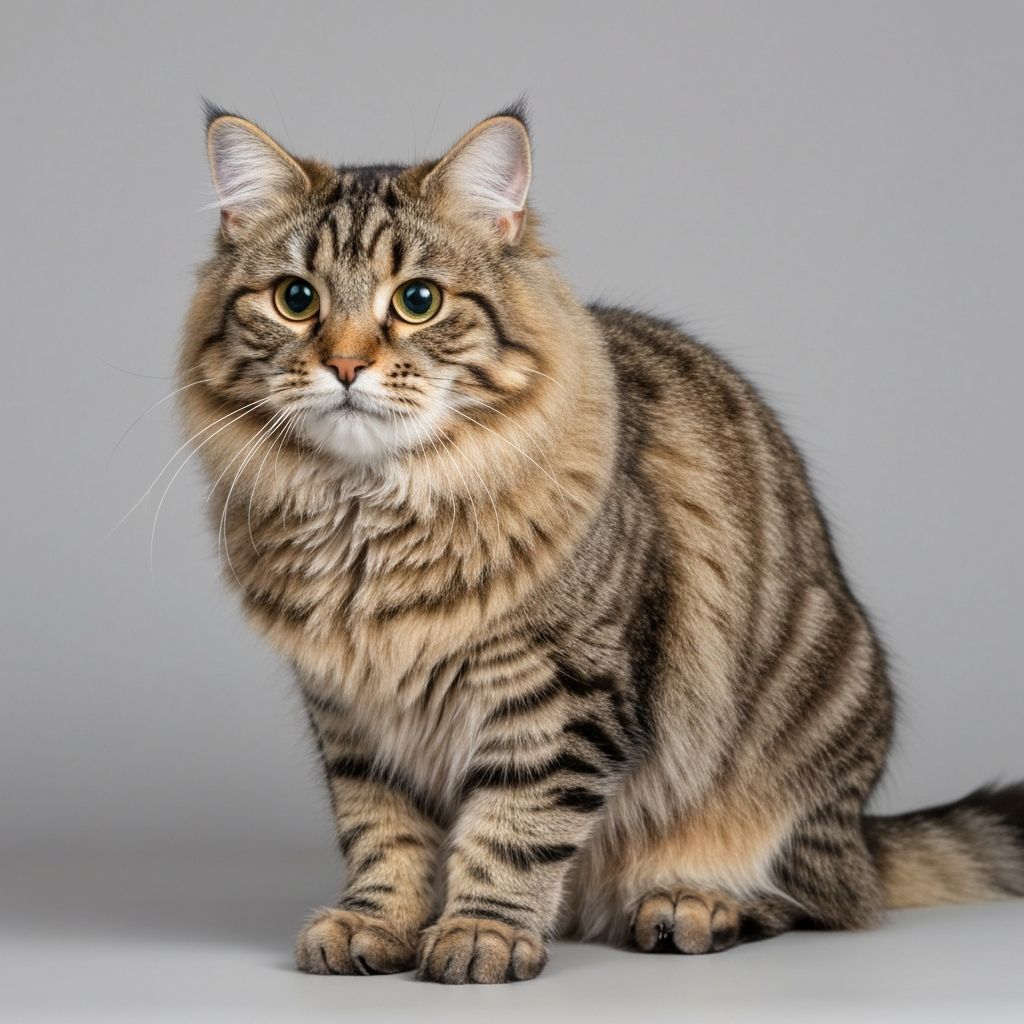
The Siberian cat survived winters beside which ours are a warm-up, wears the only triple coat in the world — and chose your sofa to live on. Siberia taught it to appreciate warmth.
The Siberian is the only cat in the world that wears a triple coat — and when you think about it, everything else in this breed suddenly makes sense. Three layers — down at the skin, a dense middle, a water-resistant top layer — as in an expedition jacket, except that nature tailored this model for several hundred years there where minus forty is an ordinary Wednesday. Added to this, a compact, powerfully muscled silhouette and a jumper's hind legs that carry it onto the wardrobe in one fluid movement — the Siberian does not measure twice. It measures once, jumps once, and always lands it. And the frost outside the window it observes from the windowsill with the expression of a veteran: it has been worse.
Because this breed pretends nothing — it really is from there. The Siberian is Russia's natural cat, mentioned for centuries: for generations it lived by huts and homesteads from the Urals to the taiga, guarding supplies against rodents and choosing its people on its own terms. Russian folk tales knew it perfectly — it is in them that Kot Bayun lives, an enormous storyteller cat that could lull wanderers to sleep with its voice; whoever has heard the evening, low purr of a Siberian knows that the tale-tellers made nothing up. And then history added to this cat a perverse finale: throughout the whole 20th century the West practically did not know it, because the Siberian sat on its own side of the Iron Curtain. It left Russia only after 1990 — and so Russia's oldest cat became the last great feline premiere of the century. The world waited for it longer than for many a treaty.
It was worth waiting, because the Siberian brought with it something that changed the lives of thousands of people: it was the one that became famous as the cat for allergy sufferers. Siberians usually produce noticeably less Fel d 1 — the main feline allergen — thanks to which many people who spent their whole lives sneezing through every visit to friends with a cat breathe normally around a Siberian. In fairness one must add: this is not a guarantee or full “hypoallergenicity” — the allergen level differs between cats, so before adoption it is best simply to spend some time with that particular cat and check on your own nose. But the fact itself remains beautiful: a cat from the harshest place in the world opened the doors of homes that had been closed to cats.
And inside those homes the Siberian turns out above all to be one thing: a cat that loves all the way. This is an almost dog-like loyalty, served with feline dignity — it chooses its people once and treats that choice deadly seriously. It knows the sound of your steps in the stairwell and waits at the door before the key reaches the lock. It follows you from room to room not because it wants something, but because where you are is its place. In the evening it lays its heavy, furry head on your lap and switches on that low, Bayun-like purr — a private lullaby that no one but you will hear. And when a cold catches you, it takes up the watch: it lies by you for hours, patient and warm, as if it knew that in the taiga no one is left alone. Gentle with children, politely curious toward guests, unshaken in household chaos like someone who has seen real storms. Siberia taught it one thing forever: warmth is the most precious currency in the world. And it pays it generously — to you, every day, without reserve.
At the bowl this triple-layered athlete has the needs of a large cat that carries its mass in muscle:
- Full-value animal protein in first place — those famous jumps and that vigor come from muscle, and muscle from good meat in the bowl
- It matures in the Siberian manner, that is, without haste: it reaches its full might only around the 5th year of life — a young Siberian needs a diet supporting long, gradual growth
- Portions to match high activity, but with control: this is a cat with an appetite worthy of its stature, and the triple coat masterfully masks the first roundings
- Omega-3 and omega-6 acids for the skin and that beautiful covering — its healthy shine begins in the bowl
- Fresh water always available, and wet food in rotation — a large body means large work for the kidneys
Beyond the bowl, it is worth knowing a few matters important for this breed:
- Heart: Siberians have a predisposition to hypertrophic cardiomyopathy (HCM) — periodic heart echo is a wise routine, and a lean silhouette is daily relief for the heart muscle
- Blood: pyruvate kinase (PK) deficiency, which can lead to anemia, occurs in the breed — a genetic test exists, and a responsible breeder has the parents' results at hand
- Coat: for most of the year surprisingly self-sufficient, but twice a year the Siberian changes its wardrobe almost entirely — in shedding seasons a daily brush is a necessity and a ritual
- Movement and heights: a jumper of this class needs levels — solid scratching posts, shelves, and windowsills with a view are its gym and observation point in one
- Play with the head: intelligent and agile, it adores fetch, puzzles, and shared “hunts” — ten minutes twice a day keeps body and spirit in form
Because the Siberian is a rare combination: strength that has nothing to prove, common sense tempered by the world's toughest school, and a heart that went through that whole school completely untouched.
In its coat it brought you three layers of Siberia. In its heart — not a single gram of its cold. There, there was always only warmth. And all of it is now yours.
Most common health issues
The most common heart disease in cats - the heart muscle thickens, making it harder to pump blood. It can be hereditary; a DNA test is available for some breeds. It remains asymptomatic for a long time, so periodic heart echo examinations at the vet are the best prevention. Maintaining a proper weight and good hydration relieve the circulatory system.
A hereditary deficiency of an enzyme important for red blood cells, which can lead to anemia (pallor, drowsiness, decline in condition). Detectable by a genetic test - which is why choosing a breeder who tests the parents is crucial. A complete diet supports overall condition, but the disease itself requires veterinary care.
Health issues
2 most common conditions
Health issues
2 most common conditions
The most common heart disease in cats - the heart muscle thickens, making it harder to pump blood. It can be hereditary; a DNA test is available for some breeds. It remains asymptomatic for a long time, so periodic heart echo examinations at the vet are the best prevention. Maintaining a proper weight and good hydration relieve the circulatory system.
A hereditary deficiency of an enzyme important for red blood cells, which can lead to anemia (pallor, drowsiness, decline in condition). Detectable by a genetic test - which is why choosing a breeder who tests the parents is crucial. A complete diet supports overall condition, but the disease itself requires veterinary care.
Nutritional needs
Cat hydration - why wet food matters
Cats naturally have a low thirst drive and often drink too little water. Their ancestors - desert cats - obtained water mainly from food. Wet food contains 70-80% water, which significantly supports hydration and helps prevent kidney and urinary tract problems.