Singapura
(Kot Singapurski)
Origin: Singapore
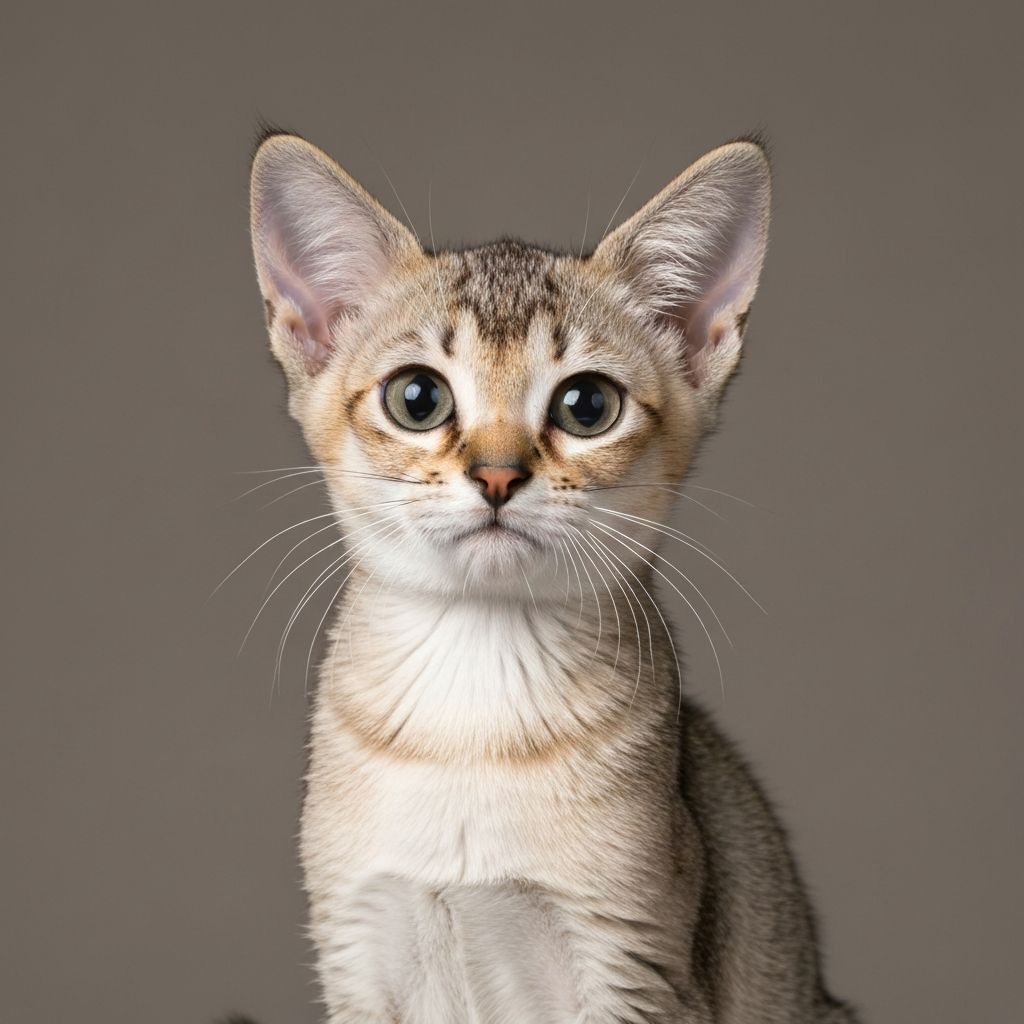
The Singapura is the smallest cat breed in the world: an adult will fit in the hood of your sweatshirt. But do not be fooled by the scale — it is a full-size personality of which nature reduced only the size.
The Singapura is the smallest cat breed in the world — an adult female can weigh as much as two bars of chocolate, and an adult human's hand holds it almost entirely. But you will make a mistake if you think you are getting a cat in reduction. The Singapura is a full-size feline personality of which nature reduced only the scale: the same temperament, the same self-confidence, and the same unlimited energy, only packed into a little body that will fit in the hood of your sweatshirt. That sepia-beige fur with dark ticking, the enormous eyes outlined as if with kohl, and the great, alert ears make the cat look like an astonished kitten all its life — and all its life it behaves like one.
Where a cat so small came from was for a long time the subject of a heated dispute — and its origin legend is one of the most perverse in the whole feline world. The official version holds that Singapuras are descendants of the street cats of Singapore, which survived in the city gutters and drainage canals — hence their local nickname kucing longkang, literally cats from the drains. That same small silhouette that today enchants at shows was said to have been born as a clever adaptation for hiding in the tight nooks of the street. The story is so beautiful that no one particularly minds that some researchers suspect the breed was actually recreated from cats brought back to Singapore — because true or not, one thing remains certain: the Singapura today looks like a refined jewel, though its roots lie in the toughest street school of survival.
And this street resourcefulness has remained in it to this day, except that it turned into unrestrained curiosity and mischief. The Singapura is nosy to a degree that shames cats twice its size: it must know everything, check every cabinet, climb onto the highest shelf, and personally supervise every activity in the home — ideally from your shoulder or the top of the fridge. It is agile, fast, and adores climbing, and its favorite place in the world is any point located higher than your head. It is also a cat that gravitates to people with disarming boldness: it jumps onto your lap, slides under your hand, and participates in everything, as if its small size imposed on it the obligation to make up for it with personality.
And beneath all this liveliness hides a heart that is far larger than the body containing it. The Singapura is deeply attached to its people and sincerely cannot stand being alone — this is a cat that wants to be by you constantly, nestled up, participating, present. It has a delicate, quiet little voice with which it gently demands attention, and a habit of wedging itself into every warmed crevice: under the duvet, behind the neck, onto the lap, as long as it is closer to warmth and closer to you. This breed is not suited to a home in which it would spend long hours in solitude — but for someone who wants a tiny, faithful companion for every moment by their side, the Singapura is literally ideal. You get the smallest cat in the world and one of the most devoted hearts a cat can offer.
Although the Singapura is tiny, its bowl is governed by the rules of a very serious, active cat:
- A small cat, big energy needs: despite its smallest size, the Singapura is extraordinarily active and needs a diet truly rich in protein (34–44%) and fats (16–22%) to keep up with its temperament
- Frequent, small meals: small breeds can be prone to hypoglycemia (drops in sugar level), which is why several smaller portions during the day are better for the Singapura than one large meal
- Quality above all: with such a small stomach, every bite must be valuable — good, meaty ingredients instead of fillers are a basic
- Fresh water always available, and wet food in the diet supports hydration and general condition
- Watch out for portions despite the energy: a small cat needs precisely measured food — it is easy both to overfeed and to underestimate the needs of such an active little one
Beyond the bowl, it is worth knowing a few matters important for this breed:
- Blood: Singapuras can be burdened with pyruvate kinase deficiency — an enzyme important for red blood cells, whose lack can lead to anemia; this is a disease detectable by a genetic test, so ask the breeder about the parents' examinations
- Reproduction: uterine inertia (atony) occurs in this breed, which is why the breeding of Singapuras should be left exclusively to experienced, responsible breeders under a vet's care
- Warmth is a necessity: a tiny body loses heat faster, so warmed beds, blankets, and access to sunny spots are not a luxury but a real need of this cat
- Movement and heights: despite its size it is a born climber and acrobat — scratching posts up to the ceiling, shelves, and safe high points are a condition of its happiness
- Company: the Singapura bears solitude very badly — if you are often away, a second gentle cat can be the best gift for it
Because the Singapura is the best proof that personality is not measured in kilograms. In this smallest of feline bodies fits the courage of a street survivor, the curiosity of an explorer, and a tenderness beside which many larger cats come off as reserved.
You will take it in your hand like a small, warm jewel — and after just a week you will realize that this tiny cat has taken up far more space in your life than it takes up on your lap. The greatest hearts really do sometimes come in the smallest packaging.
Most common health issues
A hereditary deficiency of an enzyme important for red blood cells, which can lead to anemia (pallor, drowsiness, decline in condition). Detectable by a genetic test - which is why choosing a breeder who tests the parents is crucial. A complete diet supports overall condition, but the disease itself requires veterinary care.
Weakening of uterine contractions during birth (atony), which in females of this breed can make natural birth difficult and require veterinary intervention. For this reason, breeding should be left solely to experienced breeders, under a doctor's care. For non-breeding females, spaying is the best solution.
Health issues
2 most common conditions
Health issues
2 most common conditions
A hereditary deficiency of an enzyme important for red blood cells, which can lead to anemia (pallor, drowsiness, decline in condition). Detectable by a genetic test - which is why choosing a breeder who tests the parents is crucial. A complete diet supports overall condition, but the disease itself requires veterinary care.
Weakening of uterine contractions during birth (atony), which in females of this breed can make natural birth difficult and require veterinary intervention. For this reason, breeding should be left solely to experienced breeders, under a doctor's care. For non-breeding females, spaying is the best solution.
Nutritional needs
Cat hydration - why wet food matters
Cats naturally have a low thirst drive and often drink too little water. Their ancestors - desert cats - obtained water mainly from food. Wet food contains 70-80% water, which significantly supports hydration and helps prevent kidney and urinary tract problems.