Somali
(Kot Somalijski)
Origin: USA
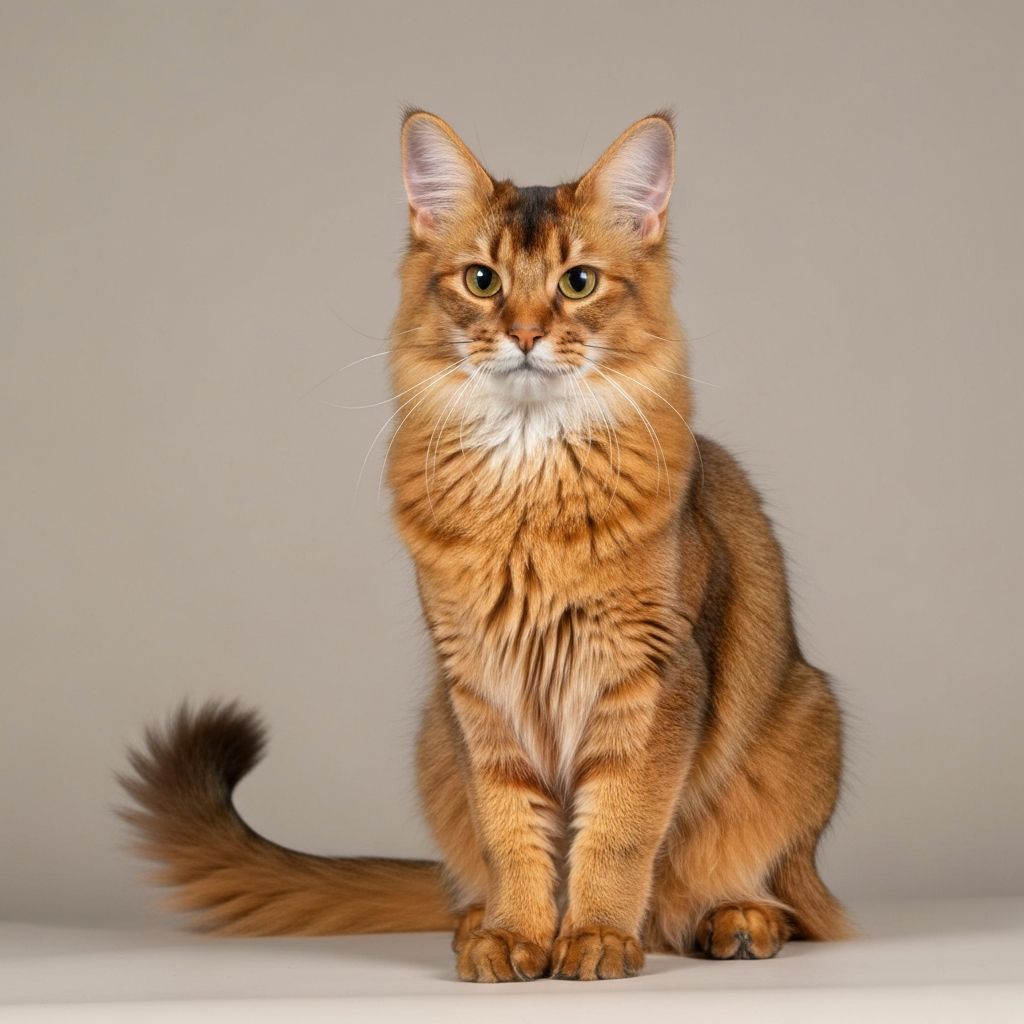
The Somali is the closest thing to a tame fox that exists: rusty, gleaming fur, a dark outline around the eyes, and a magnificent, bushy brush of a tail. Wild only in looks — inside, an affectionate accomplice.
The Somali is the only cat in the world that is regularly mistaken for a small, ginger fox — and it is by no means a groundless mistake. It has warm, rusty-golden fur, a dark outline around the large eyes like carefully applied makeup, a ruff on the neck, and above all that tail: dense, bushy, a magnificent fox's brush with which the cat conducts as with a baton. When the Somali slips across the room with that banner raised aloft, it really is hard to resist the impression that a scrap of wild forest has stolen into the living room. And then this forest sprite jumps onto your lap and begins to purr — and the whole spell turns into pure tenderness.
The secret of this fox-like beauty is brilliantly simple: the Somali is a long-haired Abyssinian. The breed was born from the same natural surprise as the Balinese from the Siamese — in litters of short-haired Abyssinians, kittens with longer, fluffy fur were born from time to time. Initially breeders treated them as an undesirable error and removed them from programs, until in the 1960s and 70s someone finally looked at these long-haired kittens differently and saw in them a separate, dazzling breed. It was named Somali — after Somalia, the neighbor of Abyssinia (old Ethiopia) — to underline that close kinship. Each single hair of the Somali has several bands of different colors (the phenomenon called ticking), thanks to which its fur shimmers and gleams in movement like that of a real wild animal.
Under this fox's gown, however, hides the soul of an untamed mischief-maker, because in character the Somali is one hundred percent Abyssinian: a force of nature, an acrobat, and an incorrigible curious one. It is one of the most active cats there are — a being in constant motion that must investigate everything, climb everywhere, and crack every closed mechanism. The Somali opens cabinets, turns taps, filches and hides shiny trinkets (it has deft, almost monkey-like little paws and likes to use them), and treats the highest shelf in the home as its rightful viewing terrace. It is at the same time brilliant and mischievous in a way that requires a partner to play with: this is a cat that does not want to be watched, but to co-create every mischief with you.
And here lies the crux of this breed: the Somali loves through shared action. It is not a passive cuddler that will lie through an afternoon on your lap — it is an accomplice that wants to be at the center of everything you do. Playing fetch, learning tricks, discovering the apartment together, following you step by step, and peering into every activity of yours — this is its love language. And since it needs company and occupation so much, it bears solitude and boredom badly: a Somali left alone for whole days begins to seek entertainment on its own, and its ideas can be costly for household order. This is a cat for someone who wants an active partner for years — ideally with a second lively cat for a pair, if the home often stands empty.
This fox-like athlete has at the bowl needs to match its enormous energy and its magnificent fur:
- Plenty of full-value protein (34–44%): this muscular, athletic silhouette without good protein loses muscle — the diet must keep up with its unceasing movement
- Omega-3 and omega-6 for the fox's brush: the dense, bushy tail and the long, ticked fur need good fats to shine and keep condition — this luster begins in the bowl
- Fuel for the very active: this is one of the most energetic breeds, one that really burns calories — the quality of the ingredients counts here more than in a calm couch dweller
- Fresh water always available, and wet food in the diet supports hydration and the work of the kidneys
- Play through food: dispensers and interactive toys with food are for this quick mind an ideal — they combine the meal with the longed-for hunt
Beyond the bowl, it is worth knowing a few matters important for this breed:
- Blood: like Abyssinians, Somalis can be burdened with pyruvate kinase deficiency — an enzyme important for red blood cells, whose lack can lead to anemia; this is a disease detectable by a genetic test, so ask the breeder about the parents' examinations
- Kidneys: the breed has a predisposition to renal amyloidosis (the deposition of amyloid protein) — regular blood and urine tests, and a diet supporting the kidneys, help you react early
- Coat: though long, it is silky and has little undercoat, so it rarely felts — combing two or three times a week is entirely enough, and in shedding season somewhat more often
- Movement and heights are a necessity: this acrobat must be given scratching posts up to the ceiling, shelves, and a climbing course — for the Somali, activity is not an option but a condition of balance
- A head for work: intelligent and sensitive, it needs company and challenges — a bored and lonely Somali is an unhappy cat
Because the Somali is a piece of living, ginger wilderness that agreed to live on your sofa: all the curiosity and all the energy of a wild little predator, packaged in fur beautiful as a fox's and served with a tenderness that clings to its human.
Give this forest sprite a world full of things to investigate and be its accomplice in every mischief — and that fox's tail will flicker at your side for long years, leading you straight to where it is always most interesting: into the middle of its little, sparkling world, of which you are the center.
Most common health issues
A hereditary deficiency of an enzyme important for red blood cells, which can lead to anemia (pallor, drowsiness, decline in condition). Detectable by a genetic test - which is why choosing a breeder who tests the parents is crucial. A complete diet supports overall condition, but the disease itself requires veterinary care.
A variant of amyloidosis in which the amyloid protein is deposited in the kidneys, gradually impairing their function. It can be hereditary. Regular blood and urine tests help catch the problem early, and a kidney-supporting diet (good hydration, phosphorus control) helps preserve their function longer.
Health issues
2 most common conditions
Health issues
2 most common conditions
A hereditary deficiency of an enzyme important for red blood cells, which can lead to anemia (pallor, drowsiness, decline in condition). Detectable by a genetic test - which is why choosing a breeder who tests the parents is crucial. A complete diet supports overall condition, but the disease itself requires veterinary care.
A variant of amyloidosis in which the amyloid protein is deposited in the kidneys, gradually impairing their function. It can be hereditary. Regular blood and urine tests help catch the problem early, and a kidney-supporting diet (good hydration, phosphorus control) helps preserve their function longer.
Nutritional needs
Cat hydration - why wet food matters
Cats naturally have a low thirst drive and often drink too little water. Their ancestors - desert cats - obtained water mainly from food. Wet food contains 70-80% water, which significantly supports hydration and helps prevent kidney and urinary tract problems.