Sphynx
(Sfinks)
Origin: Canada
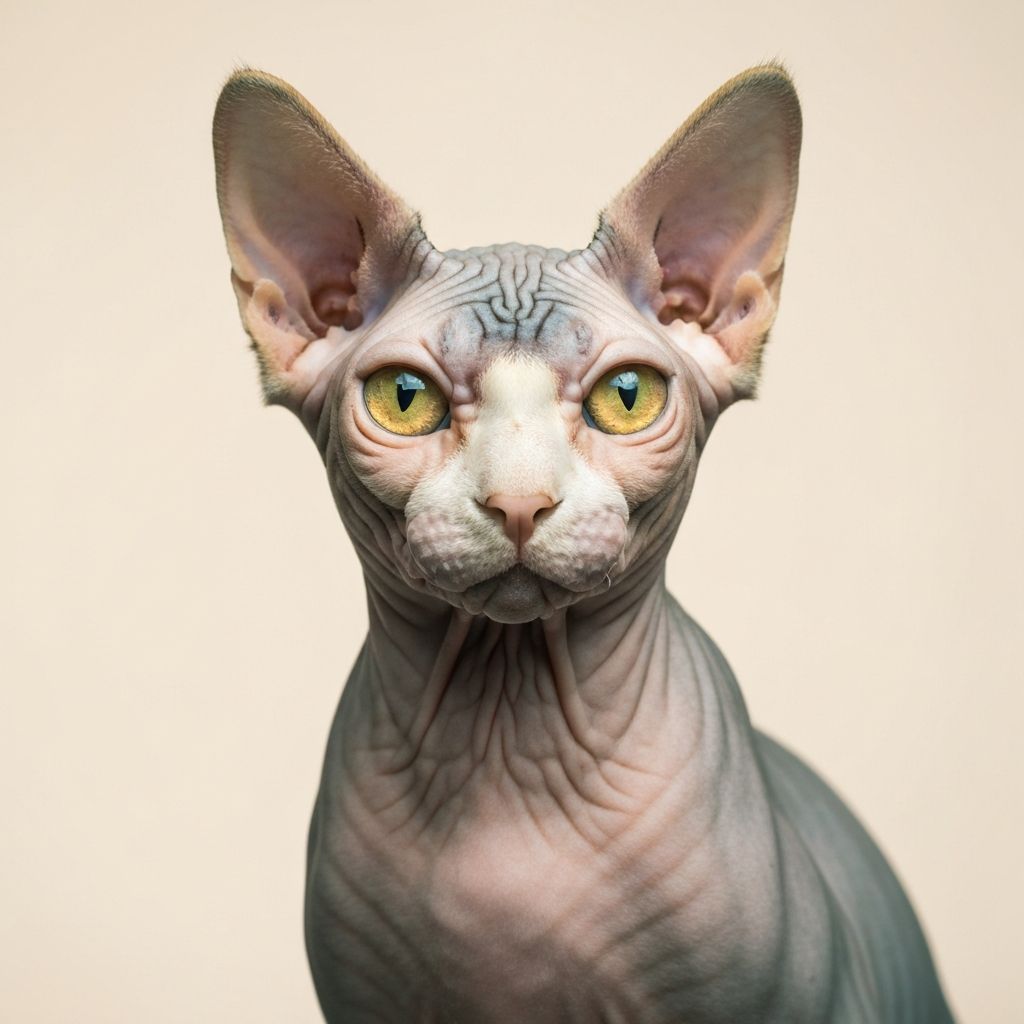
The Sphynx has no fur, so it makes up for it with temperature — literally and emotionally. It is the warmest cat in the world to the touch and one of the most affectionate overall.
The first contact with a Sphynx overturns two myths at once. Myth one: that it is cold and smooth like a statue. Nothing of the sort — to the touch it resembles a warm, suede peach, and the temperature of its skin surprises everyone who gives it a hand for the first time. Myth two: that it is haughty like its Egyptian name. Meanwhile the Sphynx throws itself into human company with an enthusiasm beside which many a dog looks reserved — it can settle on a guest's lap before the guest has managed to take off their coat. It looks like a wise, wrinkled old man from another era, and behaves like a preschooler after a birthday cake. And it is precisely this combination that it is loved for.
The name itself is, by the way, this breed's best joke: the most ancient-looking cat in the world is… a Canadian. The story began in 1966 in Toronto, where an ordinary house cat gave birth to an entirely bare kitten — it was named Prune, and it quickly turned out to be a natural mutation that could be preserved. Breeders refined the breed, and borrowed the name from the Egyptian sphinx, because those great ears, almond eyes, and statuesque silhouette looked as if they had stepped straight off a bas-relief. Except that no statue in history purred so loudly or crawled so decidedly under the duvet.
Because life with a Sphynx is life with a small, restless source of heat that knows perfectly where in the home it is warmest — and always gets there first. It knows the temperature of every appliance, every windowsill with sun, and every blanket. In the evening it goes under the duvet with the precision of a heat-seeking missile and settles skin to skin, because who needs distance. And during the day it is an acrobat and a clown in one: it climbs, jumps, chases toys, and performs on the carpet figures a gymnast would not be ashamed of — all with an expression full of seriousness that makes it even funnier.
And here is the thing that in this breed is the most touching: the Sphynx gave up its fur, so it has nothing to cover anything with. It carries all its feelings on the surface, just like its skin — it does not know the game of unavailability, does not measure out affection, does not make you beg. But that same nakedness makes it defenseless: against cold, drafts, and even the sun, which can burn its skin like a human's. The Sphynx is an exclusively indoor cat, one that in winter finds a little sweater and a warm bed useful, and in summer — shade and moderation. It gave up its coat. Now its coat is your home.
The most interesting thing, however, happens at the bowl, because the lack of fur has its energy cost — and a concrete one.
The Sphynx maintains its body temperature solely through its own metabolism, so it eats like a little furnace constantly feeding the fire:
- 25–30% more calories than an average cat of the same weight — this is not greed, it is heating costs
- Animal protein at a very high level (40–50% of the diet) — its fast metabolism burns first-quality fuel
- Several smaller meals a day instead of one large one — the furnace likes even stoking
- Omega-3 acids, which help regulate the work of the skin and the production of sebum
- Watch out for food allergies — in the Sphynx they show immediately, with the naked eye: reddening and blemishes on the skin are a signal to review the bowl (paradoxically this is its great advantage — other cats hide the problem under fur)
The skin is altogether its own separate chapter — without hair, which normally absorbs sebum, it requires regular servicing:
- A gentle bath or wiping down from time to time, because the oiling skin can leave marks on the bedding (and on you)
- Ears and claws: earwax and residue collect faster than in cats with fur — regular, gentle cleaning is a routine
- Heart: as in several breeds, the Sphynx has a predisposition to cardiomyopathy (HCM) — periodic heart echo at the vet is wise prevention
- Warmth in winter, shade in summer: a little sweater is not a whim, and a filter in the form of a curtain in a sunny window really makes sense
- Movement and company: this is a very active and very human cat — boredom and solitude harm it more than many a draft
Because the Sphynx is a cat that rejected everything that divides: fur, distance, feline haughtiness. What remains is warmth alone — the kind measurable with a thermometer, and the other kind, which nothing measures.
Touch it, and you will understand this whole breed in one second: where other cats have hair, it simply has warmth. And all of it is for you.
Most common health issues
The most common heart disease in cats - the heart muscle thickens, making it harder to pump blood. It can be hereditary; a DNA test is available for some breeds. It remains asymptomatic for a long time, so periodic heart echo examinations at the vet are the best prevention. Maintaining a proper weight and good hydration relieve the circulatory system.
A tendency to acne, irritation and fungal skin infections, common in breeds with a thin or hairless coat. Gentle, regular hygiene helps, as does a diet rich in omega-3 and omega-6 fatty acids that support the skin barrier. Recurring or severe lesions should be shown to a vet.
Health issues
2 most common conditions
Health issues
2 most common conditions
The most common heart disease in cats - the heart muscle thickens, making it harder to pump blood. It can be hereditary; a DNA test is available for some breeds. It remains asymptomatic for a long time, so periodic heart echo examinations at the vet are the best prevention. Maintaining a proper weight and good hydration relieve the circulatory system.
A tendency to acne, irritation and fungal skin infections, common in breeds with a thin or hairless coat. Gentle, regular hygiene helps, as does a diet rich in omega-3 and omega-6 fatty acids that support the skin barrier. Recurring or severe lesions should be shown to a vet.
Nutritional needs
Cat hydration - why wet food matters
Cats naturally have a low thirst drive and often drink too little water. Their ancestors - desert cats - obtained water mainly from food. Wet food contains 70-80% water, which significantly supports hydration and helps prevent kidney and urinary tract problems.