Tonkinese
(Kot Tonkijski)
Origin: USA/Canada
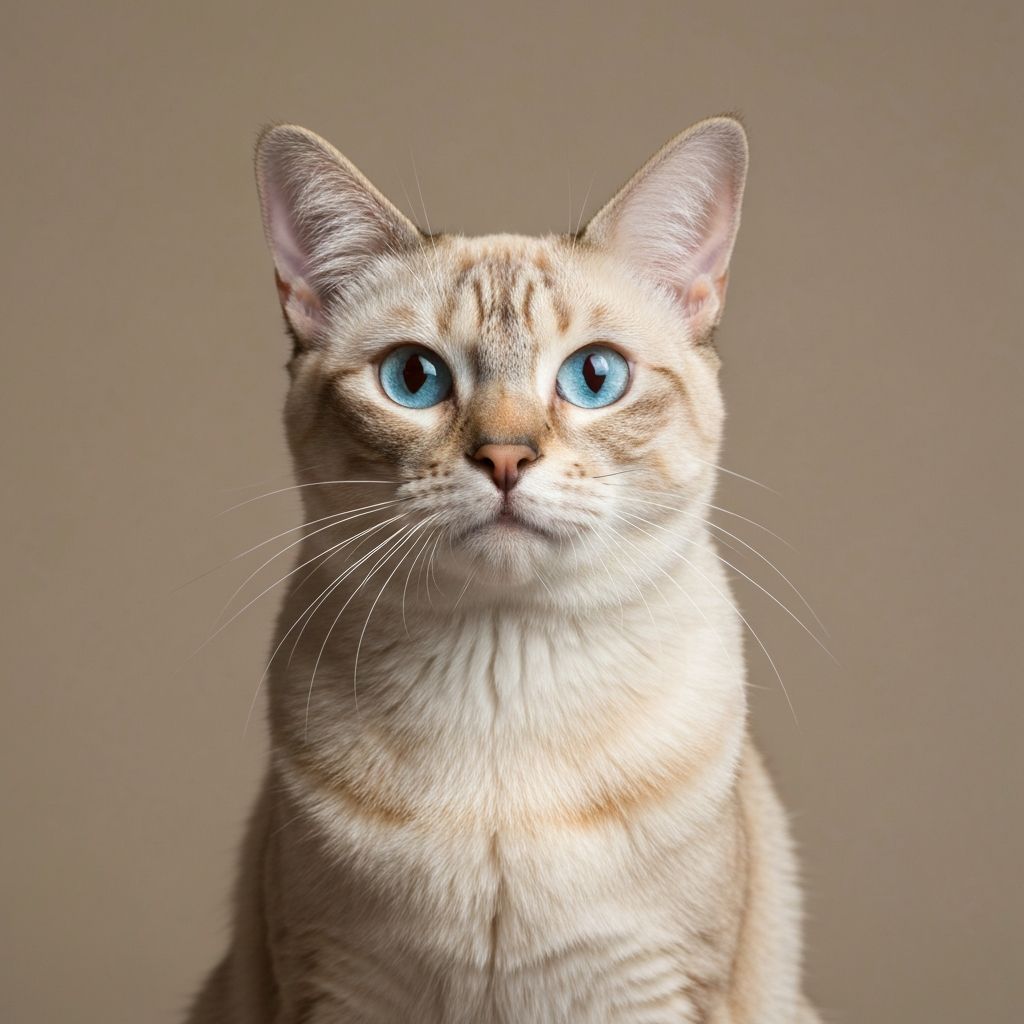
The Tonkinese looks like a gentle diplomat with aquamarine eyes, and is a born cunning one that wraps the whole house around its paw — and does it so charmingly that everyone lets themselves be fooled with joy.
The Tonkinese arose from a simple but brilliant idea: what if you took the two most loving cats in the world and combined in one the best of each of them? That is precisely how the Tonkinese was born — a cross of the Burmese with the Siamese, a consciously designed golden mean. It has an intermediate silhouette: not as massive as the Burmese and not as slimmed as the Siamese, but shapely and surprisingly heavy, because under the silky fur hides solid muscle. And above all this a pair of eyes in a color no other breed has: a luminous aquamarine, sea-blue with a green shimmer, that can stop you in your tracks.
This coloring has, moreover, its own charm and its own name. The Tonkinese most often occurs in the mink variety, in which the body has a warm, uniform tone, and the points on the face, ears, and paws are only delicately darker — as if someone had taken the sharp contrast of the Siamese and blurred it into a soft, coffee-colored half-shade. The breed was bred in North America in the 1960s, when breeders decided to fix this intermediate type into one harmonious cat — and gave it a name in honor of a region of Southeast Asia, underlining its eastern lineage. The Tonkinese is therefore not an accident of nature, but a consciously composed synthesis of two legends.
But the Tonkinese's true character is something you would not guess from its lineage: it is a born negotiator and a charming cunning one. This breed is famous for intelligence used not for talking, but for managing you — the Tonkinese learns that if it sits just so and looks with just that aquamarine gaze, it will get a treat; that a door handle can be opened if you jump up at the right angle; that the best way to get your attention is to sit exactly on the keyboard, mid-sentence. It greets guests at the door like a professional host, invites itself into every conversation, and with disarming self-confidence persuades the whole house that everything revolves around it — and the funniest part is that after a few days it actually does. Added to this is a weakness for carrying small objects in its mouth and setting up ambushes from behind the door frame: the Tonkinese does not want to be petted on the sofa, it wants to play out with you a game whose rules it invents on the fly.
And yet under all this craftiness hides a cat that sets all this cleverness in motion for one touching purpose: to be closer to you. Because the Tonkinese needs closeness as strongly as it needs movement. The Tonkinese is at your side a clever, cheerful companion — it will learn to play fetch, open doors, and climb onto the highest shelf — but above all it wants to be your shadow and confidant. It will jump onto your lap, wedge itself under the duvet, assist at work, and comment on your day, because for the Tonkinese there is nothing worse than solitude. Left alone for long, it authentically suffers, which is why it is a cat for someone who wants a real companion at home — ideally in a pair with a second cat if you are often away. In return you get a being that will love you with the intelligence of a Siamese and the tenderness of a Burmese at once.
This sociable athlete has at the bowl needs to match its energy:
- Plenty of full-value protein (32–42%): a shapely, muscular silhouette without good protein loses muscle — the diet must keep up with its lively temperament
- Fuel for the active: this is an energetic breed that really burns calories — the quality of ingredients counts here more than in a calm couch dweller
- Gum health under watch: Tonkinese can be prone to gingivitis, which is why it is worth relying on a diet and habits supporting the mouth, including regular tooth brushing
- Interactive feeding: dispensers and food toys excellently occupy this quick mind, combining the meal with the longed-for hunt
- Fresh water always available, and wet food in the diet supports hydration and general condition
Beyond the bowl, it is worth knowing a few matters important for this breed:
- Amyloidosis: as with both parents, Tonkinese have a predisposition to the deposition of amyloid protein in the organs — regular blood tests at the vet allow the problem to be caught early
- Gums and teeth: a tendency toward gingivitis makes oral hygiene and vet monitoring with this breed not an add-on but a basic of health
- Warmth and company: this is a warmth-loving and deeply attached cat — soft, warm beds and the presence of loved ones are for its wellbeing as important as a good bowl
- Movement and heights: a lively, intelligent Tonkinese must be given scratching posts up to the ceiling, shelves, and a play course — boredom is its real enemy
- A quick mind: learning tricks, puzzles, and shared play keep it in balance — a Tonkinese without occupation and company becomes unhappy
Because the Tonkinese is a rare proof that sometimes the synthesis is more perfect than the originals: it takes the talkative intelligence of the Siamese and the soft, devoted tenderness of the Burmese, subtracts the excess from both, and leaves you a cat perfectly balanced — clever, cheerful, and loving in just the right measure.
And that is the whole secret of the Tonkinese: you will let it win every little game — for a treat, for a place on the keyboard, for the last word — and in return it will give you the only stake it was really playing for from the start. Itself, whole, for the rest of its life. Besides, you have won anyway: whoever has a Tonkinese at home loses every day in the most pleasant possible way.
Most common health issues
A disease in which the amyloid protein is deposited in organs (in cats most often in the liver or kidneys), over time disrupting their function. It can be hereditary. Regular blood tests at the vet help catch the problem early, and good-quality, easily digestible nutrition supports the burdened organs.
A tendency to gum inflammation and periodontal disease, which if untreated lead to pain and tooth loss. Oral hygiene is the foundation: regular tooth brushing and food with a structure that supports their cleaning. It is worth including dental check-ups in routine visits.
Health issues
2 most common conditions
Health issues
2 most common conditions
A disease in which the amyloid protein is deposited in organs (in cats most often in the liver or kidneys), over time disrupting their function. It can be hereditary. Regular blood tests at the vet help catch the problem early, and good-quality, easily digestible nutrition supports the burdened organs.
A tendency to gum inflammation and periodontal disease, which if untreated lead to pain and tooth loss. Oral hygiene is the foundation: regular tooth brushing and food with a structure that supports their cleaning. It is worth including dental check-ups in routine visits.
Nutritional needs
Cat hydration - why wet food matters
Cats naturally have a low thirst drive and often drink too little water. Their ancestors - desert cats - obtained water mainly from food. Wet food contains 70-80% water, which significantly supports hydration and helps prevent kidney and urinary tract problems.