Turkish Angora
(Turecka Angora)
Origin: Turkey
From old Angora come a goat that gives mohair, a rabbit that gives wool, and a cat that gives nothing at all. The Turkish Angora is Europe's oldest longhaired cat, saved by Ankara Zoo: light, clever and devoted to one person.
From Ankara, which used to be called Angora, come three animals famous for their hair. The Angora goat gives mohair. The Angora rabbit gives the wool known simply as angora. The Angora cat gives nothing: no yarn, no jumper, no use whatsoever, unless you count the white hairs on every black garment in your wardrobe. The cat is of the opinion that, of the three, it made the best arrangement. It is hard to argue.
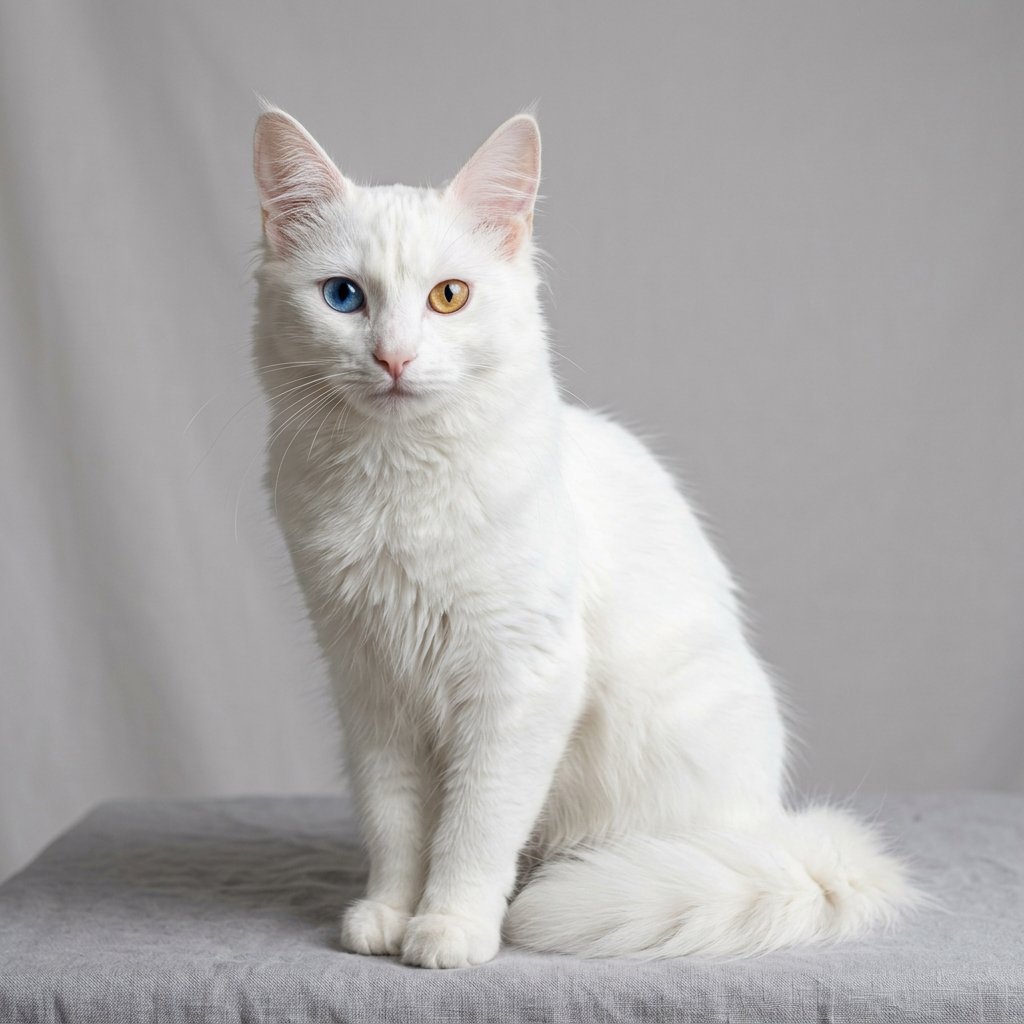
It is also the oldest longhaired cat Europe ever knew. As early as the sixteenth century Turkish sultans were sending white cats from Angora as gifts to European courts, and for the next three hundred years the word "angora" here simply meant a cat with long hair. Then Persians came into fashion. The Angora was used to create them, and by the early twentieth century the breed itself had almost vanished from Europe. It was saved by a zoo. Since 1917 the zoological garden in Ankara has run a breeding programme of white Angoras with blue, amber or odd-coloured eyes, and for a long time it did not let them leave the country. Only in 1963 was one pair allowed to go to the United States: a male named Yildiz and a female, Yildizcik, that is, Star and Little Star. This is probably the only domestic cat to have reached the world's sofas straight from a zoo.
The Angora is light in every sense of the word. It weighs three or four kilos, has fine bones, long legs, a tail carried like a plume and a silky coat with no undercoat that hardly ever mats. It travels around the flat by the upper route: along chair backs, bookshelves and door frames, and its favourite spot is usually somewhere you need a chair to reach. It is very bright and has a temper: it learns fast, gets bored fast and is quick to let you know when something does not suit it. It plays into old age. And out of the whole family it picks one person, whom it follows step for step and guards against the rest of the world, the other members of the household included.
The most famous Angora is white and has eyes of two colours, one blue, one amber. With one it judges you, with the other it forgives you. This beauty has a price, though, and you need to know about it. The gene that whitens the coat can also switch off hearing: among white cats with one blue eye about forty per cent are deaf, sometimes in one ear only: the one on the side of the blue eye. So the Angora is the only cat that may have a doctor's note for ignoring you. You never know whether it did not hear or did not see fit. Today Angoras are bred in every colour, and the coloured ones hear like any other cat. But people who live with a white one quickly learn one thing: to approach from the side it hears on. Not to startle it from behind. To tap the floor lightly before touching it. To switch on a light instead of calling. These are small things. And really this is the whole art of being with someone: knowing which side to approach them from.
At the bowl, one practical thing follows from this. A cat that cannot hear will not come running at the rattle of food, so you invite it to supper another way: always at the same time, in the same place, with the same gesture. An Angora learns this in a few days, and from then on it is the one keeping time while you are the one who is late. The rest is simple, because this is a light, lively cat with little tendency to put on weight.
In an Angora's bowl:
- A complete food with meat or fish as the first ingredient
- Omega fatty acids for skin and coat. With hair this fine and no undercoat, the quality of the food shows at once
- Measured portions split into several small meals. At three kilograms, even a small surplus makes a difference
- Fresh water and wet food in the daily diet
Beyond the bowl a few things are worth remembering:
- Hearing: white kittens are worth testing. A deaf cat lives a normal life, but strictly indoors, with a secured balcony and windows
- Coat: combing once or twice a week is enough, more often in summer so that it swallows less hair
- Heart: hypertrophic cardiomyopathy occurs in adult cats, so a periodic heart ultrasound makes sense
- Ataxia: an inherited disease of kittens occurs in the breed, showing as tremors and movement problems. Ask the breeder about the parents' tests
- Heights: shelves, a floor-to-ceiling scratching post and safe access to the top of the wardrobe. It will get up there anyway
After a few years you do all this without thinking. You enter the room from its good side. You tap your foot before sitting down beside it. You switch on a lamp when you want it to come.
It has long known, for that matter, which side to approach you from.
Most common health issues
In white cats, especially those with blue or odd-coloured eyes, the gene responsible for the white coat can cause congenital deafness in one or both ears. In odd-eyed cats the deaf ear is more often the one on the side of the blue eye. A kitten's hearing can be checked with a BAER test. A deaf cat lives a normal life but should be kept strictly indoors; diet has no influence on this trait.
The most common heart disease in cats - the heart muscle thickens, making it harder to pump blood. It can be hereditary; a DNA test is available for some breeds. It remains asymptomatic for a long time, so periodic heart echo examinations at the vet are the best prevention. Maintaining a proper weight and good hydration relieve the circulatory system.
An inherited disease described in Turkish Angora kittens, passed on recessively, which shows as tremors and impaired coordination of movement in the first weeks of life. A responsible breeder selects parents so as to avoid it. Diet has no influence on it.
Health issues
3 most common conditions
Health issues
3 most common conditions
In white cats, especially those with blue or odd-coloured eyes, the gene responsible for the white coat can cause congenital deafness in one or both ears. In odd-eyed cats the deaf ear is more often the one on the side of the blue eye. A kitten's hearing can be checked with a BAER test. A deaf cat lives a normal life but should be kept strictly indoors; diet has no influence on this trait.
The most common heart disease in cats - the heart muscle thickens, making it harder to pump blood. It can be hereditary; a DNA test is available for some breeds. It remains asymptomatic for a long time, so periodic heart echo examinations at the vet are the best prevention. Maintaining a proper weight and good hydration relieve the circulatory system.
An inherited disease described in Turkish Angora kittens, passed on recessively, which shows as tremors and impaired coordination of movement in the first weeks of life. A responsible breeder selects parents so as to avoid it. Diet has no influence on it.
Nutritional needs
Cat hydration - why wet food matters
Cats naturally have a low thirst drive and often drink too little water. Their ancestors - desert cats - obtained water mainly from food. Wet food contains 70-80% water, which significantly supports hydration and helps prevent kidney and urinary tract problems.