Miniature Pinscher
(Pinczer Miniaturowy)
Origin: Germany
Polish has done this dog an injustice with the saying “to tremble like a ratlerek”. The Miniature Pinscher fears nothing — and if it is shaking all over, it is from cold, from impatience, or because you have just come home.
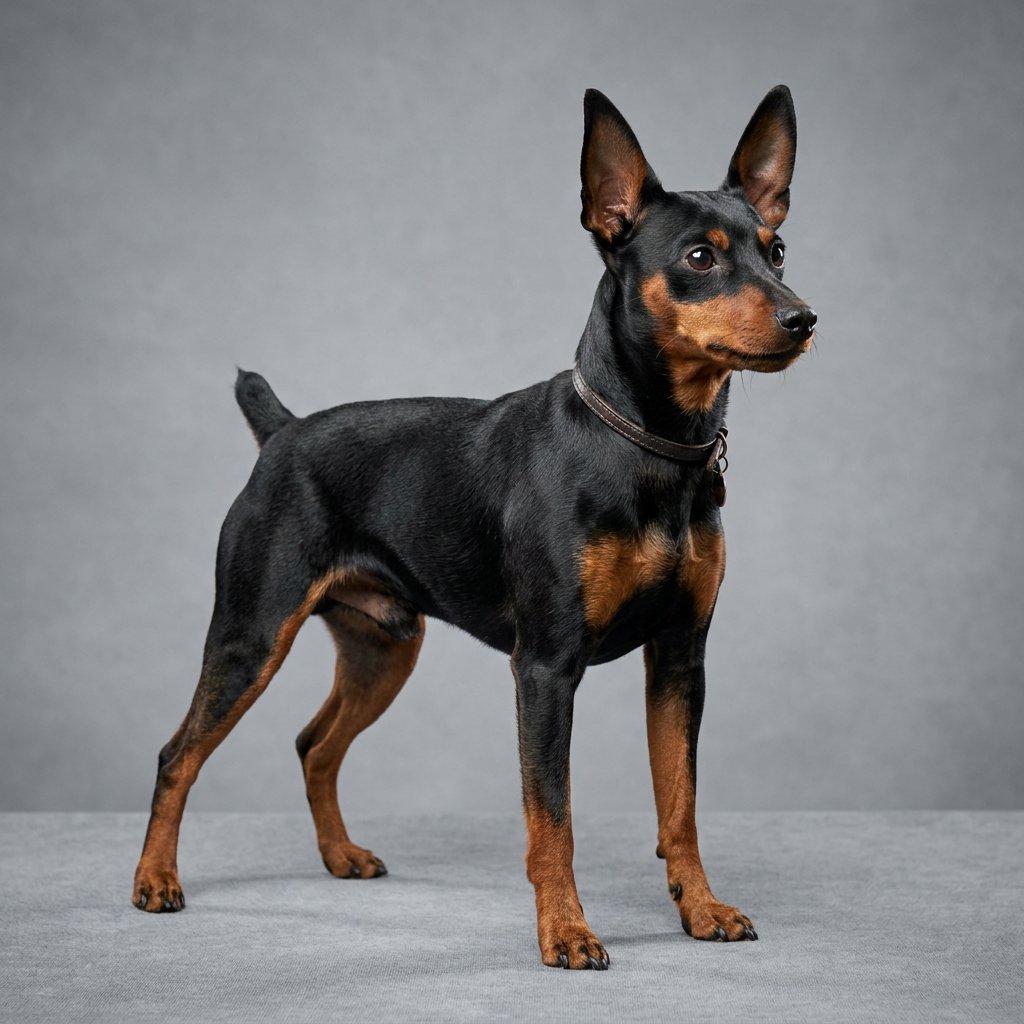
The Polish language has done this dog an injustice. “To tremble like a ratlerek” is what Poles say of someone who is afraid — and the ratlerek, the everyday Polish name for the Miniature Pinscher, is among the bravest creatures ever to weigh five kilos. Yes, it trembles. Just not from fear. It has a short, smooth coat with no undercoat, so it gets cold faster than you do in a thin jacket. Temperament does the rest: impatience before a walk, indignation at a pigeon, joy that you are reaching for the lead — all of that has to go somewhere, so it comes out as trembling. Nor is the word “ratlerek” itself an insult. It came from German and means, more or less, rat-catcher: it is a job title. And the breed standard describes the dog in four terms among which you will look in vain for “timid”: lively, spirited, self-assured and evenly tempered.
The second injustice is called “a small Doberman”. The resemblance is striking; it is just that the order is the other way round. Small pinschers were killing rats in German stables and farmyards long before Mr Louis Dobermann bred his first dog in 1890. So if anyone here resembles anyone, it is rather the Doberman that resembles the pinscher — only a good thirty kilos heavier. The Germans also called it the “Rehpinscher”, the roe-deer pinscher, because its red coat and thin, long legs reminded them of a little forest deer. Hence the third Polish nickname: sarenka, the little roe deer. Ratlerek, small Doberman, little deer. Three names and none of them its own. It doesn't mind in the slightest, because it has something no dictionary can take away: it knows perfectly well who it is.
And above all it is a dog for whom nothing is closed. A door left ajar for three seconds is an invitation. It inspects a fence metre by metre, like a building inspector, and always finds a defect. A gap you couldn't slide your hand into turns out to be just right for a pinscher. Everything that enters the house has to be checked personally: the shopping bag, the inside of the cupboard, the contents of the bin. It takes a squeaky toy apart faster than you can brew a cup of tea, because the only thing that interests it is whatever was squeaking. After a working day like that it is owed some sun: it lies down in a bright patch on the floor and moves along with it all afternoon, centimetre by centimetre, like the hand of a sundial. And in the evening it goes under your duvet — head first, without asking — and settles in the crook of your knees. It is warm there. There, at last, there is no need to tremble.
That leaves the matter of that saying. A Miniature Pinscher does not tremble at the vacuum cleaner, at a thunderstorm, or at a courier carrying a parcel bigger than itself. There is, however, one situation in which this fearless dog really does tremble — all over, from nose to the tip of its tail — and it has nothing to do with the cold. It happens every time you appear in the doorway. After eight hours or after eight minutes, it makes no difference. That much joy simply doesn't fit into five kilograms, so it has to come out somehow. If anyone has ever trembled like that at the sight of you, you know there is no shame in it. It is a compliment.
The trembling is, incidentally, behind the most common mistake at the bowl. The dog shakes, the human feels sorry for it — and adds more food. But you don't feed a trembling pinscher; you dress it. This breed puts on weight easily, and the excess is then carried by the same thin, deer-like legs whose knees and hips are its weakest point.
So a few simple rules apply at the bowl:
- A portion measured on kitchen scales, to the gram. For a five-kilo dog, a few pieces of kibble over the limit each day make a clear difference over a year
- Good-quality animal protein: this is a small athlete that is on the move all day, and its muscles need something to work with
- Treats cut into tiny pieces and counted into the daily allowance — with its stubbornness, training takes a while, so a lot of rewards get used
- Small kibble and a daily toothbrush, because tartar builds up quickly in a small mouth
- A bin with a lid: whatever is interesting goes into its mouth, and whatever goes into its mouth usually gets swallowed
Beyond the bowl, a few things typical of the breed are worth knowing:
- Knees and hips: luxating patella occurs, as does Legg-Calvé-Perthes disease, a necrosis of the head of the thigh bone in young dogs. Any lameness in a hind leg is a reason to see the vet
- DNA test: a rare hereditary disease, mucopolysaccharidosis type VI, occurs in the breed. A responsible breeder tests the parents and shows the results without being asked
- Eyes: progressive retinal atrophy can be hereditary, so it is worth asking about eye examinations too
- Cold: a coat that covers the chest and belly is compulsory winter equipment, not a whim
- Escapes: a secure fence, a lead whenever a door is open, and medicines and small objects kept out of reach of its mouth
Ratlerek, small Doberman, little deer. The Polish language gave it three names, all of them borrowed, and it will not take a single one back. Only you can put that right — with one word.
You will choose it after a long family council. It will be short, it will collect five pet versions within a week, and it will never make it into any dictionary. But that is the one it will tear across the whole flat for, skidding on the corner, to stand in front of you and tremble from ears to tail.
Someone watching from the side will say: “Oh, a ratlerek. Look at it shaking.” It has simply heard its own name.
See also: Doberman Pinscher, Chihuahua, Jack Russell Terrier
Most common health issues
The kneecap slipping out of its proper groove, causing the knee to momentarily "skip" or lock. Very common in small and miniature breeds. A symptom can be periodic tucking-up of a hind leg while running and sudden, brief lameness. A lean build takes pressure off the joints, while supporting the cartilage with omega-3 fatty acids and the right calcium level promote knee stability.
Aseptic necrosis of the femoral head due to blood-supply disturbances, typical of young dogs of small breeds. It leads to hip pain and increasing lameness of one hind leg. Keeping a low body weight eases the joint, while supporting the cartilage with omega-3 fatty acids aids recovery.
A rare hereditary disease in which the body lacks an enzyme that breaks down certain complex sugars; the excess builds up in the tissues. In young dogs it shows as growth problems, changes in the bones and joints, and clouding of the cornea. A DNA test exists, so the key is choosing a breeder who tests the parents. Diet does not cure it, but a lean body takes the load off the affected joints.
A hereditary eye disease in which the retina gradually loses function, leading to worsening eyesight — first after dark. It doesn't hurt, so the first sign is often the dog's uncertainty in the dark and bumping into objects. Antioxidants and omega-3 fatty acids support eye health (though they don't stop the disease); keeping the furniture in fixed positions at home helps.
Excess body weight that strains the joints and heart and increases the risk of diabetes and metabolic disorders. In some breeds, such as the Labrador, the tendency to gain weight can even be genetically determined. It's worth checking regularly whether the ribs are easily felt and whether the waist is visible from above. Portion control, weighing the food, and daily exercise are the most effective prevention.
Health issues
5 most common conditions
Health issues
5 most common conditions
The kneecap slipping out of its proper groove, causing the knee to momentarily "skip" or lock. Very common in small and miniature breeds. A symptom can be periodic tucking-up of a hind leg while running and sudden, brief lameness. A lean build takes pressure off the joints, while supporting the cartilage with omega-3 fatty acids and the right calcium level promote knee stability.
Aseptic necrosis of the femoral head due to blood-supply disturbances, typical of young dogs of small breeds. It leads to hip pain and increasing lameness of one hind leg. Keeping a low body weight eases the joint, while supporting the cartilage with omega-3 fatty acids aids recovery.
A rare hereditary disease in which the body lacks an enzyme that breaks down certain complex sugars; the excess builds up in the tissues. In young dogs it shows as growth problems, changes in the bones and joints, and clouding of the cornea. A DNA test exists, so the key is choosing a breeder who tests the parents. Diet does not cure it, but a lean body takes the load off the affected joints.
A hereditary eye disease in which the retina gradually loses function, leading to worsening eyesight — first after dark. It doesn't hurt, so the first sign is often the dog's uncertainty in the dark and bumping into objects. Antioxidants and omega-3 fatty acids support eye health (though they don't stop the disease); keeping the furniture in fixed positions at home helps.
Excess body weight that strains the joints and heart and increases the risk of diabetes and metabolic disorders. In some breeds, such as the Labrador, the tendency to gain weight can even be genetically determined. It's worth checking regularly whether the ribs are easily felt and whether the waist is visible from above. Portion control, weighing the food, and daily exercise are the most effective prevention.
Nutritional needs
Proper hydration for your dog
Proper hydration is essential for a dog's health. Dogs need constant access to fresh water, especially on hot days and after physical activity. Wet food can serve as an additional source of fluids.