Mixed Breed Dog
(Mieszaniec / Kundelek)
Origin: Worldwide
The mixed-breed dog has no pedigree — but it has something no pedigree can provide: it is the only dog of its kind in the whole world, an unrepeatable original that nature created in one, single copy.
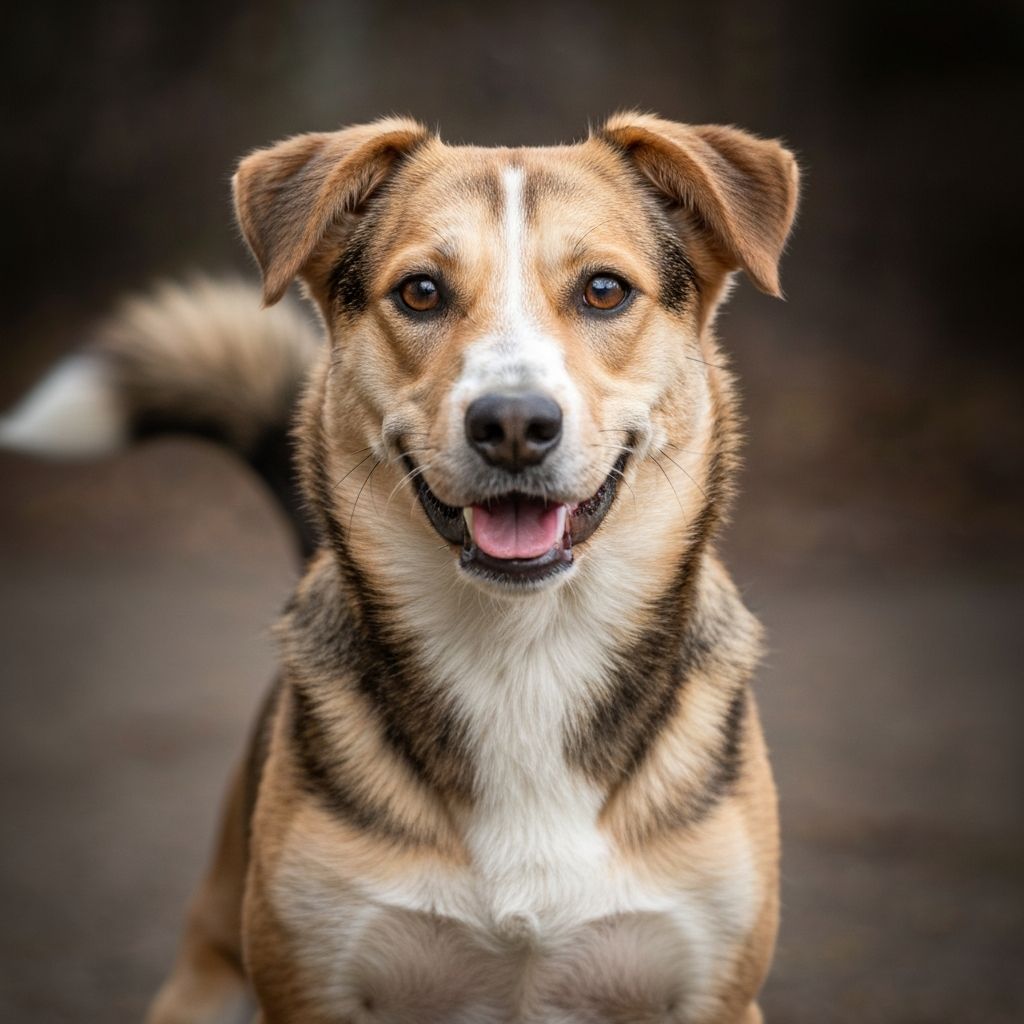
You will not find another dog like it in the whole world. Not because it is rare — because it is the only one. The mixed-breed dog does not come with a pedigree or a list of ancestors reaching generations back, but it gets something no breeder can guarantee: absolute, one-hundred-percent unrepeatability. Every mixed-breed dog is a completely original blend — ears as if borrowed from one great-grandfather, a tail from a wholly different tale, and a character you will not find in any breed standard, because such a standard simply does not exist. It is a dog created by nature in one, single copy, without a backup and without the possibility of reprinting. And it is precisely in this that its first, quiet secret lies: to love a mixed-breed dog is to love someone absolutely one of a kind.
Life with a mixed-breed dog therefore has in it a note of constant surprise. The question “and what breed is it?”, which comes up on every walk, has finally received the only sensible answer: “yes.” Because a mixed-breed dog can be everything at once and nothing in particular, and a visit to the vet can turn into a social guessing game from which no one emerges victorious. On top of this, nature, when assembling a mixed-breed dog, apparently worked in an excellent mood and without an instruction manual: it happens that one ear stands up and the other firmly refuses to cooperate, that the legs come from three different designs, and the coloring looks as if someone painted it with their eyes closed — and all of this together adds up to a dog more beautiful than many a show champion. A real adventure can also be adopting a puppy “that surely will not grow big,” and watching how in a few months it turns into a strapping fellow the size of a small pony. But there is not a gram of mistake in this. The mixed-breed dog is a model available in one copy in the world — a luxury that no breeder, even the most expensive, can afford.
And yet the most important thing about a mixed-breed dog is not at all how it looks or which ancestors it descends from. The most important thing is that a huge number of these dogs are waiting somewhere at this very moment — in shelters, in foundations, in foster homes — for one single thing: for their human. And there is probably no dog in the world that would love more strongly than one that got a second chance. Because a mixed-breed dog from adoption seems to understand perfectly what has just happened. You can see it in that first, shy wag of the tail, in the gaze that asks “really? me? I'm staying?”, in that gratitude that cannot be faked and that is not forgotten to the end of a life. Such a dog does not need a pedigree to become the most faithful friend you have ever had — it needs only for someone to look at it once and say “come, I'm taking you home.” And once it hears that, it gives in return its whole heart: without reserve, forever, and without any conditions.
Since every mixed-breed dog is different, its feeding is best tailored to that one, particular dog:
- A diet matched to its size, age, and activity — a small, mobile mixed-breed dog is fed differently than a large, calm giant, and a senior differently still
- A good-quality, full-value food is the foundation — mixed-breed dogs often enjoy strong health, but they too function best on valuable food
- Weight control and a lean silhouette — this is the simplest gift you can give its joints and heart, regardless of its build
- Observation of individual needs — if your mixed-breed dog has a sensitive stomach, a tendency to allergies, or its own preferences, the diet should simply follow it
The health of a mixed-breed dog is, moreover, one of its most beautiful advantages — though here too it is worth staying vigilant:
- Hybrid vigor: thanks to great genetic diversity, mixed-breed dogs can be exceptionally healthy and resilient, less often inheriting the burdens typical of purebreds
- This does not, however, exempt one from prevention: regular vet visits, vaccinations, deworming, and basic examinations are just as important as with any other dog
- It is worth getting to know its type: if in appearance it resembles a particular breed, it is good to know which ailments to pay special attention to in it
- Movement, grooming, and attentiveness matched to its size and coat are the best investment in its long, cheerful life
In a mixed-breed dog, as through a lens, one simple truth is visible: a dog's value has nothing to do with papers. Because love, faithfulness, and gratitude do not need a pedigree — and the hearts of these dogs can be bigger than many a prize from a show. It is a dog that does not expect much: a bit of food, a warm corner, a few shared walks, and the certainty that it is home. And in return it gives something that cannot be bought for any money.
Somewhere right now — maybe a few streets away, maybe in a shelter on the outskirts of town — a dog is waiting that does not yet know it is yours. A dog without a pedigree, without a certain past, and with no idea how its fate will turn out. It has, in return, a whole, still-unused heart, ready to love someone as strongly as only a dog can. If you give it a chance, it will repay you with years of unconditional love and become what so many people later say with a tightened throat: the best dog they ever had. Because a mixed-breed dog is not a “worse” dog without papers. A mixed-breed dog is simply a one-of-a-kind friend — who is waiting precisely for you. All you have to do is reach out your hand for it.
Most common health issues
Mixed-breed dogs generally enjoy better health than purebreds thanks to their genetic diversity (so-called hybrid vigor).
Health issues
1 most common condition
Health issues
1 most common condition
Mixed-breed dogs generally enjoy better health than purebreds thanks to their genetic diversity (so-called hybrid vigor).
Nutritional needs
Proper hydration for your dog
Proper hydration is essential for a dog's health. Dogs need constant access to fresh water, especially on hot days and after physical activity. Wet food can serve as an additional source of fluids.