Thai Ridgeback
Origin: Thailand
The Thai Ridgeback kept its original type because for centuries there was no easy way into eastern Thailand. Today it lives eight thousand kilometres away, complains about the weather and sticks with its own people.
Bad roads saved the Thai Ridgeback. That is not an anecdote but the official version: in its description of the breed, the Fédération Cynologique Internationale states that it kept its original type because transport in eastern Thailand was too poor for other dogs to get there. In Poland people talk about bad roads a great deal, and never kindly. In Thailand they owe a dog to them.
The oldest Thai records of it are about three hundred and sixty years old. All that time it did the same things in the same few provinces: it kept watch, escorted carts and saw to its own dinner. The Thais call it the dog with a saddle on its back, and for a long time they had it entirely to themselves. The first dogs did not reach America until 1994.
For three hundred and sixty years it never left its province, and when it finally did, it went straight to the other end of the world. Today it lies on a sofa in Poland, more than eight thousand kilometres from home, and behaves exactly like anyone who has moved abroad: it complains about the weather, sticks with its own people and regards the locals with polite reserve.
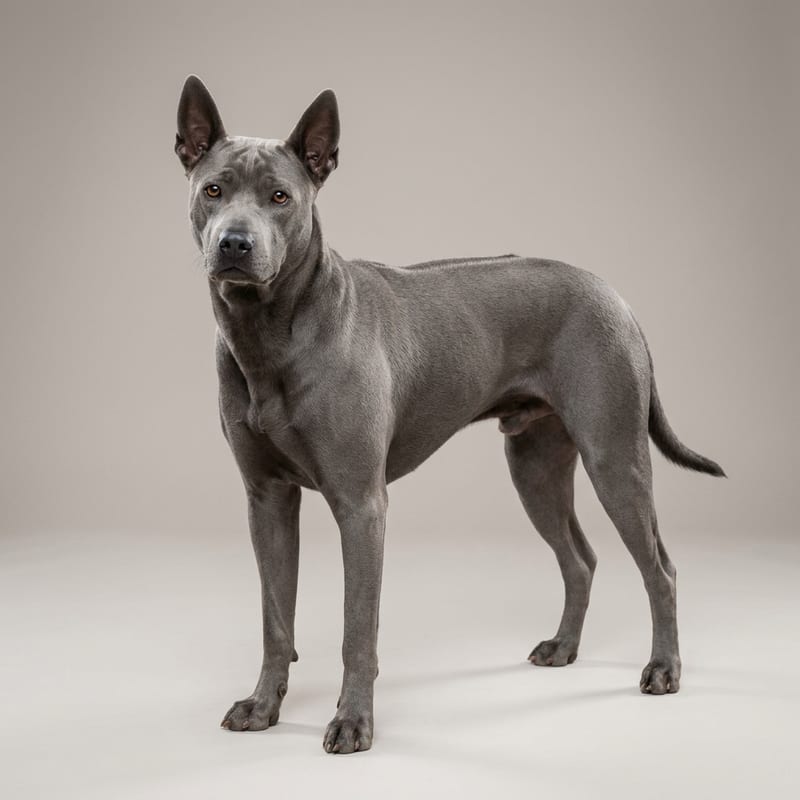
Let us start with the weather, because that is where it starts every day between October and April. It has a short coat with no undercoat, cut for a region where the average temperature over the year is about twenty-eight degrees. The Polish norm is just under nine. When sleet is falling it stops in the doorway, looks at it, then at you, and in that look is the question known to everyone who ever left home to earn a living elsewhere: what did I need this for. It accepts a coat without enthusiasm but also without argument; it has thought the matter through and would rather look silly than be cold. A walk in that weather it handles like business at a government office: quickly, to the point and with no unnecessary pleasantries. You will learn that the heating season has begun from the dog, not from the building manager.
It sticks with its own people, which means you. A Thai Ridgeback bonds with one household, often most strongly with one person, and closes the list there. It neither barks at guests nor greets them. It sits where it can see both them and you, and behaves like someone who does not yet speak the language: politely, attentively and promising nothing. It has been getting to know the neighbour across the landing for three years and has still not reached a decision. That is why a puppy has to be introduced to people and places early and calmly, and an adult dog should not be pushed into friendliness. It is neither timid nor bad-tempered. It is simply not from round here.
Like anyone who for generations relied only on itself, it is more resourceful than necessary. The federation, characterising it in two sentences, fitted jumping ability into the first and loyalty only into the second. It jumps from a standstill, climbs and is known for its escapes, so judge your fence by its measure, not yours. It needs at least an hour of proper exercise a day and something for its mind to do, and a lead anywhere that is not fenced, because it takes anything small and running personally. A wish to please is foreign to it. It listens when it sees the sense in a request, and gets on best with someone who has already had a dog with opinions of its own.
It arrived, like many before it, with what it had on its back. In its case that is literal: along the spine runs a strip of hair growing in the opposite direction to the rest. Breeders distinguish eight shapes of this ridge and named them like the contents of a very strange suitcase: needle, feather, arrow, leaf, bowling pin, lute, violin and saddle. The Rhodesian Ridgeback of southern Africa carries the same entry in its DNA, and geneticists have established that both inherited it from a common ancestor. Who wandered to whom, nobody knows. In this family, leaving home is an old tradition.
There is one thing in its new country it does not criticise: the food. Here a little more reserve would be welcome, because in winter it cuts its own walks to the bare minimum while the bowl stays the same. This is a dog made of muscle and it should stay that way: ribs you can feel under your hand, a clear waist. Hip dysplasia occurs in the breed, and every surplus kilo loads precisely those hips.
What that means for the bowl:
- A portion worked out from the dog's weight, not from the name of the breed. A bitch usually weighs 16–25 kg, a dog 23–34 kg, so two Thai Ridgebacks may need quite different amounts
- Less exercise in winter means less in the bowl. Weigh the dog in autumn and at the end of winter; if it has gained, cut the portion rather than waiting for spring
- Two meals a day for an adult, two or three for a puppy
- Puppy food until the end of the first year, then food for adult dogs
The rest in brief:
- Dermoid sinus: a congenital defect along the line of the back, linked to the ridge gene. The breeder should check every puppy for it and tell you the result
- Hips: ask for the X-ray results of both parents
- Cold: a coat for chill and rain, a bed away from draughts
- A tongue with dark patches: it looks as if the dog has been picking bilberries, and in this breed it is entirely normal
- Coat: one brushing a week and a bath a few times a year. In that respect you could hardly find a cheaper lodger
Not being from round here is simpler than it seems. It has no old acquaintances here and nobody in reserve, so everything it has to give it brings to one address. That is why it does not spread itself thin. It does not need strangers, because it already has its own people, and it treats them with the seriousness of someone who crossed half the world for them.
You will see it one evening, in the sleet, a hundred metres from home. The lead will tighten and it will be the dog pulling you. Yes, partly because of the weather. But a dog saved by bad roads is known by this: there is one it knows by heart.
On those hundred metres it is already a local.
Most common health issues
A congenital defect in which a narrow tube leads from the surface of the back into the deeper tissues, sometimes as far as the area of the spine; it becomes infected easily. It is linked to the same duplication of a stretch of DNA that gives the breed its ridge. Breeders check every puppy for it by touch, and treatment is surgical. Diet has no effect on it.
A congenital abnormality in which the head of the femur does not fit perfectly into the socket, over time leading to joint degeneration and pain. It mainly affects large and giant breeds, though it can occur in small ones too. Watch for reluctance to jump, a "bunny-hopping" gait, and stiffness after rest. A lean build and controlled exercise take pressure off the hips, while omega-3 fatty acids support the cartilage.
Health issues
2 most common conditions
Health issues
2 most common conditions
A congenital defect in which a narrow tube leads from the surface of the back into the deeper tissues, sometimes as far as the area of the spine; it becomes infected easily. It is linked to the same duplication of a stretch of DNA that gives the breed its ridge. Breeders check every puppy for it by touch, and treatment is surgical. Diet has no effect on it.
A congenital abnormality in which the head of the femur does not fit perfectly into the socket, over time leading to joint degeneration and pain. It mainly affects large and giant breeds, though it can occur in small ones too. Watch for reluctance to jump, a "bunny-hopping" gait, and stiffness after rest. A lean build and controlled exercise take pressure off the hips, while omega-3 fatty acids support the cartilage.
Nutritional needs
Proper hydration for your dog
Proper hydration is essential for a dog's health. Dogs need constant access to fresh water, especially on hot days and after physical activity. Wet food can serve as an additional source of fluids.