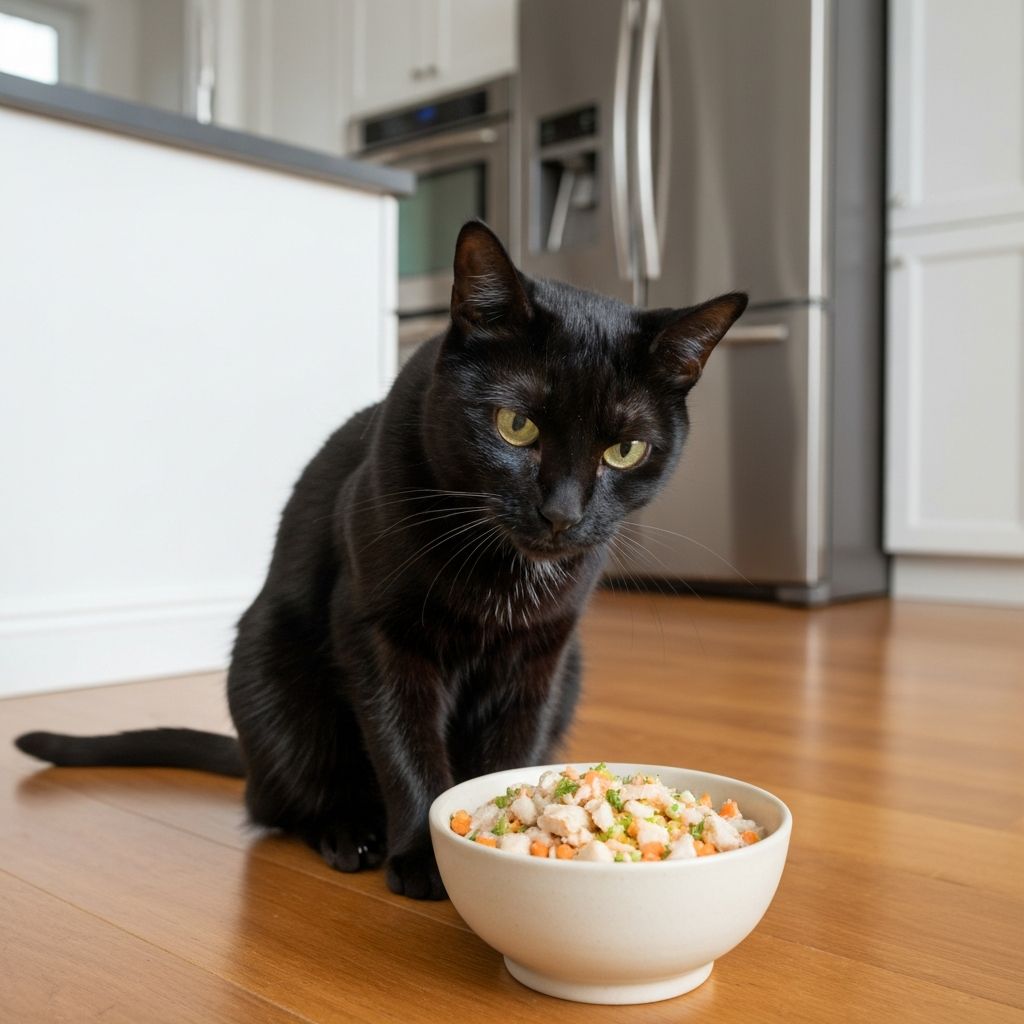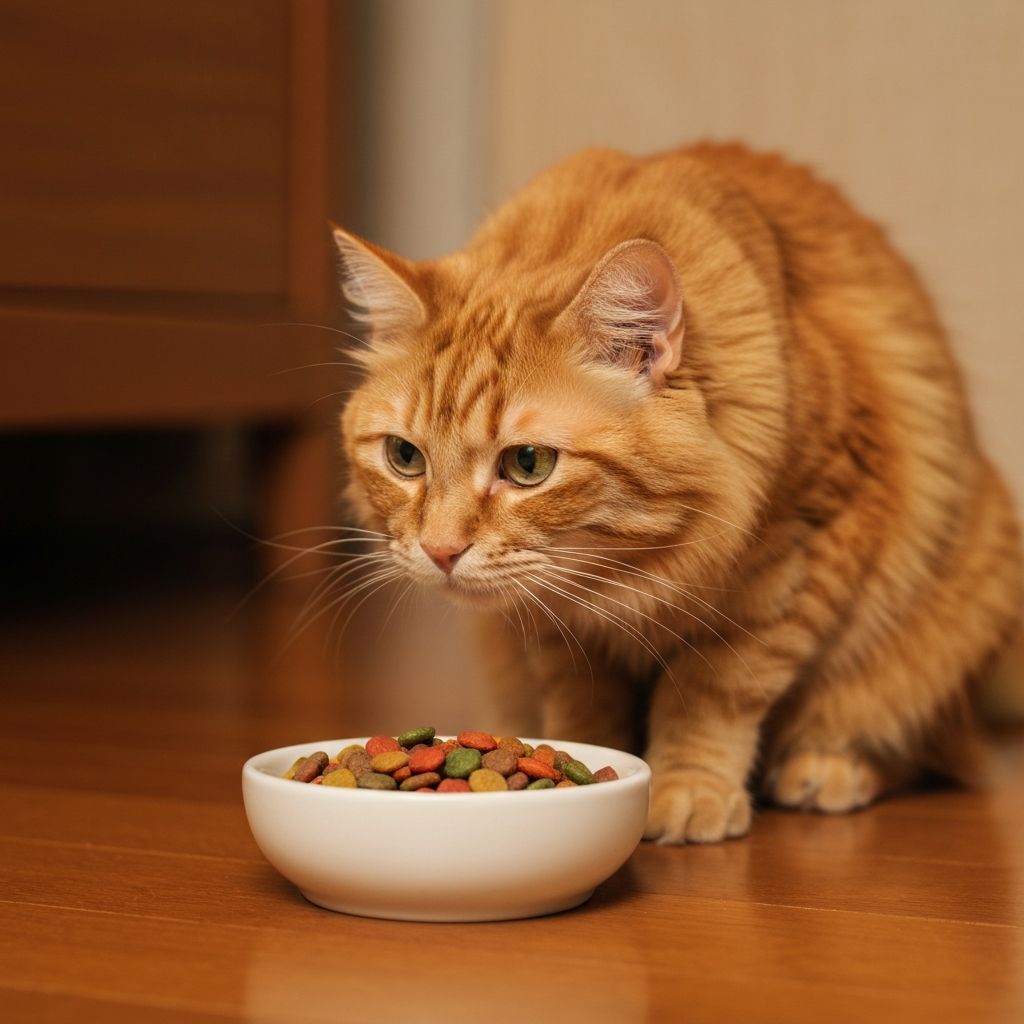
You bought twenty-four pouches. Because last week he ate that food with such enthusiasm that you thought you had finally cracked it.
Today he walks up to the bowl. Sniffs. Looks at you. Looks at the bowl. Scrapes the floor beside it with his paw — that characteristic gesture which in cat language means exactly what you think it means. And walks away.
Twenty-three pouches.
Before you start searching the internet for "how to make a cat eat", I have good news: it isn't malice and it isn't your failure. It is the biology of a species that domesticated itself on its own terms and kept far more from the process than the dog did.
But there is also something that has to be said at the beginning, not the end — because everything else depends on it.
First, the most important thing: when it isn't fussiness
A cat that hasn't eaten for 24 hours is urgent. A cat that hasn't eaten for 48 hours is a matter for the vet — immediately.
The reason is called hepatic lipidosis. In a cat deprived of food, the body starts rapidly mobilising fat from its reserves, and the feline liver can't cope with processing it. Fat builds up in the liver cells and starts to damage the organ. The process is fast, and the heavier the cat, the faster — paradoxically, overweight cats are most at risk.
A dog can fast for a few days and be fine. A cat can't. It is one of those differences that make general "pet advice" guides dangerous.
So: if your cat has suddenly stopped eating and was eating normally before — don't wait for it to get hungry. Especially if there are other changes: hiding, no interest in its surroundings, drooling, a change in the smell of its breath, weight loss.
Only once you have ruled out a health problem can we talk about fussiness.
Where it comes from: the cat is an obligate carnivore
The dog is an omnivore with a leaning towards meat. He can live on a diet containing grains, vegetables and meat in sensible proportions. Over some thousands of years alongside humans he even acquired extra copies of the gene responsible for digesting starch.
The cat didn't. The cat remained an obligate carnivore — which is not a marketing label but a description of physiology.
Specifically, it means that a cat:
- doesn't produce enough taurine — an amino acid whose deficiency leads to heart disease and retinal degeneration. It has to get it from animal food;
- doesn't efficiently convert beta-carotene into vitamin A — it needs ready-made vitamin A, which occurs in animal tissue;
- doesn't synthesise arachidonic acid from plant precursors;
- needs clearly more protein than a dog — and animal protein at that.
This isn't a matter of preference. A cat on a plant-based diet gets ill — and that is one of the few sentences in animal nutrition about which there is no scientific dispute.
This biology translates directly into what happens at the bowl. A cat that rejects a food does so with a sensory apparatus specialised in one thing: judging whether what is in front of it is fresh meat.
The four senses a cat judges food with — and none of them is taste
Smell decides everything
A cat has about 200 million scent receptors. A human has some five million.
The "eat / don't eat" decision is made before the cat touches the food. Sniffing isn't a prelude to the meal — it is the meal at the assessment stage. If the smell doesn't pass, there is no second chance, even if the food is top of the ranking.
Hence something that surprises many owners: a cat with a cold stops eating. Not because its throat hurts, but because it can no longer smell the food. To a cat, an odourless bowl is an empty bowl.
Taste — surprisingly weak, and missing one category
A cat has about 470 taste buds. A dog has 1,700, a human about 9,000.
But more interesting than the number is what is missing from the set: a cat can't taste sweetness. The gene responsible for the sweet taste receptor is non-functional in felids — a change from the deep evolutionary past of a species that for millions of years had no need to detect sugars, because there were none in its diet.
The practical conclusion: a "tasty" food with added sugar or sweet fillers is no more attractive to a cat. It is more attractive to you, when you read the description on the pack.
A cat does, however, have an exceptionally well-developed sensitivity to bitterness — which makes sense in a predator, because in nature a bitter taste often means a toxin or spoiled meat.
Texture — a cat has an opinion on the shape of a kibble
This is a category owners almost never consider, and it is sometimes decisive.
A cat forms texture preferences — pâté, mousse, chunks in gravy, chunks in jelly, crunchy kibble, small kibble, flat kibble. And it can consistently reject one form while accepting another from the same brand with an almost identical composition.
It isn't a whim. Sensation around the mouth and the whiskers gives a cat information about its prey — and the structure of the food is part of that.
Temperature — 38 degrees, the body temperature of prey
A cat prefers food at a temperature close to the body temperature of freshly caught prey. Food straight from the fridge falls, for a cat, into the category "this has been lying here a long time and is probably bad".
It is the simplest and most often overlooked fix in this whole subject. A pouch taken out of the fridge and served at once is often the only reason for refusal.
Neophobia and neophilia: a cat wants novelty but is afraid of it
Here we come to the paradox that explains the story of the twenty-four pouches.
Cats show two contradictory tendencies at once:
Food neophobia — distrust of new food. In a wild cat it is a protective mechanism: unknown food may be poisonous, so better leave it alone. That is why a sudden change of food so often ends in refusal.
Food neophilia — weariness with the same taste and an attraction to change. That makes evolutionary sense too: a predator feeding on just one kind of prey risks deficiencies, so it pays to have a built-in motivation for variety.
These two forces operate alternately, not simultaneously. And that is the answer to why a cat adored a food for three weeks and in the fourth turned away from it looking offended.
It hasn't gone mad. It has moved from the phase "this is known and safe" to the phase "same thing for a month, let's look for something else".
What follows in practice
Sticking rigidly to one food for years has a side effect: the cat becomes more and more fussy, because neophobia grows towards everything that isn't that one familiar product. And when that food one day goes out of production, or you need to move to a veterinary diet, you have a real problem.
Kittens that got to know different flavours and textures in kittenhood (roughly between the 4th and 8th week of life) are clearly less fussy as adults.
Rotation within reason — a few tried-and-tested foods in a cycle instead of one for five years — works as prevention.
Eight things you can change today
| Problem | What to do |
|---|---|
| Food straight from the fridge | Warm it to room temperature, ideally slightly above. A hand placed against the bowl shouldn't feel cold |
| Bowl by a wall or in a corner | Move it so the cat eats with its back to the wall and a view of the room. A predator doesn't eat with its back to open space |
| Bowl next to the litter tray | Move it. To a cat this is so obvious it's odd it needs writing down — and yet it happens often |
| Deep, narrow bowl | Change to a flat, wide one. Narrow sides irritate the whiskers — a phenomenon known as "whisker fatigue" |
| Food bowl next to the water bowl | Separate them. In nature a cat doesn't drink beside its prey — water next to a carcass is suspect |
| Food stands out all day | Wet food loses its smell within 20–30 minutes. Serve smaller portions more often and take away leftovers |
| Changing food overnight | Spread it over 7–10 days, starting with 10% new food. Slower for cats than for dogs |
| One food for years | Introduce a rotation of 2–3 tried-and-tested products before it becomes a necessity |
What not to do
Don't starve a cat "until it gets hungry". That advice works on dogs and can kill a cat. See: hepatic lipidosis, the first section of this article.
Don't keep adding ever more attractive extras to get it to eat. A cat quickly learns that refusal leads to a better offer — and starts negotiating. Two weeks later you are eating dinner and the cat is standing beside you with a look that says "I know you've got chicken there".
Don't change the food at every refusal. If the cat refuses once and otherwise behaves normally, wait until the next meal. If it refuses consistently for a day — then react.
Don't feed a cat table food as the solution. Onion, garlic, chocolate and xylitol are toxic to cats, and most human food is simply badly balanced. Besides, the negotiation problem comes back.
When fussiness is a symptom, not character
It is worth knowing the line beyond which "my cat has character" ends and "my cat has a problem" begins.
Go to the vet, not the pet shop, if:
- the cat hasn't eaten for 24 hours (and with an overweight cat — all the more urgently),
- it refuses food suddenly, with no change of food or surroundings,
- it is losing weight although you think it eats normally,
- it drools, tilts its head when eating, drops mouthfuls — that can be tooth or gum pain,
- there is also vomiting, diarrhoea, apathy or hiding,
- it drinks clearly more than usual,
- it is an older cat whose appetite has changed over a few weeks.
Kidney disease, hyperthyroidism and oral disease are common in cats, and all three can begin with what looks like fussiness.
A cat is not a small dog
If you were to remember one sentence from this article, let it be this one.
A different physiology, a different set of senses, a different pace of reaction to fasting, a different need for taurine, a different sensitivity to temperature and texture. Feeding advice written "for pets" can be not just ineffective for a cat but dangerous.
And the fussiness that drives you to despair at twenty-three pouches? It isn't a flaw. It is the same assessment apparatus thanks to which its ancestors ate nothing spoiled for several million years.
It is just now aimed at a product off the shelf which — let's be honest — sometimes deserves that assessment.
Want to check whether your cat's food really contains what it should? The Purrtner ranking rates the composition of cat foods on meat content, protein and taurine — and the calculator works out the daily portion for your cat, taking age, neutering and activity into account.
How to choose the food itself is covered in our guide to the best cat food.