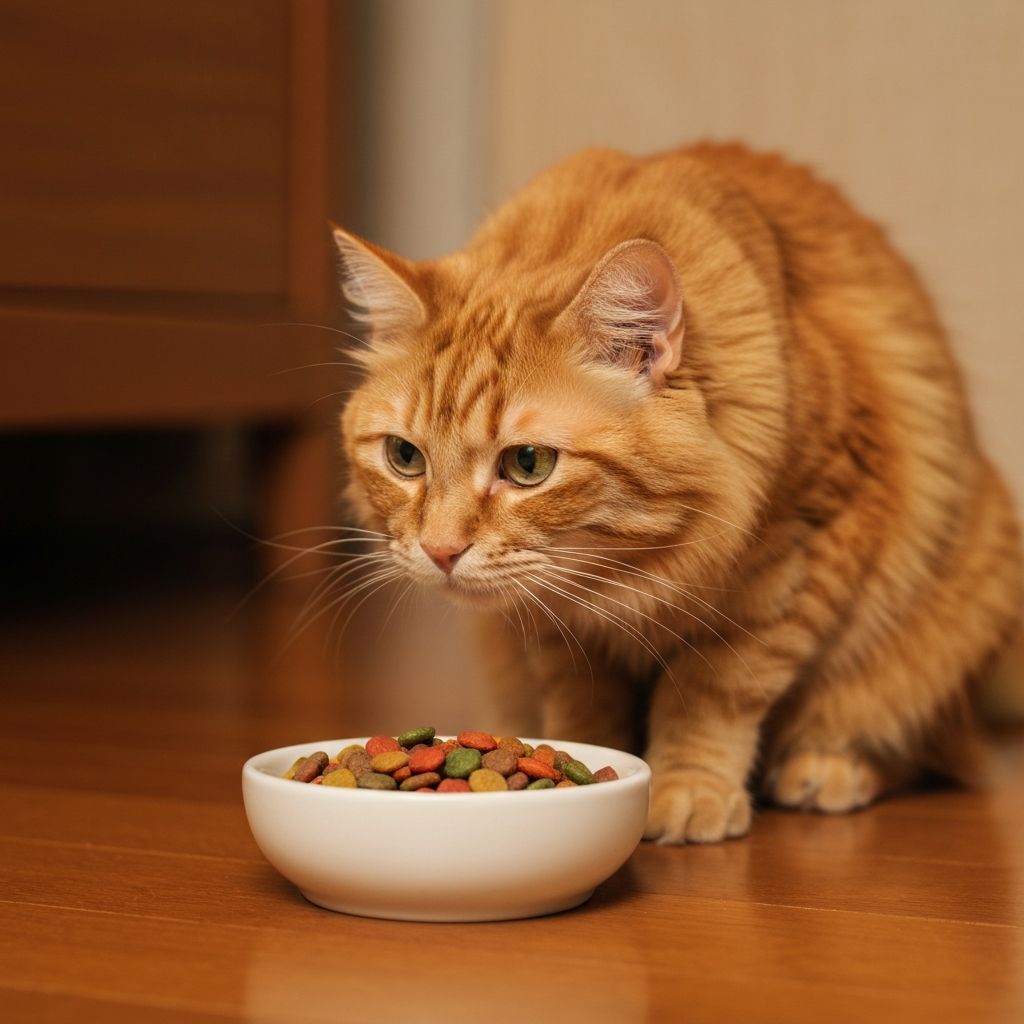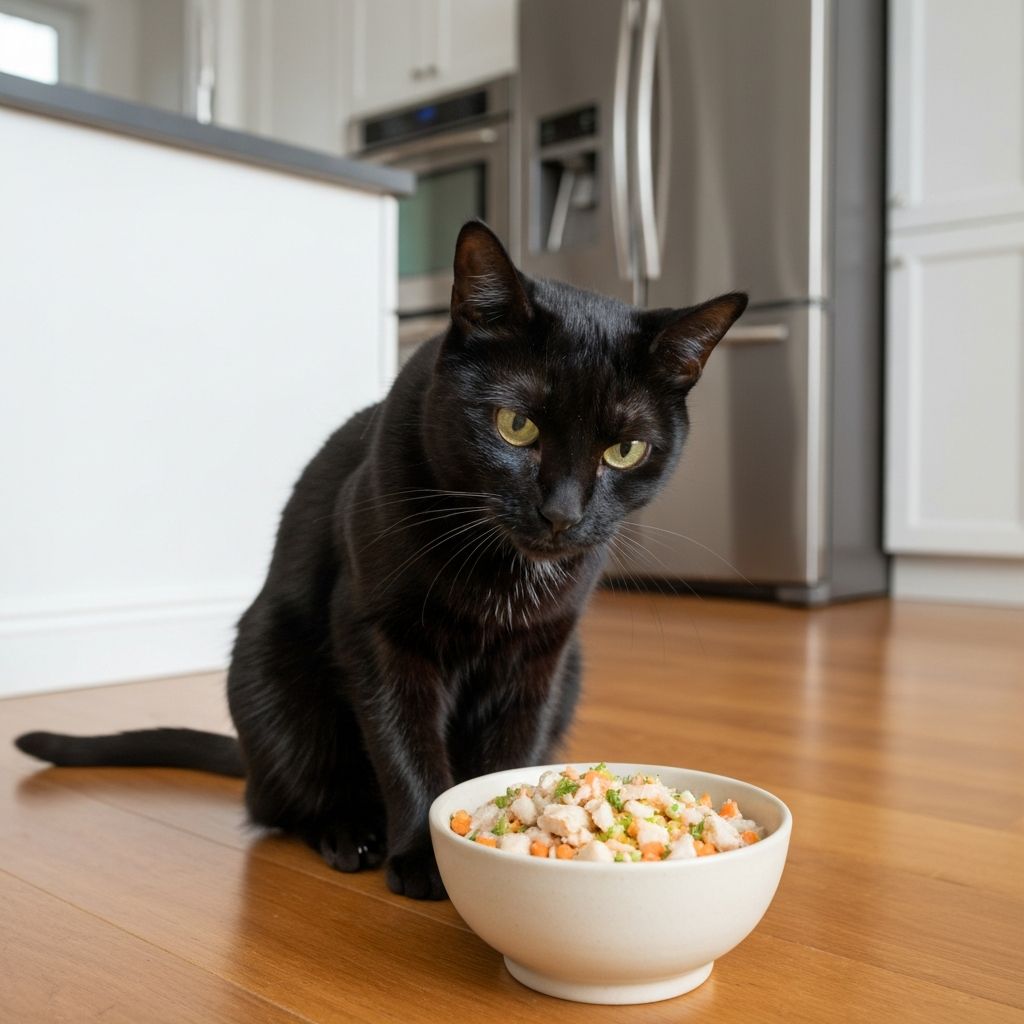
You are standing in front of the cat food shelf, reading: "for sterilised cats", "indoor", "hairball", "urinary", "sensitive". Salmon in gravy, salmon in jelly, salmon in mousse. Sixty kinds of pouch, each promising health, a glossy coat and happiness.
At home a reviewer is waiting. He weighs four kilos, sleeps through most of the day and has never read a label in his life. Even so, he will deliver a verdict in three seconds, by nose, and there will be no appeal.
So you have two jobs at once: to choose a food that is good for the cat, and one that the cat considers worthy of himself. We dealt with the second in our article on feline fussiness. This one is about the first: what really has to be in the bowl for those four kilos of character to stay with you as long as possible.
Before we begin: two situations in which you stop reading
No choice of food replaces a vet in two cases.
The cat hasn't eaten for a day. In a cat, fasting quickly leads to fatty liver disease, especially if it is overweight. You don't wait "until it gets hungry".
A tom keeps going to the litter tray and passes no urine, or only drops, cries, licks around the urethra. This may be a urethral obstruction — a life-threatening condition where hours count. You go to the clinic at once, at night too.
Everything below concerns a healthy cat.
A cat is not a small dog — and the numbers show it
A cat is an obligate carnivore. That is not a slogan from the packaging but a description of physiology: it doesn't produce enough taurine, doesn't convert plant beta-carotene into vitamin A, and has to get arachidonic acid from animal tissue.
This is how it looks in the FEDIAF nutritional guidelines, on which the European pet food industry relies:
| Adult dog | Adult cat | |
|---|---|---|
| Minimum protein in dry matter | 18–21% | 25–33% |
| Taurine in the food | no required minimum | required |
| Vitamin A | makes it from beta-carotene | must get it ready-made |
Conclusion one: dog food is not cat food. A cat that occasionally snacks from the dog's bowl will survive. A cat fed dog food permanently will get ill — heart or eyes, because it will run short of taurine.
Conclusion two: with cat food you look first at the meat, then at nothing for a long while, and only then at the rest.
The most important word on the label (and it isn't "premium")
The word is "complete".
A complete food contains everything a cat needs and can be its only food. A complementary food can't. It is a treat, an addition, a bit of variety.
And here is the trap that the most caring owners fall into. The most beautiful cat tins on the shelf — tuna fillet in broth, chicken breast in its own juices, a composition as short as a haiku: "chicken 75%, broth, rice" — are very often exactly that: complementary foods. Pure muscle meat, with no added taurine, vitamins or calcium.
It looks like the height of quality. The cat eats it with delight. And after a few months of being fed only such tins, deficiencies appear.
The information is always on the pack, but in small print, usually right next to the composition: "complete food for adult cats" or "complementary food". If you are to remember one action from this article, let it be this: turn the tin over and find that word.
Complementary fillets aren't bad. They are dessert. They work beautifully as an addition to a complete base — up to about 10% of daily calories.
Four things you check next
1. A specific animal in first place
"Chicken 65% (meat, hearts, liver)" — you know what you are buying. "Meat and animal derivatives (of which 4% chicken)" — you know only that the other 96% is a surprise. We teach how to read the rest of the composition step by step in a separate article.
Offal in cat food is not a flaw. A mouse isn't made of fillet steak alone either.
2. Protein — but calculated honestly
Almost everyone comes unstuck on this trick. You pick up a pouch: protein 10%. You pick up a dry food: protein 32%. So the dry has three times more protein?
No. A pouch is 80% water. To compare foods you have to calculate the protein in what is left once the water is taken away — in the dry matter:
protein in dry matter = protein on the label ÷ (100 − moisture) × 100
- pouch: 10 ÷ (100 − 80) × 100 = 50%
- dry: 32 ÷ (100 − 8) × 100 = approx. 35%
The modest pouch wins clearly. Without this conversion, comparing wet food with dry is like comparing soup with a stock cube.
In the Purrtner ranking you can switch the view for wet foods to dry matter — we do the sum for you.
3. Taurine
Look for it in the "additives" section, where it is given in milligrams per kilogram. A good complete food almost always lists it. If you can't see it, ask the manufacturer or choose another.
4. Calories
That is, kcal per 100 g. Both the portion and the real cost depend on them. More on both in a moment.
Dry or wet: a dispute settled by water
Your cat's ancestor, the African wildcat, lived in dry country where there was little water to drink. It solved the problem in its own way: it took its water from its prey. A mouse is roughly two-thirds water.
Your cat inherited that system in full, along with a weak sense of thirst. It doesn't drink in advance. It drinks little, late and preferably from your glass.
| Wet food | Dry food | |
|---|---|---|
| Water | 75–82% | approx. 8–10% |
| Calories per 100 g | approx. 80–110 kcal | approx. 360–420 kcal |
| Pros | hydration, smell, harder to overfeed | convenience, price, doesn't spoil in the bowl |
| Cons | dearer, loses freshness quickly | little water, very easy to overfeed |
Cats eating wet food take in more water overall and have more dilute urine than cats on dry food alone — even when the latter have constant access to a water bowl. For an animal prone to urinary tract problems that is a real difference.
Our recommendation: at least part of the daily ration as wet food. Complete wet food alone — very good. A mixed model, meaning wet in the morning and evening plus a measured portion of dry during the day — a sensible compromise between cat and wallet. Dry alone — possible, but then you keep an eye on drinking: several water bowls in different places, well away from the litter tray and from the food, perhaps a fountain.
And an honest word on carbohydrates, because feelings run high around them. A cat doesn't need them, but it can digest cooked starch. Dry food necessarily contains more, because you can't make a kibble without starch. Whether carbohydrate content alone harms a healthy cat — research hasn't settled that. It has settled something else: obesity is among the main risk factors for diabetes in cats. And the shortest route to obesity runs through a full bowl of dry food standing out all day.
What a "portion" is — and why it looks like a joke
A four-kilo, neutered cat living indoors needs about 190–240 kcal a day.
In terms of food:
- dry (380 kcal/100 g): 50–60 g a day. For the whole day,
- wet (90 kcal/100 g): approx. 210–260 g, that is two and a half to three 85 g pouches.
Fifty grams of dry food is a small handful that looks like a mistake at the bottom of the bowl. Hence the reflex to add more. Let's cost that reflex: an extra 10 grams is about 40 kcal, roughly a sixth of a cat's daily requirement. For you the equivalent would be an extra sweet pastry. Every day.
After neutering it gets tighter still: requirement drops and appetite rises. This is the moment when many cats start to put on weight. Not because the owner is doing something wrong, but because they are feeding the same as a month earlier.
The exact portion for your cat — with age, neutering, activity and the calorie content of the specific food — is worked out by the Purrtner calculator.
And one more thing: in nature a cat eats many small meals a day, not two big ones. It is better to split the daily ration into three or four portions than to put it all out at once.
Kitten, adult, senior
Kitten (up to about 12 months). Kitten food, not "the adult one, just less of it". A kitten grows at a rate that demands more energy, protein and calcium in every mouthful. Four meals a day, more for the youngest. And good news for the future: a kitten that gets to know different flavours and textures will grow into a less fussy adult.
Adult. Here the whole game is about weight. A stable weight and ribs you can feel under your hand say more than any promise on the pack.
Senior (from about 11 years). A common mistake: "he's old, so he probably needs less". In very old cats it is often the reverse — they digest fat and protein less well and need more energy to keep their muscle. Weight loss in an older cat is never "just old age". Kidneys, thyroid, teeth: that needs checking by a vet. A renal diet with reduced phosphorus is also chosen by the vet after blood tests, not by the owner just in case.
Breed adds its share: the Maine Coon and its heart, the Persian and its flat face that not every kibble shape suits, the British Shorthair and its talent for becoming round. You will find breed health profiles in the Purrtner breed catalogue.
Five things not to do
- Dog food permanently. Too little protein, no required taurine.
- A plant-based diet. Your convictions are yours; the cat's physiology is its own. Ready-made vitamin A, taurine and arachidonic acid simply aren't there in plants.
- Chicken meat alone, "because it's natural". Muscle meat without bones, offal and supplements has too little calcium and too much phosphorus. A mouse is meat, bones, offal and stomach contents. Chicken breast is only the first item on that list. A home-made diet for a cat is possible, but with a recipe from a veterinary nutritionist, not from a forum.
- Milk. Most adult cats digest lactose poorly. A picture from a fairy tale, diarrhoea from real life.
- Tinned tuna for humans as the staple. As an occasional treat — fine, if it is in spring water rather than oil or brine. As a diet — unbalanced. And a cat gets attached to it faster than you do to a new series.
What it really costs
A pouch at 2.50 zł and a pouch at 6 zł are not yet "cheap" and "expensive". First you need to know how many calories each has. The calorie content of wet foods can differ by half, so you may need almost four a day of the cheaper one and little more than two of the dearer one. The difference in price per day is often much smaller than the difference on the shelf.
What counts is the price per day of feeding. The Purrtner comparison tool shows a composition rating for every food and, where we have the data, the lowest price too.
How you know you got it right
Give a food 6–8 weeks, provided the cat eats it and tolerates it well. Then check:
- coat — smooth, glossy, no dandruff,
- litter tray — formed stools, no dramas beyond the norm for the species,
- weight — stable. Stand on the scales with the cat, then without the cat, subtract. Don't tell him the result,
- energy — as many races at three in the morning as usual,
- bowl — the cat eats willingly, without coaxing.
The label is a promise. The cat after two months is the proof.
What to do today
- Take what you feed and find the word "complete". If it says "complementary" instead, you have just found the most important thing to change.
- Convert the protein to dry matter. One division.
- Weigh your cat. Write it down.
- Work out the portion with the calculator and measure it with kitchen scales for a week.
Your cat won't thank you. Cats rarely thank anyone. At most he will come over, settle on the keyboard at the exact moment you are working, and purr as though he were doing you a favour.
He is. And that is the whole point: for him to keep coming for as long as possible.
This article does not replace a veterinary consultation. It concerns healthy cats; with kidney or urinary disease, diabetes and in cats that are losing weight, the diet is chosen by a vet.
Purrtner is free: a food ranking based on composition, portion calculator and reminders when the food is running low. Check your cat's food — without creating an account.