British Shorthair
(Kot Brytyjski Krótkowłosy)
Origin: United Kingdom
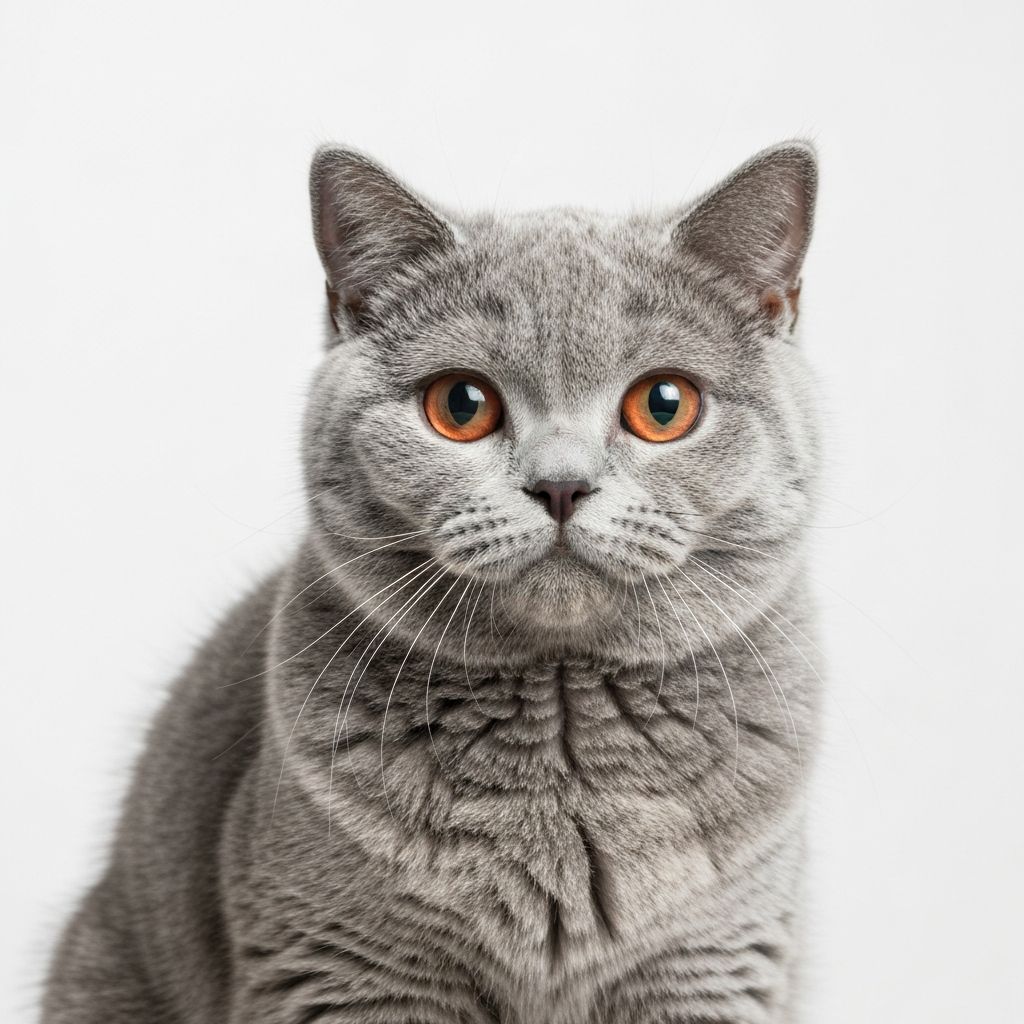
The British shorthair looks like a teddy bear, but treats cuddling the way a Briton treats small talk: yes, it knows how, but why go straight to overdoing it.
The British shorthair looks exactly as if someone had brought to life the most respectable teddy bear in the shop — a round face, round eyes, a coat so dense and springy that your hand sinks into it up to the wrist. And precisely for that reason, the first encounter with its character tends to be a small surprise: this bear is not for carrying around. The Briton loves its family with its whole self, only in the British manner — it will sit beside you, not on you. Always in the same room, always within eyeshot, always a step closer than it officially seems to think. Affection, yes, but without making scenes.
This reserve, by the way, has a very old lineage. The British shorthair's ancestors sailed to the Isles on Roman ships — as professional guardians of granaries and holds — after which they stayed there for a good two thousand years, over which they soaked up the local way of being. The result? When in 1871 the first cat show in history took place at London's Crystal Palace, it was the Briton that was its star: solid, dignified, perfectly composed. And that round face of its with its eternal half-smile passed into literature — supposedly it was the British cat that was the prototype of the Cheshire Cat from “Alice in Wonderland.” Watching yours soundlessly dissolve behind the sofa, leaving behind it only the impression of a smile, it is hard to have doubts.
In daily life this gentlemanly nature reveals itself in the details. Picked up in your arms, it stiffens politely like a lord pulled out of his favorite armchair mid-sentence — and set down, it throws you one eloquent look, smooths an imaginary tailcoat, and sits half a meter away. Of its own will, which is here the essential difference. It dispenses feelings in strictly measured portions: one head-bump in the morning, one deep, velvety purr in the evening — and that, please remember, is its version of a love letter. Guests it treats with the polite distance of an ambassador: it will receive them, appraise them, and then return to its own affairs, that is, to a dignified seating at its observation point.
There is, however, in this British reserve some fine print worth knowing: loyalty to the end. The Briton does not need to follow you step by step, because it knows exactly where you are anyway — it is you who may not notice that over the whole evening it has not once taken its eyes off you. And when a truly worse day comes, it will not put on a great performance. This distinguished gentleman will simply appear without a word, settle heavily at your side, and stay — exactly as long as needed. Affection on one's own terms has this advantage: that when it does come, it is sincere to the last hair.
And here we reach the matter in which this gentleman really needs your firmness: the bowl. The Briton is a cat of low activity and a massive, round build, on which excess weight can hide for months — and at the same time a breed predisposed to hypertrophic cardiomyopathy (HCM), a heart disease that every excess kilogram additionally burdens. Plainly put: with it, roundness is a type of beauty, not a state of health, and “teddy bear” is not an excuse.
That is why its bowl requires discipline worthy of the royal guard:
- Measured portions instead of a constantly full bowl — the Briton eats out of boredom just as willingly as out of hunger
- A complete food with taurine, which the feline heart simply requires — its deficiency can damage the heart muscle
- A daily dose of movement in the gentleman's version: two short sessions with a wand toy or a ball — the only sport it deems worthy of its station
- Water always fresh and inviting (a fountain works wonders), because good hydration supports the heart and kidneys
- Different portions for the kitten, different for the staid adult — its requirement drops with age faster than its appetite grows
Beyond the bowl, it is worth remembering a few matters that keep this bear in form for long years:
- Heart: with a predisposition to HCM it is worth discussing periodic echo examination with the vet; and rapid breathing, apathy, or fatigue are signals for an urgent visit
- Weight under control: regular weighing and assessment of the silhouette, because this dense plush masterfully masks the rounding
- Coat: once a week a brushing — this springy, double plush mostly takes care of itself
- Play and climbing: a scratching post, shelves, a window with a view — an environment that encourages a couch dweller to move does more than many a diet
- Patience in building closeness: the Briton grants trust slowly, but what it once gives it never takes back
Because the British cat is a companion for a really long time — with good care it can be with you for as much as twenty years. Two decades of the calm, velvety presence of someone who will never make noise around its love, and yet who every evening will be found exactly where you are.
So take care of its heart and its silhouette — and it will take care of the rest. And one day, looking at the armchair from which it has just soundlessly vanished, you will understand Carroll better than many a literary scholar: after a good cat there really does remain a smile in the air. Yours will be leaving one all over the house — for twenty years.
See also: British Longhair
Most common health issues
The most common heart disease in cats - the heart muscle thickens, making it harder to pump blood. It can be hereditary; a DNA test is available for some breeds. It remains asymptomatic for a long time, so periodic heart echo examinations at the vet are the best prevention. Maintaining a proper weight and good hydration relieve the circulatory system.
Excess body weight, which in cats increases the risk of diabetes, joint disease and heart disease. Portion control, regular play and monitoring the silhouette are key: the ribs should be palpable under gentle pressure, and the waist visible from above. After neutering, calorie needs drop, so portions should be recalculated.
Health issues
2 most common conditions
Health issues
2 most common conditions
The most common heart disease in cats - the heart muscle thickens, making it harder to pump blood. It can be hereditary; a DNA test is available for some breeds. It remains asymptomatic for a long time, so periodic heart echo examinations at the vet are the best prevention. Maintaining a proper weight and good hydration relieve the circulatory system.
Excess body weight, which in cats increases the risk of diabetes, joint disease and heart disease. Portion control, regular play and monitoring the silhouette are key: the ribs should be palpable under gentle pressure, and the waist visible from above. After neutering, calorie needs drop, so portions should be recalculated.
Nutritional needs
Cat hydration - why wet food matters
Cats naturally have a low thirst drive and often drink too little water. Their ancestors - desert cats - obtained water mainly from food. Wet food contains 70-80% water, which significantly supports hydration and helps prevent kidney and urinary tract problems.