British Longhair
(Kot Brytyjski Długowłosy)
Origin: United Kingdom
It can be born to two shorthaired parents, and for half a century it was the family secret of British catteries. A calm British cat in a fluffy coat whose affection cannot be summoned: you can only make room for it.
A British Longhair can be born to two shorthaired parents, and for more than half a century that is exactly how it came into the world: uninvited, in the best catteries, to the embarrassment of everyone present. Titled parents, a spotless pedigree, and in the pen, among the plush kittens, one that was distinctly fluffier. The breeder sighed, wrote the word "variant" in the paperwork and passed the kitten on to someone trusted, with no right to be shown. Every respectable English family has a relative who is not discussed over tea. In the family of British cats, it was this one.
As in every such story, it began with an affair. After the Second World War so few British cats were left that breeders looked for mates in other breeds: among Russian Blues, Chartreux and Burmese. To win back the massive build and the round head, they finally turned to Persians. It worked. The British cat looked like a British cat again, and the whole business was best forgotten. Except that the gene for long hair is recessive: it can pass from generation to generation unnoticed, and shows itself only when a kitten receives it from both parents. So the Persian great-grandfather kept turning up now and then in a perfectly innocent litter, like the family nose in the portraits. Only in 2009 was the longhaired British cat recognised as a breed by the American registry TICA, and in 2017 the European federation followed. At home, the name "British Longhair" was approved on 15 February 2017, and the right to championship titles was granted in November 2021. Owning up to a relative is always hardest in one's own house.
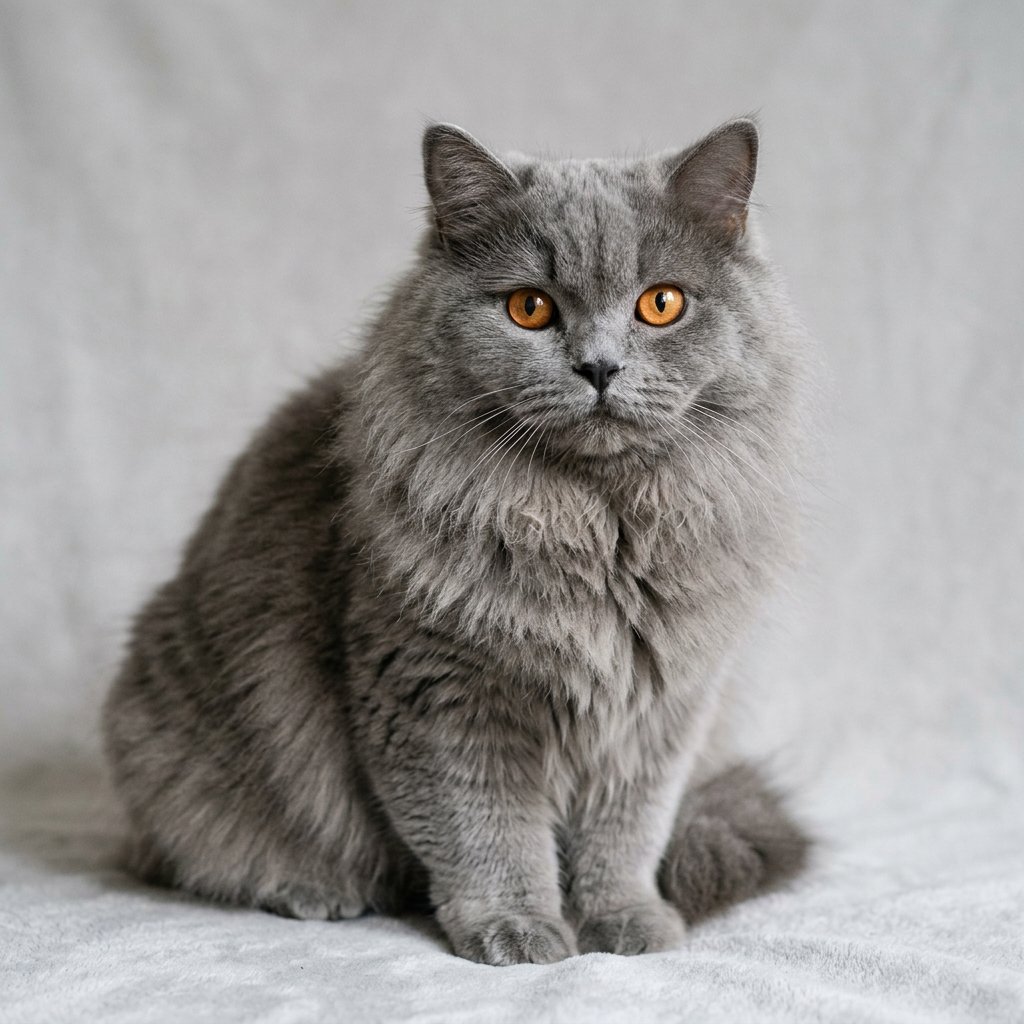
The cat itself knows nothing of this. Cats do not read pedigrees or attend meetings; through all those years of deliberation it lay in a patch of sunlight and held the highest opinion of itself. It is the same cat as its shorthaired brother: stocky, round, calm to the limit of what is possible, only in a coat that is semi-long, dense and standing away from the body, with a ruff under the chin and a tail like a feather duster. It speaks rarely and quietly. It takes part in games with a fishing-rod toy willingly, but from a lying position. It watches the rain from the windowsill the way the English watch cricket: for a long time, with concentration and without visible emotion. It does not do being carried, because it holds that a cat should stand on four paws of its own rather than hang from two of someone else's. It will put up with a dog in the house, and a rabbit too; it will accept a second cat if they grew up together.
And here genetics comes back in, because its affection works exactly like the long hair: it takes two. Called, it does not come. Placed on a lap, it gets down after a minute, with dignity and without resentment. But sit down in the evening, put your phone away, stop wanting anything from it, and it will come by itself and lie down beside you, side on, so that you are touching. Then it will start to purr. It brings its own half; the other half is your calm. People who live with a British cat learn a strange thing over time: there are feelings that cannot be summoned. You can only make room for them.
The bowl takes two as well: the cat supplies the appetite, you supply the good sense. The British Longhair moves little and puts on weight easily, and from its Persian great-grandfather it inherited not only the coat but also a tendency to kidney cysts; as in its shorthaired brother, heart disease occurs too. And one more thing: this family has had quite enough secrets. One person measures out the portion, and the rest of the household adds nothing on the quiet.
In practice it looks like this:
- A portion measured on kitchen scales and split into several small meals. Treats are included in it, not extra
- Plenty of animal protein, few carbohydrates: with so calm a way of life, every surplus goes straight to the waist
- Wet food every day and water in several places around the home, because a well-hydrated cat means kidneys with an easier job
- Hairballs: with a coat like this it swallows a good deal. Regular combing, cat grass and treats that help hair pass through all help
- The scales once a month. The coat adds volume, so you cannot judge anything by eye
Beyond the bowl a few things are worth remembering:
- Coat: combing several times a week, and daily during the moult. Neglected, it mats
- Heart: hypertrophic cardiomyopathy occurs in the breed. A periodic heart ultrasound can detect it before it causes symptoms
- Kidneys: ask the breeder about the parents' tests for polycystic kidney disease, and have your own cat's blood and urine checked once a year
- Exercise: it will not make itself do any. Two short play sessions a day, and part of its food given in a toy it has to work it out of
- Being alone: it copes well and does not need company all day. It needs it in the evening
So in the evening you sit on one sofa, each on your own side. You do not call it, because by now you know that does no good. You simply rest your hand on the cushion, palm up, and go on reading. After a while a heavy, soft head lands in it.
The long coat took two parents. This takes the two of you.
See also: British Shorthair
Most common health issues
The most common heart disease in cats - the heart muscle thickens, making it harder to pump blood. It can be hereditary; a DNA test is available for some breeds. It remains asymptomatic for a long time, so periodic heart echo examinations at the vet are the best prevention. Maintaining a proper weight and good hydration relieve the circulatory system.
A hereditary disease in which cysts form in the kidneys, gradually impairing their function. Detectable by ultrasound, and in some breeds by a genetic test - which is why it is worth asking the breeder about the parents' results. Early detection and a kidney-supporting diet (good hydration, wet food, phosphorus control) help preserve their function longer.
Excess body weight, which in cats increases the risk of diabetes, joint disease and heart disease. Portion control, regular play and monitoring the silhouette are key: the ribs should be palpable under gentle pressure, and the waist visible from above. After neutering, calorie needs drop, so portions should be recalculated.
While grooming, a cat swallows hair, which can clump into balls in the digestive tract. This happens more often in cats with longer coats, especially during the moult. Regular combing, cat grass and foods or treats that help hair pass through all help; frequent vomiting, loss of appetite or constipation call for a visit to the vet.
Health issues
4 most common conditions
Health issues
4 most common conditions
The most common heart disease in cats - the heart muscle thickens, making it harder to pump blood. It can be hereditary; a DNA test is available for some breeds. It remains asymptomatic for a long time, so periodic heart echo examinations at the vet are the best prevention. Maintaining a proper weight and good hydration relieve the circulatory system.
A hereditary disease in which cysts form in the kidneys, gradually impairing their function. Detectable by ultrasound, and in some breeds by a genetic test - which is why it is worth asking the breeder about the parents' results. Early detection and a kidney-supporting diet (good hydration, wet food, phosphorus control) help preserve their function longer.
Excess body weight, which in cats increases the risk of diabetes, joint disease and heart disease. Portion control, regular play and monitoring the silhouette are key: the ribs should be palpable under gentle pressure, and the waist visible from above. After neutering, calorie needs drop, so portions should be recalculated.
While grooming, a cat swallows hair, which can clump into balls in the digestive tract. This happens more often in cats with longer coats, especially during the moult. Regular combing, cat grass and foods or treats that help hair pass through all help; frequent vomiting, loss of appetite or constipation call for a visit to the vet.
Nutritional needs
Cat hydration - why wet food matters
Cats naturally have a low thirst drive and often drink too little water. Their ancestors - desert cats - obtained water mainly from food. Wet food contains 70-80% water, which significantly supports hydration and helps prevent kidney and urinary tract problems.