European Shorthair
(Kot Europejski Krótkowłosy)
Origin: Sweden
The first sentence generations of Polish children learned to read was about a cat. That cat now has a breed of its own, the European Shorthair, and one problem: almost no cat called "European" actually is one. Here is how it differs from an ordinary house cat.
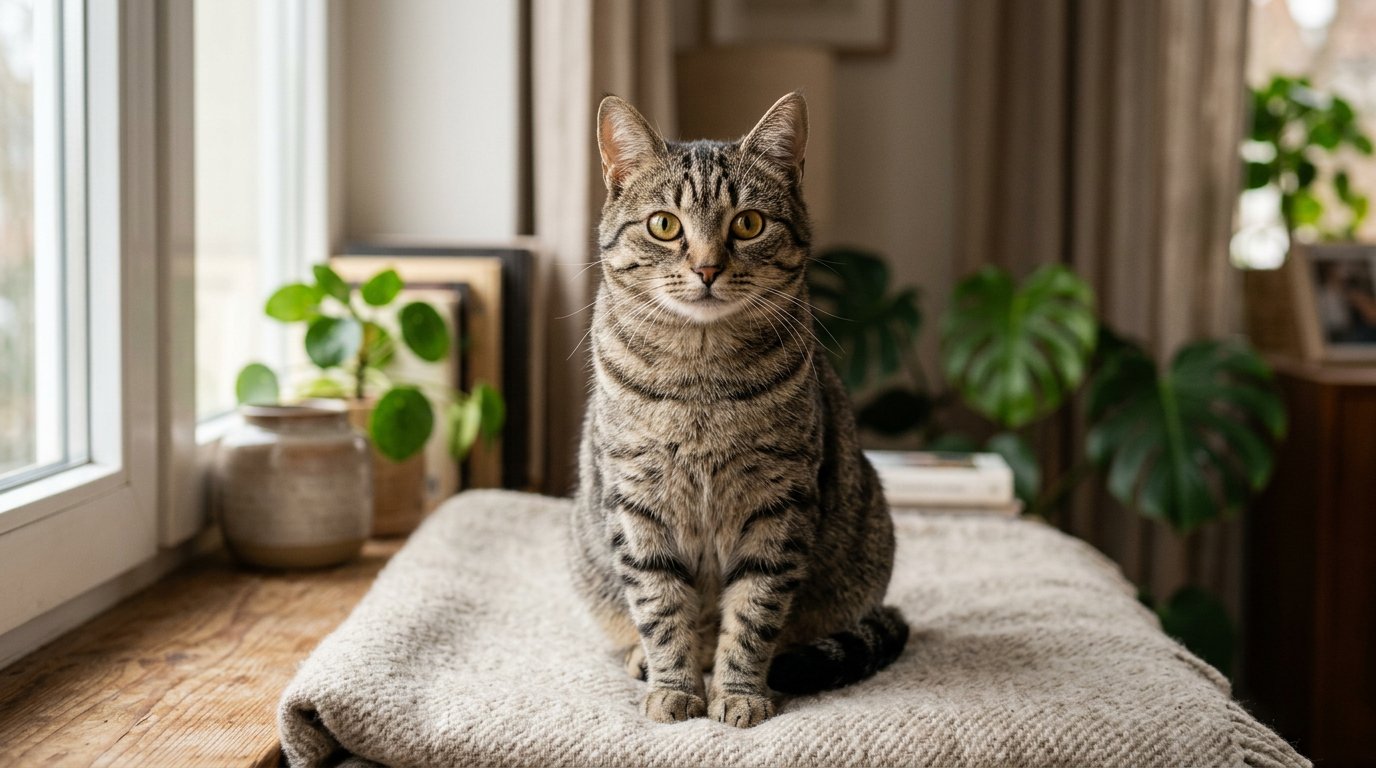
This is the cat on which Poles learned to read. "Ala ma kota", Ala has a cat, is the most famous sentence in Marian Falski's school primer, although it was only in the book until 1949; in later editions Ala had As, a dog, instead. The nation remembered the cat anyway. An ordinary one: shorthaired, tabby or patched, medium-sized, the kind every child draws when asked to draw a cat. That cat now has a breed of its own. It is called the European Shorthair, and there is one problem with it: almost no cat that people call "European" actually is one.
In Poland "European" is written in the health booklet of almost every cat without a pedigree, so on paper it is the most numerous breed in the country. In reality it is a rarity here. A true European Shorthair has a pedigree: it was developed in Sweden from ordinary house cats and has been recognised by the international federation since 1949. British breeders, meanwhile, were improving their shorthair with Persian blood until it became rounder and plusher. The Scandinavians decided not to improve anything. In 1982 their cat received a standard of its own, in which the most frequently repeated word is "medium": medium in size, with medium ears and a neck of medium length. It is probably the only document in the history of breeding to describe the average with such care. In Finland it is the national cat.
So how does it differ from an ordinary house cat? In looks, not at all. It differs in that you know what to expect. Polish has a ready-made phrase for this: a non-pedigree cat is "a cat in a sack", the Polish for a pig in a poke, in the best sense of the words, because its looks, character and health are a riddle to be solved. The European Shorthair is the same cat taken out of the sack: you know how big it will grow, whose temperament it has and what its grandparents suffered from. If your "European" from the health booklet has no pedigree, you have a house cat. You have lost nothing, and its description is on a separate page of this catalogue.
Since this is the cat of Polish sayings, it is worth checking how much truth they hold. To live like cat and dog? Untrue: it gets on well with dogs, and with other cats too. To walk its own paths? Certainly, but it comes back for dinner and likes to know where its people are. False as a cat? With its own people it is devoted and affectionate, and with strangers it is at most shy. Always landing on four paws: that one holds, because it settles into any conditions, a studio flat or a house with a garden, with small children or with the elderly. It does not have nine lives. It has one, but a long one, fifteen to twenty years, and it is ill remarkably rarely. And the proverb "when the cat's away, the mice will play" it treats as a job description: it hunts everything that moves, shoelaces and your foot under the duvet included.
One more saying remains. In Polish "to have a cat" also means to be crazy about something, and it is hard to think of a more accurate description. "Ala has a cat" is three words, the simplest sentence that can be put together from letters, and in the first year of school nobody suspects there is anything more in it than a reading exercise. Only years later, when you come home and someone striped is sitting in the hallway pretending not to have been waiting at all, do you realise that from the very beginning it was a sentence about happiness.
The standard tells it to be medium, and at the bowl that is worth sticking to. In a cat with no breed-specific diseases, what remains are the ordinary ones, and the most ordinary of all is excess weight. The one thing it should not have above average is its weight.
In a European Shorthair's bowl:
- A complete food with a high meat content, matched to its age
- A measured portion. A female usually weighs about five kilograms and a male about six, and after neutering and in a flat they need less than their appetite suggests
- Wet food in the daily diet and fresh water. A cat that is to live twenty years needs kidneys for twenty years
- A hunter should work a little for its food: give part of the portion in a toy or spread it over several places in the flat
Beyond the bowl a few things are worth remembering:
- Health: no typical hereditary diseases have been described in the breed. An annual check-up, vaccinations and dental care are enough
- Coat: short and dense, to be combed once or twice a week
- Indoors or garden: it adapts to both. In a city it is safer in a flat with a secured balcony
- Kitten: how strongly it will be drawn to people depends on its first weeks spent among them. Ask the breeder how the litters are raised
- Pedigree: if it is this particular breed you want, ask for the papers. Most catteries are in Scandinavia
The primer did not start with this cat for nothing. The simplest sentences are usually about the most important things.
… has a cat. Put your own name in place of the dots.
See also: Mixed Breed Cat
Most common health issues
Excess body weight, which in cats increases the risk of diabetes, joint disease and heart disease. Portion control, regular play and monitoring the silhouette are key: the ribs should be palpable under gentle pressure, and the waist visible from above. After neutering, calorie needs drop, so portions should be recalculated.
A tendency toward tartar buildup and periodontal disease, which lead to gum inflammation, pain, and tooth loss. It's worth reacting to bad breath and taking care of regular tooth cleaning. Food with the right texture and oral hygiene limit plaque buildup.
Health issues
2 most common conditions
Health issues
2 most common conditions
Excess body weight, which in cats increases the risk of diabetes, joint disease and heart disease. Portion control, regular play and monitoring the silhouette are key: the ribs should be palpable under gentle pressure, and the waist visible from above. After neutering, calorie needs drop, so portions should be recalculated.
A tendency toward tartar buildup and periodontal disease, which lead to gum inflammation, pain, and tooth loss. It's worth reacting to bad breath and taking care of regular tooth cleaning. Food with the right texture and oral hygiene limit plaque buildup.
Nutritional needs
Cat hydration - why wet food matters
Cats naturally have a low thirst drive and often drink too little water. Their ancestors - desert cats - obtained water mainly from food. Wet food contains 70-80% water, which significantly supports hydration and helps prevent kidney and urinary tract problems.