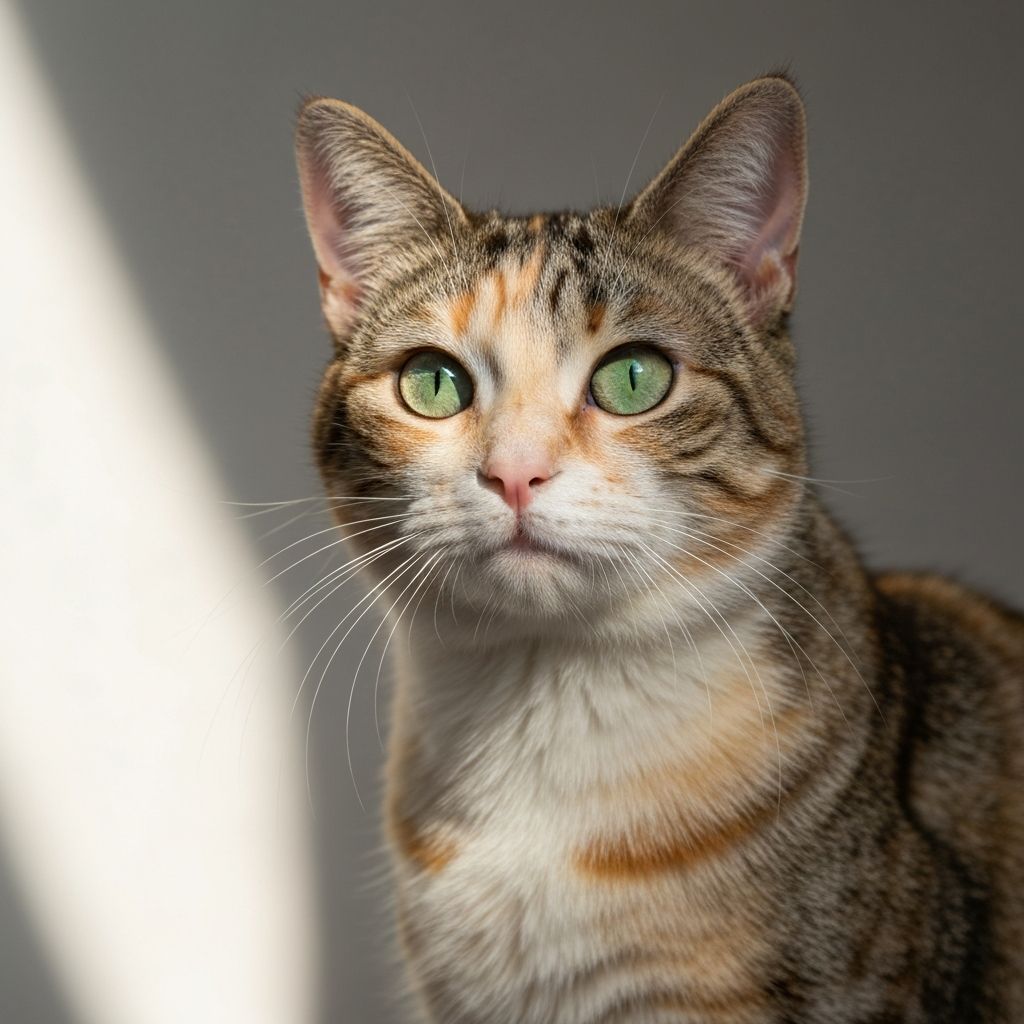
Mixed Breed Cat
(Kot Dachowiec / Mieszaniec)
Origin: Worldwide
The moggy needs no pedigree, because it is one itself: all the breeds in the world are its descendants. Ten thousand years of history, fur the color of surprise — and one non-negotiable rule: it chooses you.
The moggy is the only cat in the world that needs no pedigree — because it is the pedigree. Every breed in this catalog, from the Maine coon to the Singapura, is its descendant: the result of the fact that a human once took an ordinary cat and began to carve out single traits from it. Longer fur here, a shorter face there, a blue color, a lack of tail. The moggy is the original from which they were all carved out — ten thousand years of feline history in the full, uncut version, perfectly tested by life itself. Pedigree cats have papers. It has something better: all the genes in the world and full copyright to being a cat.
And its history is the best tale the animal world has to offer — because the cat is the only creature that domesticated itself. No one caught, herded, or trained it. About ten thousand years ago, when humans began to gather grain in granaries, mice came to the granaries — and after the mice, of their own free will, came the cat. It looked around, assessed the conditions, and decided it was staying. On its own terms, of course. Later the Egyptians worshiped it like a deity — which it accepted with the calm of a being that considers this the absolute minimum — and sailors took it onto ships as a rat-slayer, and so, port by port, it conquered every continent: the only conqueror in history to colonize the world while sleeping sixteen hours a day. And here it got its name from its favorite kingdom: the roofs it walked as an owner. Because, at bottom, it was one.
From this freedom it retained the most precious inheritance: the moggy is a genetic lottery in which there are no blank tickets. Each one is the only copy in the world — nature mixes colors, patterns, and characters so that you will not find a second one the same, even if you searched all the courtyards of Europe. One will be a chatterbox that comments on your cooking, another a philosopher of sleeping on the radiator, a third a hunter that treats every ball deadly seriously — and a fourth will devote its whole career to knocking objects off the table, looking you straight in the eye while doing it. One thing is certain: under this fur the color of surprise works the cunning of generations of survivors — cats that survived streets, winters, and moves, and that know more about life than many a titled aristocrat. In adopting a moggy, you are not buying traits from a catalog. You are getting a personality that wrote itself.
And here we come to a thing no cattery in the world will offer you. A cat — as is well known — does not come when called. And yet in a shelter, when you pass the rows of pens, at some moment a paw slips out through the bars toward exactly you. Or one day on your windowsill a courtyard regular reports for duty and looks at you as if checking references. This is no accident — it is a job interview. The descendant of an animal that ten thousand years ago itself chose a human does exactly the same: it chooses. A pedigree cat you choose. The moggy chooses you — and in that is the whole difference. A love that came to you of its own will cannot be bought for any money. It can only be received. And it must be earned.
This veteran of life has at the bowl the needs of a real cat — that is, concrete ones:
- Meat in first place: regardless of lineage, every cat is an obligate carnivore — choose a food with a high content of animal protein (a minimum of 30%), and avoid fillers
- Hydration is the secret of longevity: moggies live to as much as 20 years — wet food and fresh water (or a fountain, which it will love more than you; do not take it personally) really support the kidneys through all those years
- An optimal weight: an average moggy weighs 3.5–5.5 kg — the ribs should be palpable under gentle pressure, and the waist visible from above (yes, cats have a waist); after neutering the requirement drops, so portions must be recalculated
- Was it homeless? Show patience: shelter cats can be greedy at the bowl out of fear, or distrustfully fussy — give it time, calm, and fixed feeding times, and it will learn that the food will now never disappear again
- Quality over sentiment: the fact that a moggy will survive on anything does not mean it should — good ingredients are the cheapest health insurance you can buy for it
Beyond the bowl, the moggy asks for a few things that pay back with interest:
- Regular vet visits: the moggy has no breeding examinations or known parental history, so an annual check-up and vaccinations are its only health record — but one written as it goes
- The lottery works in its favor: a broad gene pool statistically favors resilience and health — but statistics are not a guarantee, so observe your cat, because its manual is in no catalog
- Spaying or neutering: this is the best thing you can do for its health, its calm, and for all the future moggies a shelter will not have to take in
- A home with a view: generations spent on roofs left a mark — a windowsill with a view of the world is for the moggy a theater, a cinema, and breakfast television in one, and a cardboard box next to it — a presidential suite for free
- Patience for a survivor: a cat with a difficult past does not always trust right away — but the trust you earn yourself is the most durable a cat can give
Because the moggy is the summary of everything best in cats, with no shortcuts: ten thousand years of history, the cunning of a survivor, the health of a lottery in which you hold a winning ticket, and a character no breeder could have invented — because such characters are written only by life.
In this catalog you can read about twenty-six magnificent breeds — and each is worth the read. But the truth is that the oldest, healthiest, and most original of them all stands in no cattery — it sits in a shelter a few streets from you, or is at this very moment sizing up your windowsill. And if one day you feel that gaze on you, know that you are undergoing the world's oldest job interview. Do well. Because when, out of the whole world it has known for ten thousand years, a cat chooses precisely you — you will have at home something more than an animal. You will have someone's decision that it is by you, precisely, that it is worth staying.
See also: European Shorthair
Most common health issues
Domestic shorthair cats are generally healthier than pedigree cats thanks to their genetic diversity.
Health issues
1 most common condition
Health issues
1 most common condition
Domestic shorthair cats are generally healthier than pedigree cats thanks to their genetic diversity.
Nutritional needs
Cat hydration - why wet food matters
Cats naturally have a low thirst drive and often drink too little water. Their ancestors - desert cats - obtained water mainly from food. Wet food contains 70-80% water, which significantly supports hydration and helps prevent kidney and urinary tract problems.