Scottish Fold
(Kot Szkocki Zwisłouchy)
Origin: Scotland
The Scottish fold has the face of a plush owl and a sweetness that disarms in a second. It also has a secret that must honestly be said out loud — before you fall in love with it.
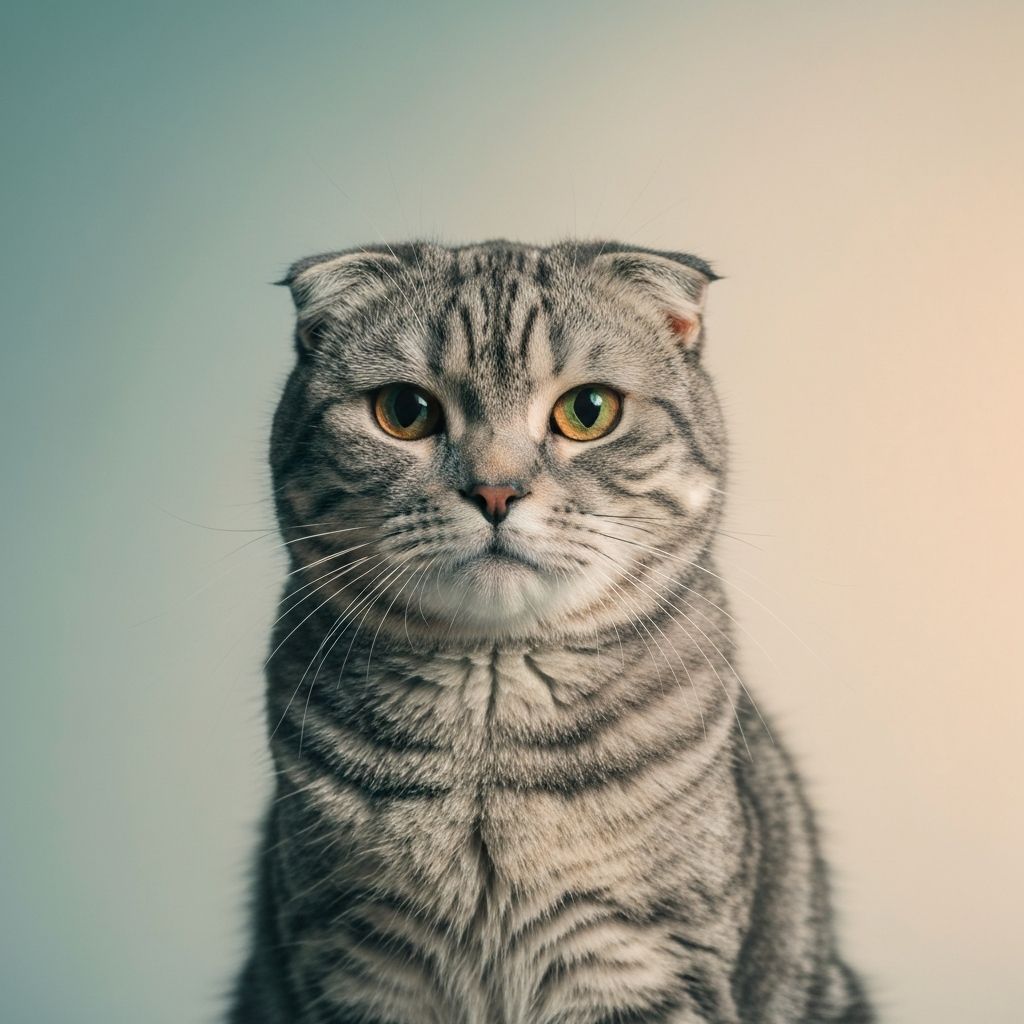
The Scottish fold looks like a plush owl that someone woke up at teatime: a round face, great round eyes, and those famous little ears folded flat against the head, through which the whole cat gives the impression of being forever surprised and forever adorable. Added to this is the gentlest character possible — the Scottish fold is a calm, attached, quiet, and sociable cat that adores being close to people and is famous for the funny habit of sitting “like a human,” with its little paws on its belly, in the pose of a tired office worker. It is hard to find a cat easier to fall in love with. And precisely for that reason one must begin with the most important thing — the kind one ought to know before that heart beats faster.
Before that, however — where a cat with folded ears came from in the first place. The story began in 1961 on a farm in the Scottish county of Perthshire, where the shepherd William Ross noticed at his neighbors' an unusual white cat with ears clinging to its head. She was called Susie — and it is from her, from one single cat, that all Scottish folds in the world descend. Ross was so enchanted by her that he took up developing the breed; it was named simply “fold.” But this same story has a second, less fairy-tale side: British cat organizations fairly quickly halted registration of the breed once it became clear that the famous little ear and the bone problems are one and the same gene. And precisely for that reason, with this cat enchantment must be joined immediately with knowledge.
Those charming, folded little ears are, you see, not an ordinary ornament of nature. They arise because the cat has a genetic defect of the cartilage — and cartilage is in the whole body, not only in the ear. The same gene that “folds” the ear also affects the cartilage in the joints. And here comes a fact that no good description of this breed may pass over in silence: practically every Scottish fold has osteochondrodysplasia, a disease causing faulty development of the bones and joints. This is not a “risk” or a “tendency that may manifest” — it is a trait written into the same genetics as the famous little ears. In some cats it gives mild symptoms, in others more serious ones, but the cartilage itself is always altered. It is worth knowing this also because, when buying a kitten, it is knowledge that protects — both the cat and you from the pain of watching its suffering.
What does this knowledge mean in daily life? That beneath this sweet exterior hides a cat that needs particular tenderness toward its body. There are Scottish folds that move less, jump reluctantly, stiffen, or have a thickened, barely mobile tail — and this is not laziness or “just its character,” but a signal that the joints are making themselves felt. Such a cat deserves a home in which no one forces it into feats: with low entrances to beds, soft bedding, a ramp instead of a high jump, and constant, attentive veterinary care. Love for a Scottish fold is to a large degree the concern that each of its days be as painless as possible.
And since this breed's body needs exceptional care, its bowl is one of the most important tools you have.
With a joint condition, feeding stops being a question of the silhouette and becomes part of the treatment:
- A lean weight is with the Scottish fold an absolute priority — every extra gram is extra burden on the sick joints and extra pain, which is why portion control is here more important than in almost any other breed
- Joint support from youth: supplements such as glucosamine, chondroitin, collagen, or MSM are worth discussing with the vet early — before the pain appears, not only after it
- Plenty of moisture and high-quality animal protein: wet food instead of dry high-carbohydrate food better supports hydration, the kidneys, and maintaining a lean silhouette
- Few carbohydrates: the cat is a carnivore, and an excess of grains in the bowl serves neither its weight nor its general condition
- The heart under watch: this breed also has a predisposition to cardiomyopathy, so periodic heart examination at the vet is sensible prevention
Beyond the bowl, the Scottish fold asks for a few simple things that really improve its quality of life:
- A home without high jumps: ramps, little steps, low beds — architecture that spares the joints
- Warmth and softness: warm, well-padded bedding can be true solace for aching joints
- Gentle movement: regular, mild play maintains the muscles that support the joints — without forcing acrobatics
- Ears: the folded structure can be worse ventilated, so it is worth checking and cleaning them regularly and gently
- Vigilance for signals of pain: stiffness, reluctance to move, a change of gait, or a stiff tail are a reason for a visit, not for waiting
Because the truth about the Scottish fold is that it is a cat of an exceptionally sweet nature that throughout its life needs exceptional care — and it deserves a caretaker who understands that care and undertakes it with open eyes. If you already share a home with it, the best you can give it is vigilance and consistency: a lean silhouette, supported joints, soft bedding, and a vet who knows its history.
Then this little, surprised sweetheart will repay you in its own quiet, tender way — sitting beside you “like a human,” with its paws on its belly, and looking at you as if you were the best thing that has ever happened to it in its life. Because from its perspective — a home in which someone truly cares about its health — is exactly that.
See also: Scottish Straight
Most common health issues
A genetic disorder of cartilage and bone development linked to the same gene that produces the characteristic folded ears - it affects every cat of this breed to varying degrees. It can cause joint stiffness and pain. A lean weight is absolutely crucial, and joint support (omega-3, glucosamine) is worth introducing early and under veterinary supervision.
A group of heart muscle diseases that weaken the heart's ability to pump blood and are often asymptomatic for a long time. Periodic heart echo examinations are the best prevention. Proper weight, good hydration and complete nutrition relieve the circulatory system and support the cat's overall condition.
Health issues
2 most common conditions
Health issues
2 most common conditions
A genetic disorder of cartilage and bone development linked to the same gene that produces the characteristic folded ears - it affects every cat of this breed to varying degrees. It can cause joint stiffness and pain. A lean weight is absolutely crucial, and joint support (omega-3, glucosamine) is worth introducing early and under veterinary supervision.
A group of heart muscle diseases that weaken the heart's ability to pump blood and are often asymptomatic for a long time. Periodic heart echo examinations are the best prevention. Proper weight, good hydration and complete nutrition relieve the circulatory system and support the cat's overall condition.
Nutritional needs
Cat hydration - why wet food matters
Cats naturally have a low thirst drive and often drink too little water. Their ancestors - desert cats - obtained water mainly from food. Wet food contains 70-80% water, which significantly supports hydration and helps prevent kidney and urinary tract problems.