Scottish Straight
(Kot Szkocki Prosty)
Origin: Scotland
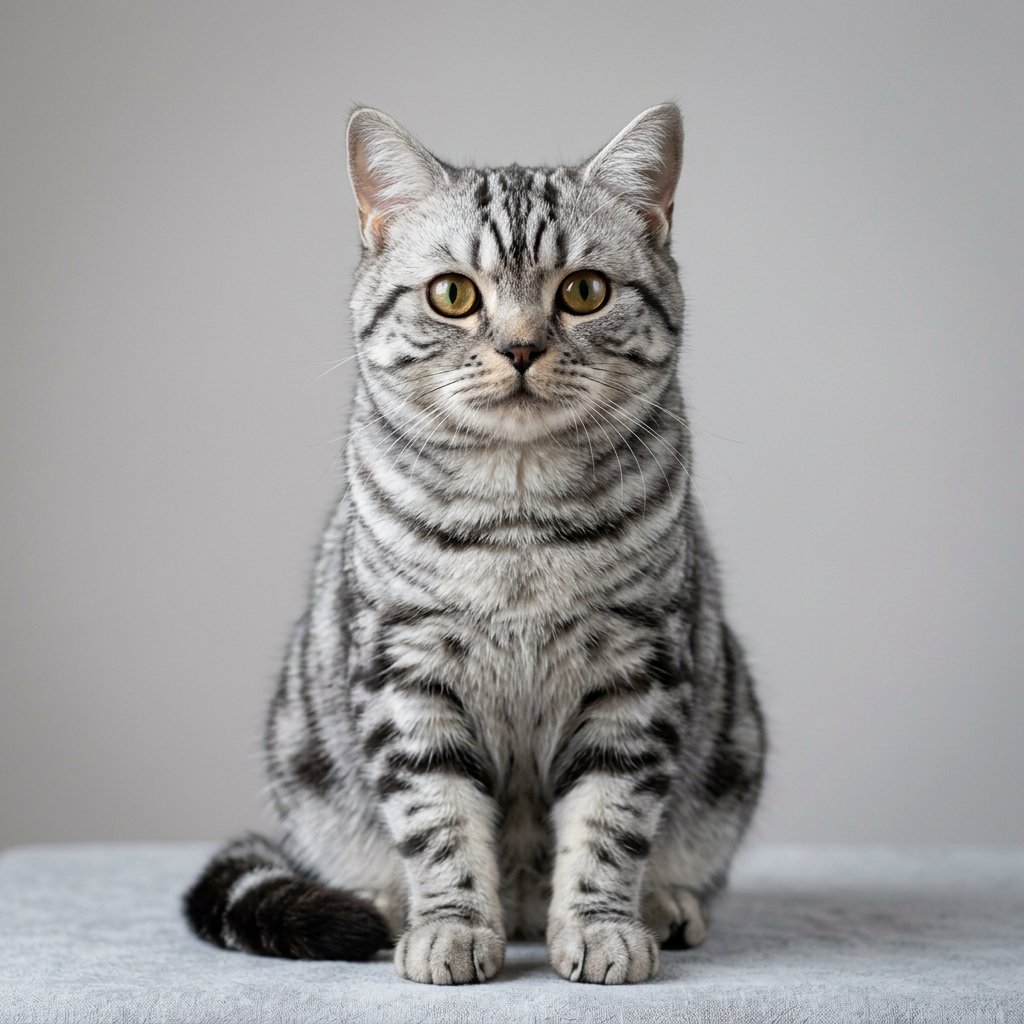
It is born in the same litter as the Scottish Fold, and for three weeks nobody knows which is which. Then its ears stay straight, and with them its joints stay healthy. The Scottish Straight got what its famous sibling does not have.
In 2016 Guinness World Records declared the most-watched animal on YouTube to be a Scottish cat whose ears never folded. His name was Maru, he lived in Japan, and he collected hundreds of millions of views by squeezing himself into every cardboard box he could find. Many articles described him as a Scottish Fold. He was a Scottish Straight: a cat from the same family, with the same round head and the same calm, only with ears that stayed where they were. As it turns out, that was the best thing that could have happened to him.
The whole family begins with one cat. In 1961, on a farm in Perthshire in Scotland, a white cat called Susie was noticed with ears folded forward, and all Scottish cats, folded and straight, descend from her. Today we know that the ear is folded by one change in one gene, which governs the structure of cartilage. The trouble is that cartilage is not only in the ears: the same gene damages the joints, and to some degree this affects every fold-eared cat. That is why a Fold is mated to a Straight, and in such a litter each kitten has roughly a fifty-fifty chance. The strangest part is the first few weeks. All the kittens are born with straight ears, and only between the third and fourth week of life do the ears of some begin to fold while the others' do not. For three weeks nobody knows who is who. Then, in part of the litter, the ears simply stay. Those kittens did not receive the gene: neither the ears nor the disease, and they will never pass it on to anyone.
Everything else they got in full. The Scottish Straight has a round head, wide-open eyes, a short nose and a rounded, sturdy body, and a character that matches the Polish name of the breed, which means both straight and simple: no catches. It is calm, gentle and likes to be where people are: it moves from room to room with the household and settles in the very middle of whatever is going on. Unlike its British cousins it is happy to cuddle and can fall asleep on a lap halfway through a film. When something catches its interest it sits up on its hind legs like a meerkat and surveys the scene from a height. Its voice is thin, quite out of keeping with the rest of it, and it uses it sparingly, mostly in matters of the bowl. And its ears are ordinary: two of them, upright, rounded at the tips, swivelling instantly towards the sound of a pouch being opened. They work flawlessly.
The Polish Renaissance poet Jan Kochanowski put it in a famous epigram more than four hundred years ago: noble health, nobody learns how good you taste until you are spoiled. The Scottish Straight is the cat from that poem. It jumps onto the wardrobe, jumps down from the windowsill, stretches to its full length until its hind legs tremble, and has no idea that in its family none of these things can be taken for granted. Its fold-eared siblings know. It never will, and that is the whole point: the best gift it was given is the one it will never notice. You will know about it on its behalf. It is odd to look at a cat that has jumped onto the fridge and think "how good". And yet with this cat that is exactly what you think.
The poem has a second half too: health can be spoiled. In a cat that inherited nothing bad, it is usually spoiled at the bowl. The Scottish Straight has the build of its British ancestors, rounded and compact, on which every extra half kilo looks at first like part of its charm. Its joints came healthy. How much they will have to carry depends on you.
In practice:
- A portion measured on kitchen scales, with treats counted in the daily amount. The ribs should be easy to feel under your fingers and the waist visible from above
- Plenty of animal protein and few carbohydrates: a cat is a carnivore, and surplus energy quickly settles on its belly
- Wet food every day and fresh water in several places around the home, because kidney cysts occur in the family
- A few short play sessions a day. It jumps willingly and well, so give it shelves and a scratching post worth jumping onto
Beyond the bowl a few things are worth remembering:
- Certainty about the gene: there is a DNA test. A result without the variant responsible for folded ears means the cat will not develop the joint disease of fold-eared cats and will not pass it on. Ask the breeder for that result
- Heart: as in Scottish Folds and British cats, cardiomyopathy occurs. A periodic heart ultrasound can detect it early
- Kidneys: ask about the parents' tests for polycystic kidney disease
- Coat: a short coat needs combing once a week, a semi-long one several times
- Teeth: brushing, which is worth getting a kitten used to
One morning it will jump from the floor onto the windowsill: in a single movement, without looking where it puts its feet. It will land, sit down and start washing a paw. For the cat there will be nothing special in it.
Notice it on its behalf.
See also: Scottish Fold
Most common health issues
The most common heart disease in cats - the heart muscle thickens, making it harder to pump blood. It can be hereditary; a DNA test is available for some breeds. It remains asymptomatic for a long time, so periodic heart echo examinations at the vet are the best prevention. Maintaining a proper weight and good hydration relieve the circulatory system.
A hereditary disease in which cysts form in the kidneys, gradually impairing their function. Detectable by ultrasound, and in some breeds by a genetic test - which is why it is worth asking the breeder about the parents' results. Early detection and a kidney-supporting diet (good hydration, wet food, phosphorus control) help preserve their function longer.
Excess body weight, which in cats increases the risk of diabetes, joint disease and heart disease. Portion control, regular play and monitoring the silhouette are key: the ribs should be palpable under gentle pressure, and the waist visible from above. After neutering, calorie needs drop, so portions should be recalculated.
Health issues
3 most common conditions
Health issues
3 most common conditions
The most common heart disease in cats - the heart muscle thickens, making it harder to pump blood. It can be hereditary; a DNA test is available for some breeds. It remains asymptomatic for a long time, so periodic heart echo examinations at the vet are the best prevention. Maintaining a proper weight and good hydration relieve the circulatory system.
A hereditary disease in which cysts form in the kidneys, gradually impairing their function. Detectable by ultrasound, and in some breeds by a genetic test - which is why it is worth asking the breeder about the parents' results. Early detection and a kidney-supporting diet (good hydration, wet food, phosphorus control) help preserve their function longer.
Excess body weight, which in cats increases the risk of diabetes, joint disease and heart disease. Portion control, regular play and monitoring the silhouette are key: the ribs should be palpable under gentle pressure, and the waist visible from above. After neutering, calorie needs drop, so portions should be recalculated.
Nutritional needs
Cat hydration - why wet food matters
Cats naturally have a low thirst drive and often drink too little water. Their ancestors - desert cats - obtained water mainly from food. Wet food contains 70-80% water, which significantly supports hydration and helps prevent kidney and urinary tract problems.