Siamese
(Kot Syjamski)
Origin: Thailand (Siam)
The Siamese cat has an opinion on every subject and intends to share it. Now. Loudly. And then once more, because you weren't listening carefully enough.
The Siamese cat does not meow. The Siamese cat speaks its mind. It has a view on your being late, on the contents of its bowl, on the closed bathroom door, on the weather, and on the fact that you moved the chair again — and each of these opinions it delivers in that famous low, resonant voice of its, which can be heard through two walls. You have a question? It has an answer. You don't have a question? It has one anyway. With a Siamese you do not live in silence — you live in a conversation that begins in the morning at your waking and quiets down only in the evening, when it falls asleep nestled against your neck, mid-sentence.
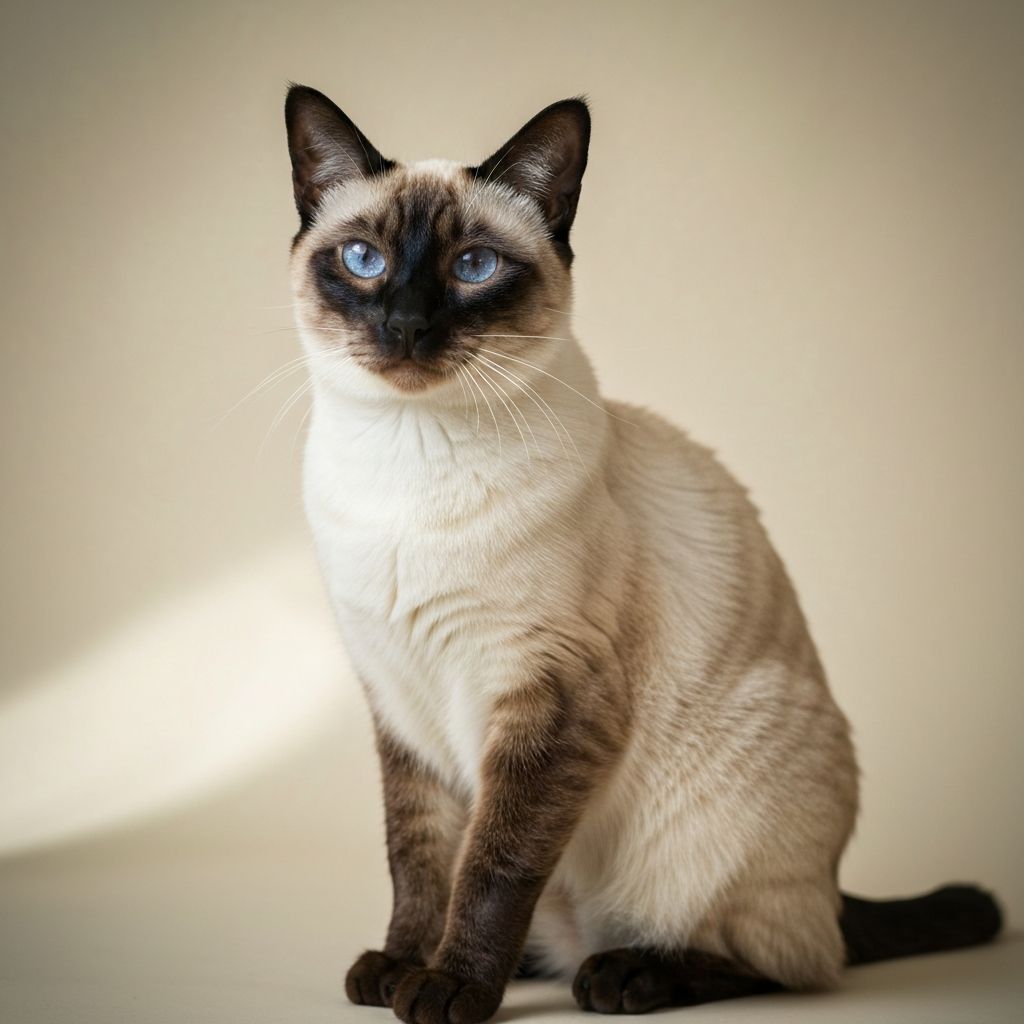
This self-confidence has, moreover, royal papers. The Siamese comes from old Siam — today's Thailand — where for centuries it lived in palaces and temples, described already in old manuscripts as a courtly cat. Legend has it that princesses, entering the bath, hung their rings on its kinked tail — and that it was precisely for this reason that it was so diligently guarded. Beyond the country's borders it traveled in only one role: a royal gift. When in 1884 a pair of Siamese named Pho and Mia arrived as a present in London and stood at a show, Europe was struck dumb — no one before had seen a cat with a cream body, a dark mask, and eyes like two sapphires. The sensation continues, unbroken, to this day.
And nature added to the Siamese one more extraordinary signature: its coloring is literally a map of its own body temperature. The dark pigment forms in it only where it is cooler — on the face, ears, paws, and tail — which is why Siamese kittens are born almost white and only over time “develop” like a photograph. The rest of the cat is equally striking: the slender, muscular silhouette of an athlete that in one second can find itself atop the wardrobe, learn to retrieve, walk on a leash, and open doors — most often the ones you have just wanted to leave closed.
But this whole opera has one very serious libretto: love. The Siamese does not talk at you — it talks with you, because it has chosen you as its human and treats that decision deadly seriously. It follows you from room to room, participates in everything, and in the evening reports for duty on your lap like someone returning to their place at the table. And that is why solitude wounds it more than most cats: a Siamese left alone for whole days does not sulk — it suffers, ever more loudly and ever more sadly. This is a cat for someone who really wants a companion. Ideally with a second feline companion for a pair, if the home often stands empty.
At the bowl the Siamese is an athlete and requires a menu worthy of an athlete — and incidentally it has one surprising affliction it is better to know about in advance:
- Animal protein in first place: this slender, muscular silhouette without good protein loses muscle, not fat
- Without needless fillers (corn, soy) — the Siamese's metabolism is set for active life, not for ballast
- Pica, that is, the compulsive eating of inedible things: Siamese are famous for nibbling wool, plastic, or fabrics — put away sweaters and strings, and above all give it enough play and occupation that boredom does not eat away at it (or your wardrobe)
- Always fresh water — this is the foundation of the work of its kidneys, which with this breed are worth caring for especially
- Portions to match real activity: a young Siamese is a perpetual motion machine, but an older gentleman can slow down — the bowl should slow down along with it
Beyond the bowl, it is worth remembering a few matters typical of the breed:
- Amyloidosis: Siamese are predisposed to the deposition of amyloid protein in the liver and kidneys — regular blood tests at the vet allow trouble to be caught early
- Teeth: this is one of the breeds in which oral hygiene really counts — accustom it to brushing from kittenhood
- Airways: they can be sensitive, so smoke, dust, and intense smells are not its friends
- Warmth: this cat from the tropics sincerely cannot stand cold — the warmest blanket in the home it regards as common property, and your duvet as recovered territory
- A head for work: puzzles, retrieving, learning tricks — a Siamese without occupation will find a project of its own, and its projects rarely coincide with yours
Because the Siamese cat is not an animal to own — it is a full-time relationship, with overtime and a very well-developed communications department. With good care this conversation can last as long as twenty years: two decades of comments, monologues, interjections, and that one quiet goodnight purr, delivered straight into your neck.
And one thing must be settled at the start, so there are no misunderstandings later: the last word in this house will always belong to it. But when you hear how much tenderness it can fit into that last word — you will give it to it yourself.
See also: Thai
Most common health issues
A tendency to infections and irritations of the upper respiratory tract, more common in breeds with a sensitive build. It is worth ensuring a calm environment free of smoke and dust, as well as good hydration. Strong immunity begins with a complete diet - and recurring symptoms always require a visit to the vet.
A disease in which the amyloid protein is deposited in organs (in cats most often in the liver or kidneys), over time disrupting their function. It can be hereditary. Regular blood tests at the vet help catch the problem early, and good-quality, easily digestible nutrition supports the burdened organs.
Health issues
2 most common conditions
Health issues
2 most common conditions
A tendency to infections and irritations of the upper respiratory tract, more common in breeds with a sensitive build. It is worth ensuring a calm environment free of smoke and dust, as well as good hydration. Strong immunity begins with a complete diet - and recurring symptoms always require a visit to the vet.
A disease in which the amyloid protein is deposited in organs (in cats most often in the liver or kidneys), over time disrupting their function. It can be hereditary. Regular blood tests at the vet help catch the problem early, and good-quality, easily digestible nutrition supports the burdened organs.
Nutritional needs
Cat hydration - why wet food matters
Cats naturally have a low thirst drive and often drink too little water. Their ancestors - desert cats - obtained water mainly from food. Wet food contains 70-80% water, which significantly supports hydration and helps prevent kidney and urinary tract problems.