Thai
(Kot Tajski)
Origin: Thailand
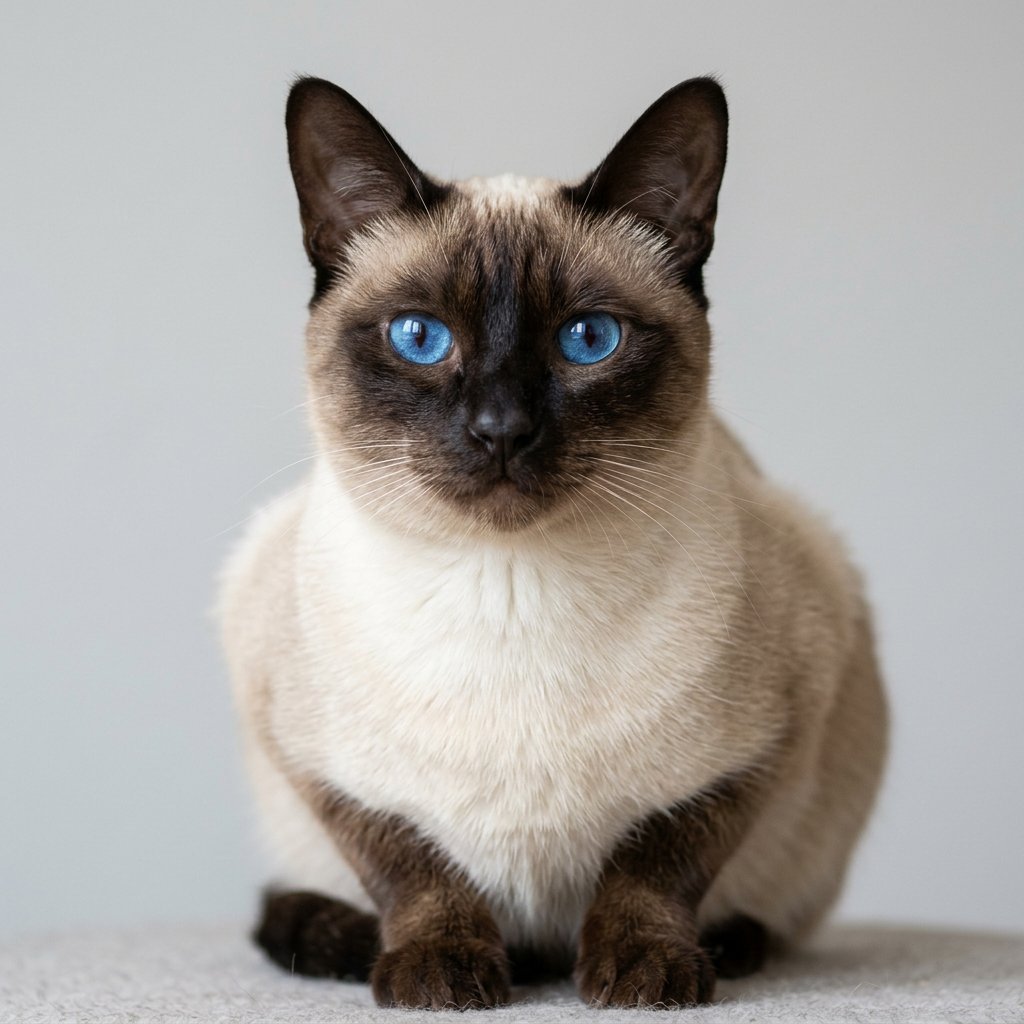
The Siamese you remember from childhood is no longer called a Siamese. The cream cat with the dark, round face and blue eyes had to change its name in order to stay itself. Today it is the Thai cat.
The Siamese you remember from childhood is no longer called a Siamese. This is the cat that belonged to an aunt or to the neighbour on the third floor: cream, with a dark, round face and blue eyes, which lay on top of the wall unit, sized up the guests and had a settled opinion about each one's calves. If you are too young for that, ask your parents, because in the Poland of the 1980s nearly everyone knew someone with a Siamese. And if you later went looking for it at cat shows, you found an animal that was long and thin, with a head like a wedge and ears like sails, and you thought your memory was playing tricks. It was not. That cat exists, is doing well and looks exactly the same. It simply had to change its name in order to stay itself. Today it is the Thai cat.
In its homeland it was known long before there was any breed name at all. In old Siam cats were described in verse: in the manuscripts of the Tamra Maew, a treatise on cats copied over the centuries, there is a pale cat with a dark face, ears, paws and tail called the wichienmaat, which is translated as moon diamond. It reached Europe at the end of the nineteenth century and caused a sensation as the Siamese cat. And then the show world took it in hand. From the middle of the twentieth century breeders selected cats that were ever longer, slimmer and more angular, until the new type had taken over the shows entirely, name included. The round-headed cats were left with the nickname "applehead" and the homes of ordinary people, Polish flats with wall units among them. In the 1980s their admirers began to set up clubs of their own, and in 1990 one of the international federations recognised the old type as a separate breed. It called the breed Thai, which has a logic of its own: Siam also changed its name, to Thailand, in 1939, and also remained the same country. In Poland, for that matter, it is like a street whose name has been changed. The sign says one thing, and people go on saying: Siamese.
The character matches what you remember too, with one correction. The Thai is cheerful, lively, talkative and very human in its manner: it follows the household from room to room and takes part in everything, from unpacking the shopping to making the bed. It tends to be a little calmer than today's Siamese. It learns tricks quickly, especially for a reward, and can be accustomed to a harness. It cannot stand being alone. And the correction concerns the calves. Those cats were not spiteful. They were highly intelligent and bored to death, in an age when nobody had heard of a scratching post, a feather wand or the idea that a cat needs to be played with. A Thai that has something to do and someone to do it with does not attack guests. It meets them at the door and tells them what has been going on.
There is one more thing from those years. Your aunt's Siamese loved your aunt. It slept on her lap and waited outside her door, and you were told: don't touch, it'll scratch. So you sat on the sofa looking at the most beautiful cat you had ever seen, and you were not allowed to touch it. Adults who, thirty years on, drive out to look at a litter of Thai kittens often cannot explain what exactly they are going for. It is simple. They are going for that cat. Only this time for their own.
One thing does have to be left in the past, though: the bowl. The Siamese on the wall unit ate what was left over from dinner, washed it down with a saucer of milk, and nobody saw anything wrong with that. Today we know that most adult cats digest milk poorly, and that scraps from a plate are not a complete meal for a cat. So nostalgia ends at the kitchen door.
In a Thai cat's bowl:
- A complete food with plenty of animal protein and few carbohydrates. This is a lean, muscular cat, and muscle comes from meat
- No milk and no table scraps. If you want to treat it, let it be a piece of cooked meat counted in the daily portion
- Measured portions: it is lively, but it lives indoors, and after neutering it gains weight more easily than you would think
- Wet food in the daily diet and fresh water always within reach
- Teeth: periodontal disease is common in this family of cats, so brushing is worth starting in kittenhood
Beyond the bowl a few things are worth remembering:
- Company: do not leave it alone all day. If the home is often empty, think about a second cat
- Occupation: daily play, a scratching post, shelves and trick training. These are the same cats as before, so when bored they behave the same way
- Health: the breed is regarded as healthy. Progressive retinal atrophy and gangliosidosis are described in the Siamese family, so ask the breeder about the parents' tests
- Warmth: it has a short coat with no undercoat and is sincerely fond of the radiator, a blanket and your duvet
- Home: it does best as an indoor cat, with a safe window or a netted balcony
So one day you will drive out to look at a litter, just to look. One of the kittens will raise its head: cream, with a dark, round face and blue eyes. For a second you will be eight years old, sitting on the sofa at your aunt's.
This time you are allowed to stroke it.
See also: Siamese
Most common health issues
A tendency toward tartar buildup and periodontal disease, which lead to gum inflammation, pain, and tooth loss. It's worth reacting to bad breath and taking care of regular tooth cleaning. Food with the right texture and oral hygiene limit plaque buildup.
A tendency to infections and irritations of the upper respiratory tract, more common in breeds with a sensitive build. It is worth ensuring a calm environment free of smoke and dust, as well as good hydration. Strong immunity begins with a complete diet - and recurring symptoms always require a visit to the vet.
A hereditary eye disease described in the Siamese family of cats, in which the retina gradually loses function and vision deteriorates first in dim light. It is painless, so the first sign is often the cat moving uncertainly at dusk. A breeder can rule out carrier status with a DNA test on the parents; diet does not halt the disease.
Health issues
3 most common conditions
Health issues
3 most common conditions
A tendency toward tartar buildup and periodontal disease, which lead to gum inflammation, pain, and tooth loss. It's worth reacting to bad breath and taking care of regular tooth cleaning. Food with the right texture and oral hygiene limit plaque buildup.
A tendency to infections and irritations of the upper respiratory tract, more common in breeds with a sensitive build. It is worth ensuring a calm environment free of smoke and dust, as well as good hydration. Strong immunity begins with a complete diet - and recurring symptoms always require a visit to the vet.
A hereditary eye disease described in the Siamese family of cats, in which the retina gradually loses function and vision deteriorates first in dim light. It is painless, so the first sign is often the cat moving uncertainly at dusk. A breeder can rule out carrier status with a DNA test on the parents; diet does not halt the disease.
Nutritional needs
Cat hydration - why wet food matters
Cats naturally have a low thirst drive and often drink too little water. Their ancestors - desert cats - obtained water mainly from food. Wet food contains 70-80% water, which significantly supports hydration and helps prevent kidney and urinary tract problems.