American Staffordshire Terrier
(Amstaff)
Origin: USA
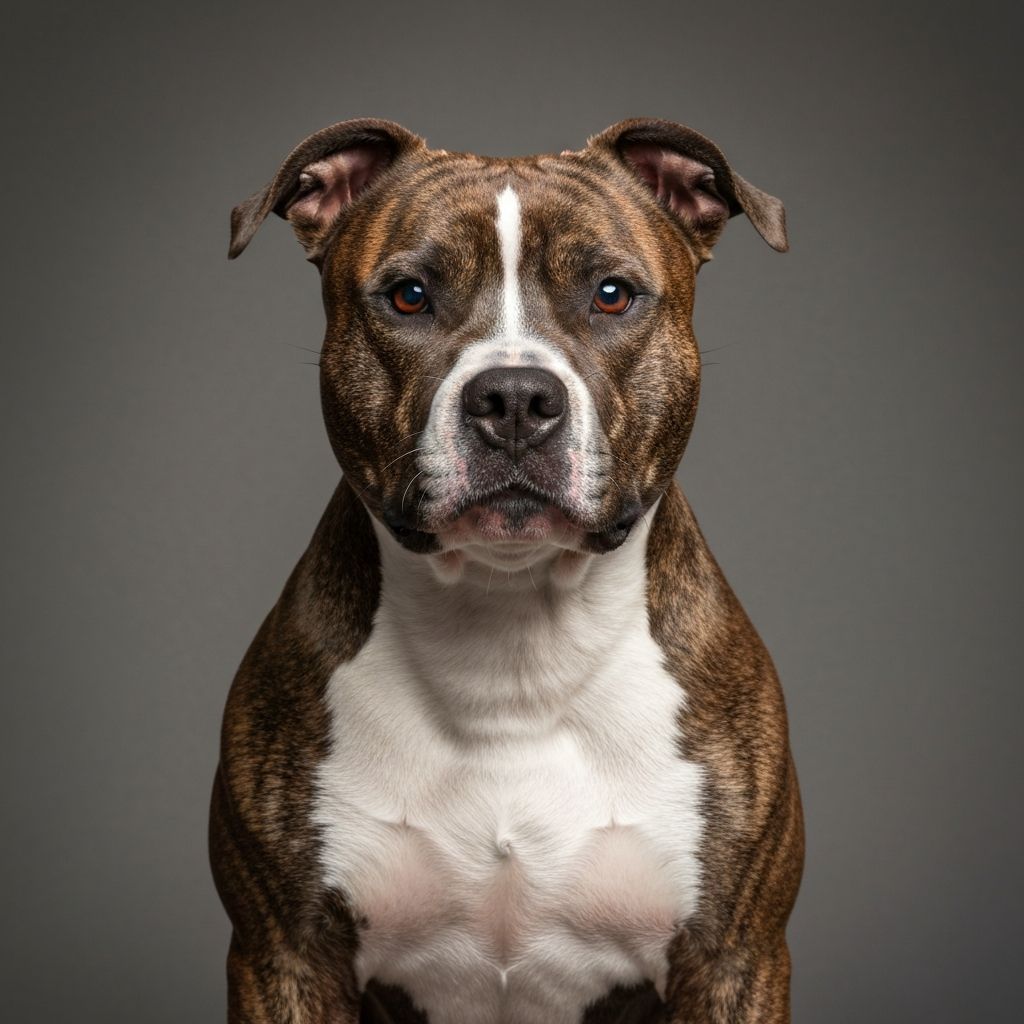
The Amstaff is a walking paradox: a muscular tough guy with the reputation of a fearsome dog, and in reality one of the most tender dogs, most in love with people, that exists.
If a burglar were to sneak into a home where an Amstaff lives, the most likely scenario is one in which the dog greets them with a joyful wag and races off for its favorite ball, counting on a new playmate. And this one sentence says more about this breed than all its fearsome fame. Because the Amstaff — the American Staffordshire Terrier — is one of the most misunderstood dogs in the world: stocky, muscular, with a broad smile and an even broader chest, it looks exactly the way the headlines and urban legends would have you see it. Meanwhile the truth about its character is almost completely the opposite. The breed derives from old bull-and-terrier type dogs and has a difficult history behind it, but the people who shaped it deliberately fixed one trait: boundless friendliness toward humans. The result? The Amstaff is a dog that simply adores people — sometimes even too much.
In daily life this fearsome-looking tough guy turns out to be an endearing lover of cuddling, convinced that all of humanity was created solely to love it — and that its sacred duty is to return this love with interest. As a guard dog it therefore, to put it mildly, comes off poorly: its powerful silhouette can be the only element of protection you can count on, because all the rest of the Amstaff greets every guest as if they had come solely to play with it. On top of this it considers itself, with deep conviction, a couch dog and sees not the slightest problem in arranging its thirty kilograms of muscular body on your lap, pinning you down with the expression of a blissfully happy infant. And that famous smile of its — wide, toothy, from ear to ear — appears at the slightest occasion and carries with it so much sincere joy that it is hard not to laugh along. It is a dog that loves life loudly, restlessly, and with its whole self.
And it is precisely this capacity for love that is the most beautiful thing in the Amstaff — and at the same time the most unjust in its fate. Because it is hard to find a dog more devoted to its people: the Amstaff attaches itself to the family with all its heart, gravitates toward every household member, is famous for its patience and tenderness toward children, and longs for one thing — to be close, to take part in everything, to belong. And despite this it still too often gets judged before anyone has come to know its true nature, condemned by a reputation that, as a particular dog, it most often did not deserve at all. People who share their lives with an Amstaff know the truth that is not visible at first glance: that it is one of the most tender, most faithful, and most grateful dogs one could dream of. Of course this strength and temperament come with obligations — the Amstaff needs a wise owner, good socialization from puppyhood, consistency, and a considerable dose of movement, and its self-assurance toward other dogs requires sensible guidance. But when it lands in the right hands, it repays with a devotion so total that it can disarm every prejudice.
This muscular athlete has very concrete nutritional needs, and a well-chosen diet is visible on it literally everywhere — in the silhouette, coat, and condition:
- A high-quality food rich in full-value protein (roughly 25–30%) — this is the building block its impressive muscle mass needs
- Omega-3 fatty acids and healthy fats — they support the skin and coat, because Amstaffs can be prone to skin allergies, which a good diet can clearly soothe
- A lean, athletic, and fit silhouette — with such an active and strongly built dog this is the foundation of joint protection
- The amount of food matched to its considerable activity and measured with reason, because muscular does not mean fat
Beyond diet, with the Amstaff it is worth remembering a few matters:
- Joints: hip dysplasia can be a problem of the breed, and with its activity and strength ligament injuries also occur — a lean weight and sensible movement help greatly here
- Skin: the tendency toward skin allergies means it is worth observing itching, redness, or recurrent infections and reacting with an appropriate diet and veterinary care
- Heart and prevention: in the breed cardiac burdens occur, so regular examinations are a wise habit
- Movement and the head: this is a strong, energetic, and intelligent dog — it needs a considerable dose of activity and occupation for the mind, without which frustration is easy
- Permit: in Poland the American Staffordshire Terrier is not on the official list of breeds regarded as aggressive, so no permit is needed — it is, however, often confused with the American Pit Bull Terrier, which is on that list
There are few dogs with which appearances are as misleading as with the Amstaff — a tough guy in build, and an incurable romantic in heart, who longs for nothing more than to love and be loved. This is not a dog without requirements: it needs a responsible, conscious owner who will give it movement, guidance, and the chance to show who it really is. But for someone who gives it that chance, it becomes one of the most faithful friends life can give.
Care for its muscles, skin, and joints, give it movement, wise guidance, and plenty of the closeness it so craves, and it will repay you with a love that knows no moderation at all. Because when this muscular sweetheart jumps onto your lap, smiles that ear-to-ear smile of its, and looks at you as if you were the best thing that ever happened to it, all that fearsome reputation turns out to be one great misunderstanding. And you have a privilege that half the world denies it: you have come to know the truth. That it is one of the most tender and faithful canine hearts that beat on this earth — and that it beats precisely for you.
See also: American Pit Bull Terrier, Boxer, Rottweiler
Most common health issues
A congenital abnormality in which the head of the femur does not fit perfectly into the socket, over time leading to joint degeneration and pain. It mainly affects large and giant breeds, though it can occur in small ones too. Watch for reluctance to jump, a "bunny-hopping" gait, and stiffness after rest. A lean build and controlled exercise take pressure off the hips, while omega-3 fatty acids support the cartilage.
Skin hypersensitivity manifesting as itching, redness, paw-licking, and recurring infections. It is triggered by environmental allergens or food ingredients. It's worth observing what makes the scratching worse. A diet with a limited number of protein sources and omega-3 fatty acids strengthen the skin barrier and soothe inflammation.
Health issues
2 most common conditions
Health issues
2 most common conditions
A congenital abnormality in which the head of the femur does not fit perfectly into the socket, over time leading to joint degeneration and pain. It mainly affects large and giant breeds, though it can occur in small ones too. Watch for reluctance to jump, a "bunny-hopping" gait, and stiffness after rest. A lean build and controlled exercise take pressure off the hips, while omega-3 fatty acids support the cartilage.
Skin hypersensitivity manifesting as itching, redness, paw-licking, and recurring infections. It is triggered by environmental allergens or food ingredients. It's worth observing what makes the scratching worse. A diet with a limited number of protein sources and omega-3 fatty acids strengthen the skin barrier and soothe inflammation.
Nutritional needs
Proper hydration for your dog
Proper hydration is essential for a dog's health. Dogs need constant access to fresh water, especially on hot days and after physical activity. Wet food can serve as an additional source of fluids.
Best foods for the American Staffordshire Terrier
Ranking based on nutrient analysis and breed requirements