Rottweiler
Origin: Germany
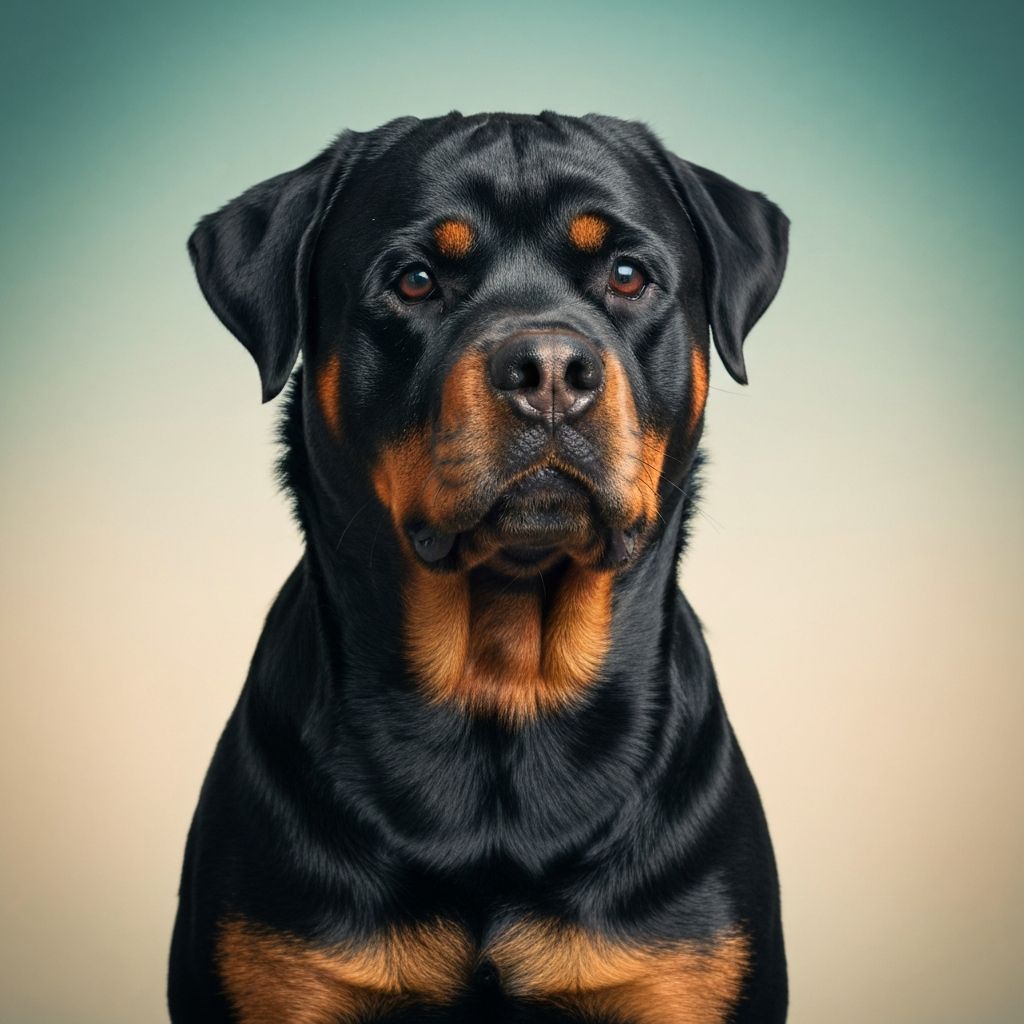
The Rottweiler looks like a tank, has a reputation as a tough guy, and is devoutly convinced that it's a dog meant to be carried in your arms.
The Rottweiler is one of the most misunderstood dogs in the world. On the outside: a powerful, muscular build, a serious face, and a reputation that runs a few steps ahead of it. On the inside: a tender, devoted homebody that's absolutely convinced it's a dog meant to be carried on your lap — and it won't accept any arguments on the matter concerning body mass. Because the Rottweiler, despite its not-infrequent fifty kilograms, sees itself deep down as a lovely little dog that simply wants to be close.
And yet this homebody has two thousand years of unbroken service behind it. Its ancestors traveled across the Alps with the Roman legions as drovers of their herds — and settled in a small town named Rottweil after its red roof tiles. There, for centuries, the dog worked for the local cattle dealers: it led herds to market, guarded the business, and after a successful sale the merchant did a thing that says everything about this breed — he hung a pouch with all the takings around the dog's neck. No one in their right mind tried to take it; the Rottweiler was the safest vault in town. When the railways took the dogs' cattle work away, the breed nearly vanished — it was saved by a new calling: Rottweilers became some of the first police dogs in the world. Two thousand years, one profession: to guard what is most precious to its people. Only what was most precious changed. Today it knows exactly — the most precious thing sleeps with it under one roof.
This is best seen in its signature gesture of affection: the Rottweiler doesn't so much cuddle as lean against you with its full weight and slowly transfer onto your legs as much of its mass as it can — in the full conviction that this is a subtle expression of attachment and not an attempt to topple you onto the couch. The menacing face can also be misleading: the same dog that a moment ago was guarding the house with a professional's seriousness, five minutes later is lying on its back with its paws up demanding a belly rub. The Rottweiler takes its duties very seriously — but it loves you shamelessly, softly, and without a shadow of reserve.
Because the truth about this breed is that it's one of the most faithful and most balanced companions you can have at your side. The Rottweiler doesn't love loudly or for show — it loves calmly, firmly, and with all of itself. Well-raised, it's self-assured, composed, and gentle toward its family, and it carries that strength of its with the dignity of a dog that knows what it's capable of and, precisely for that reason, doesn't have to prove it to anyone. It will stand between you and whatever it deems a threat without a moment's hesitation — and then it will come back, rest its head against your knee, and wait for a single word from you. It's a dog that says with all of itself: I'm here, you're safe, you belong to me just as I belong to you.
There is, however, one area in which this enormous dog needs you to be wiser than its appetite. The Rottweiler is a breed with a considerable tendency to gain weight and, at the same time, exceptionally prone to hip joint problems — they affect roughly one in five dogs of this breed. On a frame weighing as much as fifty kilograms, every extra kilogram is an enormous, daily burden on hips that already have an uphill task.
In a Rottweiler a lean, muscular weight isn't a matter of aesthetics — it's directly a concern for its ability to move without pain:
- A portion matched to its target weight and real activity, not to its pleading gaze
- A lean, athletic figure as an iron goal throughout the dog's life
- In a puppy, a calm, controlled rate of growth (large-breed food) — with too rapid a gain in mass the skeleton simply can't keep up, and it's the developing joints that pay for it
- Joint support and a well-considered diet discussed with the vet
With so powerful a dog it's also worth keeping a finger on the pulse in a few matters:
- Joints: watch its movement and respond early to stiffness or reluctance to get up
- A large, deep chest: as in many large breeds, it's safer to split food into two meals and to avoid intense exertion right after eating
- Oncological vigilance: this is a breed more prone to bone cancer, so any persistent lameness is worth checking with a vet
- Exercise with sense: plenty, but reasonably — the kind that builds the muscles that take the load off the joints
- Permit: in Poland the Rottweiler is on the official list of breeds regarded as aggressive, so keeping one requires a permit from the head of the municipality (wójt, mayor or city president) — the application is made at the municipal office for the place where the dog will live
Because with the Rottweiler comes one bittersweet truth that must be said plainly: large dogs live shorter lives than we would wish, and this devoted guardian usually gives us only a few, perhaps a dozen or so years. That hurts — but it's also the strongest possible argument for making every year together as good and as healthy as it can be.
Take care of its lean figure and strong joints, and you'll give it exactly what this great, soft giant desires most: as many days as possible in which it can stand guard over what it loves, and then come, lean against you with all its weight, and feel that it's home. Because for the Rottweiler, home isn't a place. Home is you.
See also: Doberman Pinscher, Cane Corso, Mastiff
Most common health issues
A congenital abnormality in which the head of the femur does not fit perfectly into the socket, over time leading to joint degeneration and pain. It mainly affects large and giant breeds, though it can occur in small ones too. Watch for reluctance to jump, a "bunny-hopping" gait, and stiffness after rest. A lean build and controlled exercise take pressure off the hips, while omega-3 fatty acids support the cartilage.
An aggressive bone tumor, occurring more often in large and giant breeds, most commonly in the limb bones. The first sign is often persistent lameness or painful swelling requiring urgent consultation. Maintaining a healthy weight eases the skeleton, while a well-balanced diet supports overall condition.
Health issues
2 most common conditions
Health issues
2 most common conditions
A congenital abnormality in which the head of the femur does not fit perfectly into the socket, over time leading to joint degeneration and pain. It mainly affects large and giant breeds, though it can occur in small ones too. Watch for reluctance to jump, a "bunny-hopping" gait, and stiffness after rest. A lean build and controlled exercise take pressure off the hips, while omega-3 fatty acids support the cartilage.
An aggressive bone tumor, occurring more often in large and giant breeds, most commonly in the limb bones. The first sign is often persistent lameness or painful swelling requiring urgent consultation. Maintaining a healthy weight eases the skeleton, while a well-balanced diet supports overall condition.
Nutritional needs
Proper hydration for your dog
Proper hydration is essential for a dog's health. Dogs need constant access to fresh water, especially on hot days and after physical activity. Wet food can serve as an additional source of fluids.