Dachshund
(Jamnik)
Origin: Germany
The dachshund is a big, brave special-ops dog that nature saddled with an undercarriage the size of a footstool — and that couldn't care less about the fact.
The dachshund was built for a task no one else would take on: to go down underground, into cramped, dark tunnels where the badger lived — a host bigger than the dog and sincerely displeased by visits. The name itself says so: the German “Dachshund” means literally “badger dog.” Such work called for courage that counted for more than size — and that courage shaped the dachshund to the marrow. The trouble is that nature threw in an undercarriage the size of a solid footstool, about which the dachshund, to its credit, couldn't care less. In its world there's still a very real chance that a badger is lurking behind the couch, and someone finally has to deal with it.
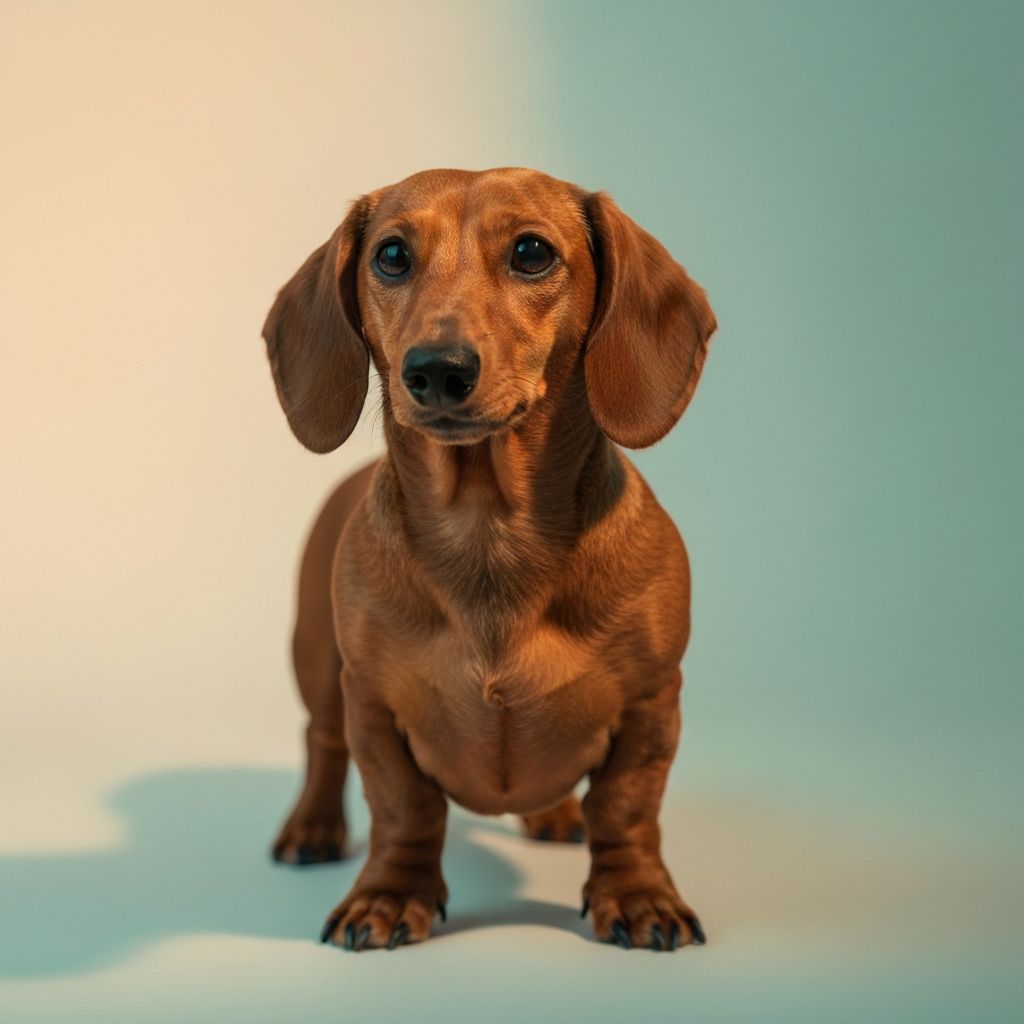
Its whole silhouette is, moreover, no whim of fashion but professional working gear: the short, powerful legs work like shovels, the elongated body fits where no other dog would so much as peer, and a champion-class nose leads it through the dark more reliably than a flashlight. From the underground tunnels the dachshund advanced in time straight into hearts and pop culture — its outline can be drawn effortlessly by any child in the world, and in 1972 a dachshund named Waldi became the first official Olympic mascot in history. Not a bad career for a dog that started with a job no one was fighting over.
From that underground past the dachshund also carried away a character one might gently call independent, and honestly — as stubborn as a boulder. It hears you perfectly; it simply puts each of your commands to an internal vote — and usually votes it down. It also has a voice that, in so short a dog, can sincerely take you aback — the bass bark is usually heard before the sender is seen. The digger's instinct has stayed in its paws forever: your flowerbeds it can, without warning, declare an earthworks site, and every blanket in the house — a burrow for immediate settlement, in which it falls asleep rolled up like a pancake. And when it decides it's raining too hard for a walk or that the day's schedule doesn't suit it, it strikes a pose of wounded dignity beside which any dramatic actor looks pale. And by some miracle it remains, through all of this, absolutely charming.
And now for something that, with a dachshund, must be said plainly, because it's the heart of the whole story: all that courage, stubbornness, and great character ride on one long, delicate spine. That famous elongated back is the breed's hallmark — and at the same time its most tender point. The dachshund's intervertebral discs are prone to serious injury: the risk of disc disease (IVDD) in this breed is estimated to be 10–12 times higher than in other dogs. It sounds serious, because it is. But the good news is that the most important element of protecting that back is within your reach — every day, at the bowl.
Because nothing burdens a dachshund's spine like excess weight. Every extra kilogram is an additional load that this long back must carry with every movement, jump, and climb up the stairs. In a dachshund a lean figure isn't a matter of looks — it's literally a matter of whether it will run without pain for a dozen or more years. And since the dachshund loves to eat and is surprisingly enterprising at obtaining food for someone who can barely reach the counter, this is easy to overlook.
That's why at its bowl discipline matters, not magnanimity:
- A measured portion instead of pouring “by eye” — in a stocky dog, excess shows quickly
- Treats counted into the daily limit, not tossed in for a sad look
- Food matched to its target weight, not to its appetite
- When it moves less — for example during rehabilitation after a back injury — the portion should shrink too, because calories always follow activity
- A lean, compact figure as a constant goal, not a seasonal resolution
The bowl alone, however, isn't everything — with a dachshund it's worth thinking about the spine beyond it too:
- Limiting jumps off the couch and bed (that's what little steps or a ramp are for)
- Carrying it with the back supported, not “under the armpits” like a plush toy
- Regular, moderate exercise — strong abdominal and back muscles are a natural corset that takes the load off the spine
- Vigilance about signs of back pain and a quick response at the vet
Because the dachshund is a small dog with a hero's biography and a stubbornness that doesn't know the word “give up.” It will give you years of laughter, character, and that wonderful, obstinate faithfulness of its — a dog that will follow you anywhere, even on short legs and at its own, unhurried pace.
Your part of the bargain is simple: help it stay lean and protect that famous back of its. Do that, and for long years you'll have at your side a fearless companion who, to the end of its life, will remain devoutly convinced that the matter of the badger behind the couch remains open — and that he will personally see to it.
See also: Beagle, Jack Russell Terrier, Miniature Pinscher
Most common health issues
Very common due to the body structure.
Excess body weight that strains the joints and heart and increases the risk of diabetes and metabolic disorders. In some breeds, such as the Labrador, the tendency to gain weight can even be genetically determined. It's worth checking regularly whether the ribs are easily felt and whether the waist is visible from above. Portion control, weighing the food, and daily exercise are the most effective prevention.
Health issues
2 most common conditions
Health issues
2 most common conditions
Very common due to the body structure.
Excess body weight that strains the joints and heart and increases the risk of diabetes and metabolic disorders. In some breeds, such as the Labrador, the tendency to gain weight can even be genetically determined. It's worth checking regularly whether the ribs are easily felt and whether the waist is visible from above. Portion control, weighing the food, and daily exercise are the most effective prevention.
Nutritional needs
Proper hydration for your dog
Proper hydration is essential for a dog's health. Dogs need constant access to fresh water, especially on hot days and after physical activity. Wet food can serve as an additional source of fluids.