English Bulldog
(Buldog Angielski)
Origin: United Kingdom
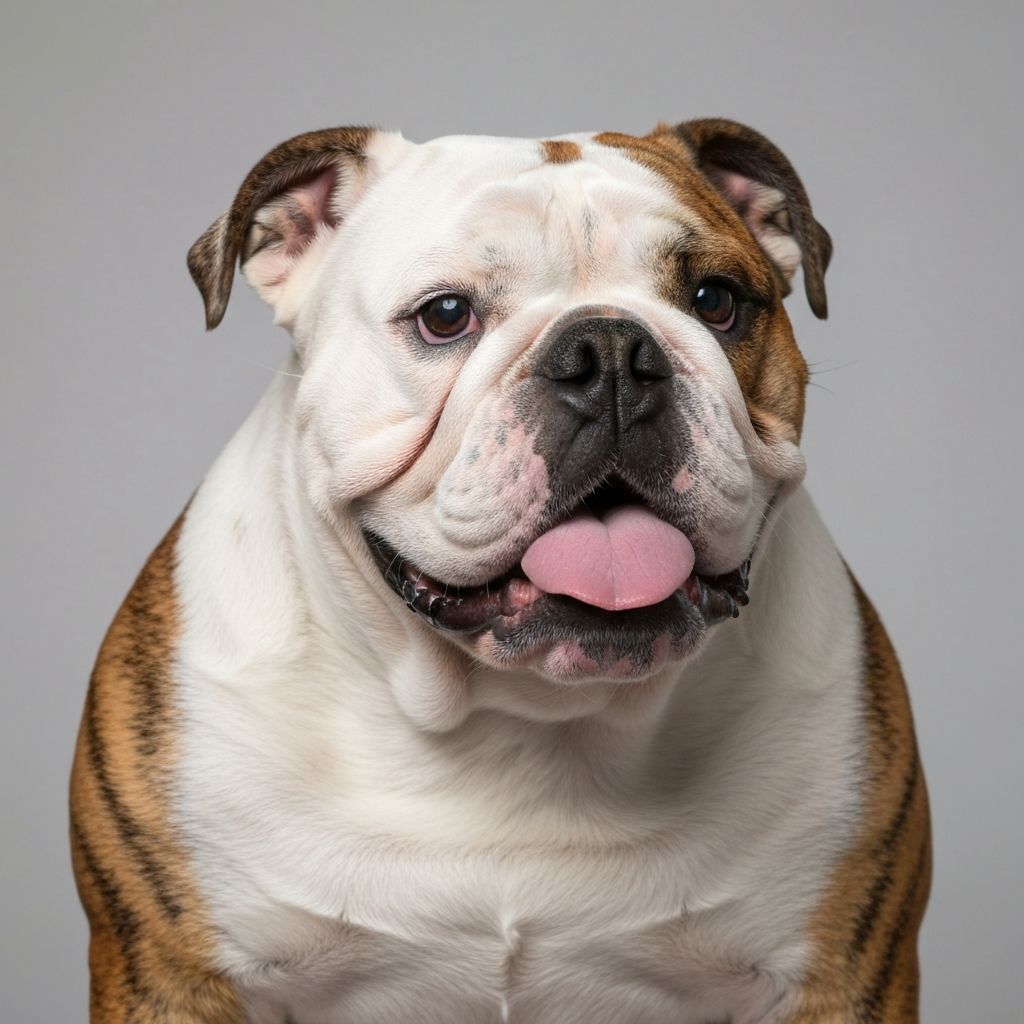
The English Bulldog looks like the most offended creature in the world — a small, wheezing tank with an expression saying “I know all your mistakes” — and is in reality the most tender, most lazy philosopher of happiness the earth has ever borne.
Let us start with what catches the eye first: that face. The English Bulldog has the facial expression of a creature that has just heard exceptionally bad news and intends to hold someone responsible for it — a wrinkled brow, mournfully drooping cheeks, a chin thrust forward with an expression of everlasting disapproval. It is one of the most recognizable faces in the entire canine world. And it is, down to the last iota, one great bluff. Because in this grumpy mask there is not a gram of real dissatisfaction — instead there is the soul of a calm, blissful sage who long ago cracked the secret of a good life and decided not to waste it on running. And the history of this breed makes this gentleness even more moving: bulldogs were once bred in England for brutal fights with animals, and when that cruel practice was banned, dog lovers did not let the breed disappear — over generations they patiently reforged the former warrior into what the bulldog is today. Into the gentlest bumpkin under the sun, who put all its former pugnacity to one single purpose: the defense of the most comfortable spot on the couch.
Because the modern bulldog is a true virtuoso of stillness. Laziness is not a flaw in it — it is a life philosophy that it practices with a dedication worthy of an athlete. A short walk it will graciously accept, but the suggestion of a longer expedition it will receive with a deep sigh and a look full of reproach, and if need be will simply sit down in the middle of the sidewalk to file a formal complaint. On top of that it is stubborn like no one else — a bulldog is not forced, a bulldog is bribed, and the only accepted bribe is something truly delicious. Once it has finally settled in a spot of its own choosing — preferably spread out on the cool floor like someone who just slid off a melting iceberg — it begins its showpiece number: a concert of snoring with the power of a small combustion engine, interwoven with a whole range of snorts, puffs, and grumbles with which it comments on reality in real time, even in its sleep. And when it wants to show you affection, it simply slumps onto you with all its weight like a sack of cement, turns you into its personal pillow, and instantly falls asleep — without warning, without the right of appeal, and without an escape route.
And this is precisely the whole secret of the bulldog — that wonderful dissonance between the fearsome, sulky shell and a heart so soft it is hard to believe. Because underneath lives a dog that is tender, patient, and attached to its people without reserve, for which there is no greater happiness than being close to them. The bulldog is at the same time disarmingly good-natured — it endures children's teasing with angelic forbearance, holds no grudge, seeks no quarrel, and treats the whole world with the indulgent kindness of someone who really has nothing left to prove. It is a dog that does not dream of adventures or conquests. It dreams of lying right beside you, feeling your closeness, and sleeping through another quiet afternoon with you. And there is something truly moving in this — that a breed a human once created for fighting was given a second chance and used it in the most beautiful way possible: to, instead of fighting, simply love. That whole grumbling theater is merely wrapping. Inside beats one of the most faithful and tender hearts you can find in a canine breast.
This inclination toward blissful idleness has its price, however — and here begins the part that must not be underestimated with a bulldog: weight. This is a dog with little mobility and at the same time a great glutton, so it is very easy to become overweight, and in a bulldog every excess kilogram is a real threat — it burdens the already-difficult breathing and worsens the condition of the skin folds.
That is why you care for its silhouette above all through the bowl, not through running:
- Strictly controlled, precisely measured portions — in such a low-activity dog this is an absolute must, because excess weight simply cannot be “run off”
- A good-quality diet matched to the low activity and considerable tendency to gain weight — a lean silhouette is one of the most important things you can do for a bulldog
- Ingredients supporting the skin and joints (like omega-3 fatty acids), because these are sensitive points of this breed
- Calm during eating, and often a raised bowl too, because a bulldog eating greedily easily swallows air
The bulldog also requires conscious care for the health typical of this build:
- Breathing and heat: the shortened muzzle (brachycephalic syndrome) means the bulldog tolerates heat and exertion poorly — on hot days protect it absolutely from overheating, provide coolness and shade, and never overtire it
- Skin folds: bulldogs have the highest risk of all breeds of inflammation in the folds — they must be regularly cleaned and dried, and a lean silhouette helps greatly with this
- Joints: with this build it is worth watching the weight and reacting to limping or reluctance to move
- Eyes and veterinary checkups: it is worth observing the eyes and visiting the vet regularly, because with this breed an early reaction really changes a great deal
Because the English Bulldog is the best proof that you must not judge a book by its cover — nor a dog by its expression. That whole sulky, grumbling mask is a costume — worn by one of the gentlest, most faithful, and most tender companions a person can have; a being that wants really little — a warm corner, a bit of blessed peace, and your presence — and in return gives you its whole great heart.
Its wish list is short: a lean weight, coolness on hot days, clean folds, and regular vet visits — that is enough to give it what it most deserves: as many good, comfortable years slept through at your side as possible. Because although the bulldog will to the end of its life gaze at the world with the expression of a deeply offended gentleman, underneath beats a heart that long ago abandoned all fighting for one single mission — to be by you and to love you as strongly as it can possibly fit in that stocky, wheezing, wonderful breast.
See also: French Bulldog, Pug, Boxer
Most common health issues
A set of breathing problems resulting from a shortened skull structure: narrowed nostrils and an elongated palate impede airflow. It affects short-muzzled breeds. Warning signs include noisy breathing, snoring, quick tiring, and trouble in the heat. A lean build eases the airways, while feeding from a flat bowl and avoiding overheating relieve the symptoms.
A congenital abnormality in which the head of the femur does not fit perfectly into the socket, over time leading to joint degeneration and pain. It mainly affects large and giant breeds, though it can occur in small ones too. Watch for reluctance to jump, a "bunny-hopping" gait, and stiffness after rest. A lean build and controlled exercise take pressure off the hips, while omega-3 fatty acids support the cartilage.
Health issues
2 most common conditions
Health issues
2 most common conditions
A set of breathing problems resulting from a shortened skull structure: narrowed nostrils and an elongated palate impede airflow. It affects short-muzzled breeds. Warning signs include noisy breathing, snoring, quick tiring, and trouble in the heat. A lean build eases the airways, while feeding from a flat bowl and avoiding overheating relieve the symptoms.
A congenital abnormality in which the head of the femur does not fit perfectly into the socket, over time leading to joint degeneration and pain. It mainly affects large and giant breeds, though it can occur in small ones too. Watch for reluctance to jump, a "bunny-hopping" gait, and stiffness after rest. A lean build and controlled exercise take pressure off the hips, while omega-3 fatty acids support the cartilage.
Nutritional needs
Proper hydration for your dog
Proper hydration is essential for a dog's health. Dogs need constant access to fresh water, especially on hot days and after physical activity. Wet food can serve as an additional source of fluids.