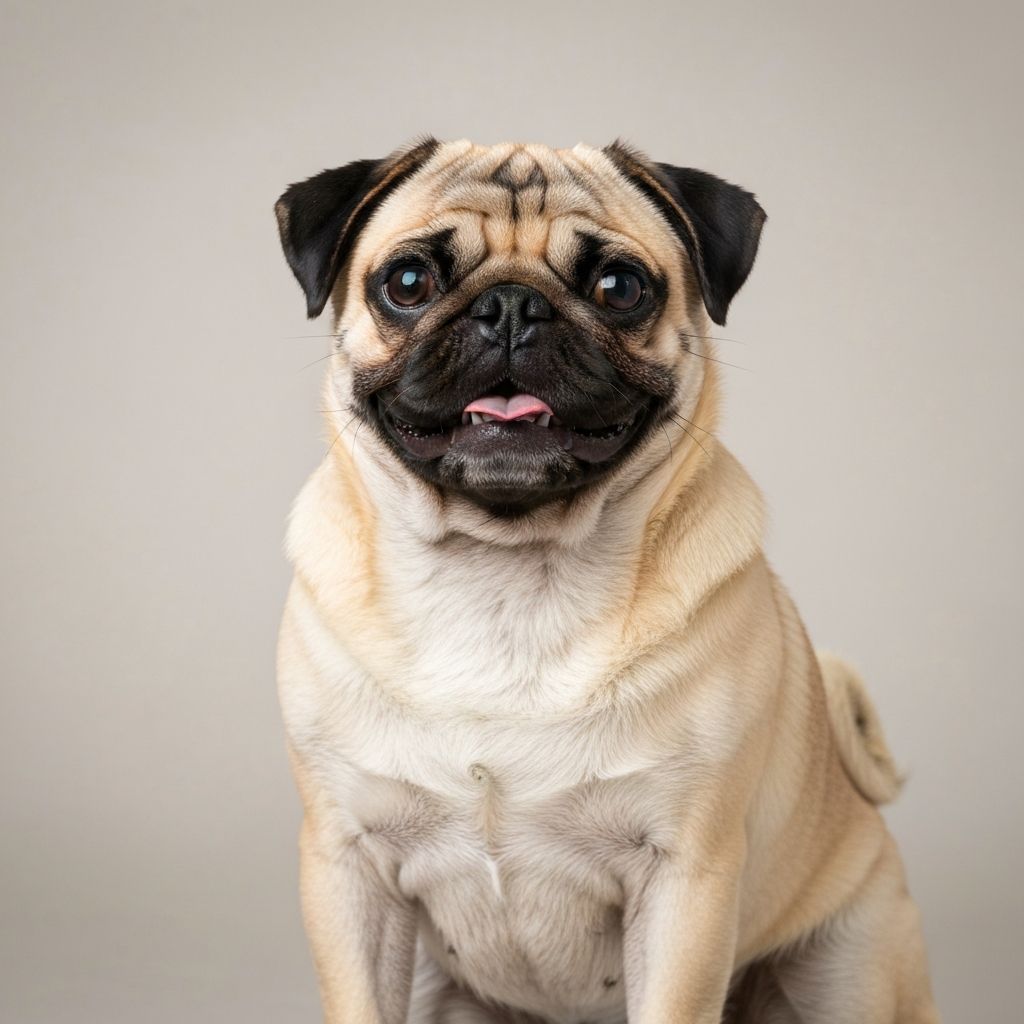
Pug
(Mops)
Origin: China
The pug is a little comedian in the disguise of a philosopher: behind that serious, wrinkled face it's planning only one thing — how to make you laugh and grab a snack along the way.
The pug operates by an old principle its admirers know by heart: multum in parvo, or “much in little.” For in that stocky, small body there lives a personality the size of a room — cheerful, sociable, and gifted with a real comic talent. The pug doesn't just want to be at home. The pug wants to be the home's main attraction. It's happiest when it has an audience and you're laughing at its latest antic — and it does absolutely everything to make sure that's exactly how it is.
As befits a comedian, the pug has, moreover, made a great international career. It began in ancient China as the beloved dog of monks and emperors — legend has it that the wrinkles on its forehead were prized because they formed a mark resembling the word “prince.” But its most famous performance took place in the Netherlands: a pug named Pompey woke the sleeping Prince William of Orange in the middle of the night when enemies had crept into the camp — and with that alarm saved his life. As a reward, pugs became favorites of the whole dynasty and, along with it, eventually reached the English court, and then the drawing rooms of all Europe. Since then this little dog has essentially done one thing: it conquers one court after another. Most recently — yours. Very much in the spirit of its motto: much in little.
It has the perfect equipment for it: that large, round head, the wrinkled forehead, and bulging eyes that can take on literally any expression — from deep contemplation to sincere indignation that someone has just stopped petting it. It communicates, meanwhile, with its own repertoire of snorts, wheezes, and grunts, which after a while you start to understand like a second language. And all this delivered with the gravity of a small dignitary who evidently has no idea that it's hilarious — and that's exactly what makes it funnier still.
All this clowning has, moreover, a tender backstory: the pug is a dog with a genuinely warm, sociable heart. It lives for closeness — but in an active version: quietly lying in a corner isn't enough for it, it wants to take part, to get involved, to be in the very middle of whatever you're doing. It senses moods, meanwhile, better than you might expect from such a jester, and on a bad day it can settle in closer to simply cheer you up with its repertoire of faces. It was always bred purely for companionship and joy — and it takes that role with full devotion. That's why one so badly wants it to stay with us healthy as long as possible.
Here begins the part where the pug really needs your good judgment — because its two great loves, food and being the center of attention, together form a dangerous duo. The pug can beg for a snack in such a way that it stages for you an entire spectacle of astonishment at how it's even possible it hasn't gotten one yet — and since it's a low-activity dog naturally inclined to gain weight, every “reward for being adorable” deposits itself instantly. The secret is simple: don't pay the comedian in food.
Appreciate it with attention, play, and petting, and keep the bowl under control:
- A portion matched to a small, low-activity dog — the pug needs fewer calories than most owners think (and decidedly fewer than it thinks itself)
- Treats counted into the daily limit (for a pug, a few “rewards” already amount to a real excess)
- Good-quality food with kibble convenient for a short muzzle
- Constant weight monitoring, because in that stocky figure excess weight appears quickly and burdens everything at once — breathing first and foremost
The pug also has a few sore points written into its looks, worth keeping in mind day to day:
- A short muzzle: the pug's skull has shortened, but the soft tissues inside have not — hence the narrowed nostrils and the cramped throat. That's why it tolerates heat and exertion less well, and on hot days it needs coolness and calm; a lean figure genuinely makes breathing easier for it
- Snoring and loud wheezing: contrary to popular opinion, this isn't the “charm of the breed” but a signal that breathing is an uphill struggle — a lean, healthy pug breathes much more quietly, and intensified symptoms are worth consulting with a vet
- Little folds on the face: lovely, but they require cleaning and drying, because in the crevices irritation comes easily
- Bulging eyes: exposed and delicate — worth protecting from injury and keeping an eye on
- Moderation in exercise: short, calm walks and play without overheating, ideally during the cooler parts of the day
Because the pug won't dazzle you with either agility or obedience — it does something far harder: it makes sadness hard to come by in its company. It's a small, devoted comedian whose only aim in life is to be close to you and, at every turn, to remind you that life can simply be fun.
Your role in this arrangement is simple and full of tenderness: care for its weight, its breathing, and those funny little folds as attentively as it cares for your good mood. Because a well-managed pug means years of small, cheerful happiness — a comedian who, to the very end, will be convinced that all of this is one big, shared game, and that you're its best audience.
See also: French Bulldog, Boston Terrier, Shih Tzu
Most common health issues
A set of breathing problems resulting from a shortened skull structure: narrowed nostrils and an elongated palate impede airflow. It affects short-muzzled breeds. Warning signs include noisy breathing, snoring, quick tiring, and trouble in the heat. A lean build eases the airways, while feeding from a flat bowl and avoiding overheating relieve the symptoms.
Excess body weight that strains the joints and heart and increases the risk of diabetes and metabolic disorders. In some breeds, such as the Labrador, the tendency to gain weight can even be genetically determined. It's worth checking regularly whether the ribs are easily felt and whether the waist is visible from above. Portion control, weighing the food, and daily exercise are the most effective prevention.
Health issues
2 most common conditions
Health issues
2 most common conditions
A set of breathing problems resulting from a shortened skull structure: narrowed nostrils and an elongated palate impede airflow. It affects short-muzzled breeds. Warning signs include noisy breathing, snoring, quick tiring, and trouble in the heat. A lean build eases the airways, while feeding from a flat bowl and avoiding overheating relieve the symptoms.
Excess body weight that strains the joints and heart and increases the risk of diabetes and metabolic disorders. In some breeds, such as the Labrador, the tendency to gain weight can even be genetically determined. It's worth checking regularly whether the ribs are easily felt and whether the waist is visible from above. Portion control, weighing the food, and daily exercise are the most effective prevention.
Nutritional needs
Proper hydration for your dog
Proper hydration is essential for a dog's health. Dogs need constant access to fresh water, especially on hot days and after physical activity. Wet food can serve as an additional source of fluids.