German Shepherd
(Owczarek Niemiecki)
Origin: Germany
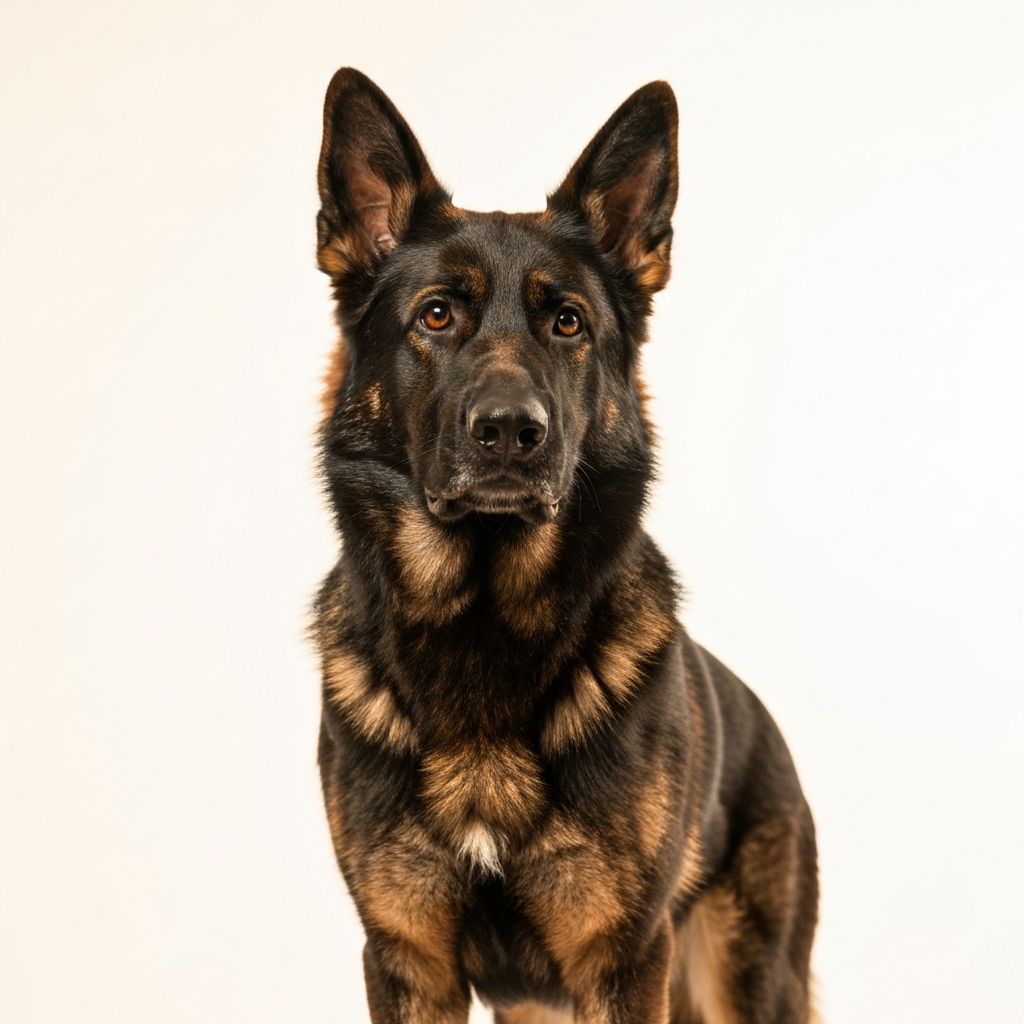
The German shepherd does nothing by halves — neither work nor loving. It's a partner-dog that treats every matter of your day as a shared mission and that can perform almost every profession in the world.
The German shepherd does nothing by halves — and loving least of all. Once it decides you're its person, it stops being a dog “on the side” and becomes a partner in every matter of the day. It goes where you go. It watches what you watch. It lies down exactly between you and the door — just like that, on duty. And it looks at you with that attentive, X-ray gaze of its, as if at any moment it were ready to drop everything and set off with you even to the end of the world — preferably this very second.
This readiness for service didn't come out of nowhere. The German shepherd was conceived at the end of the 19th century by Captain Max von Stephanitz, who set out to create the perfect working dog — clever, brave, and versatile — and from a dog named Horand began the whole breed. The rest unfolded as though the shepherd had decided to personally try out every profession in the world: it was German shepherds that became the first trained guides for the blind, they serve to this day in the police and in rescue teams, and one of them — Rin Tin Tin, a puppy rescued during the war by an American soldier — became Hollywood's greatest canine star and reportedly lost the first Oscar for Best Actor by a hair. Quite a career for a breed that has sheep-herding in its name. And yet of all these professions the shepherd invariably considers one the most important: to be yours.
This is a dog that must have an occupation, because otherwise it will find one for itself. A shepherd without a task can promote itself to head of security for the household: it carries out a document check on every pigeon on the windowsill, treats a closed door as a minor breach of procedure, and, with a serious face, supervises everything that happens in the house. It learns, meanwhile, faster than you can come up with lessons — after a week it knows new commands, after a month it can tell from your shoes whether you're leaving for work or for a walk, and it's hard to resist the impression that, if only it had thumbs, it would open the gate for you itself. That's not overzealousness — it's a need for meaning. This dog wants to be useful, wants to learn, and wants to know that its work matters. Give it that, and you get a partner few people understand until they've had one themselves.
All this magnificent machinery, however, requires conscious care — and that from the very first months of life. The shepherd grows to a considerable size, and its joints and hips are a well-known sore point of the breed. A rule applies here that sounds counterintuitive: in a puppy, less means better. Too-rapid growth and an excess of calories in youth are a straight path to joint troubles in the future. Calm, even development gives a stronger, fitter dog for long years — and with a shepherd it's always those years that matter most. The second sore point is less obvious and can be truly dangerous: the shepherd's deep chest raises the risk of gastric torsion (bloat) — a sudden condition that can threaten life. On top of that, many shepherds simply have sensitive digestion — and there's a rarer but very “shepherd-typical” trouble: EPI, or exocrine pancreatic insufficiency. As much as 70% of all diagnoses of this disease fall precisely on German shepherds. Such a dog eats normally and yet loses weight and is perpetually hungry, because without enzymes given with meals it simply cannot digest its food — fortunately, once diagnosed, EPI can be managed well.
That's why with this breed it matters not only what it eats but how:
- A meal split into 2–3 smaller portions over the day, instead of one large one
- A moment of calm right after eating — no running or wild play
- Easily digestible, good-quality food, gentle on the stomach
- A calm eating pace (a slow-feeder bowl if it wolfs food down in a flash)
The rest is feeding tailored to what the shepherd really is: a large, clever, and very active dog that burns a good deal of energy and, throughout its life, needs support for its joints:
- A portion matched to its age, weight, and genuinely high activity
- Support for the joints and hips — especially in a growing dog and an older one
- Good-quality protein for the muscles of a working body
- Training treats counted into the daily allowance (and the shepherd learns a great deal)
- Probiotics and a steady, repeatable food for delicate intestines — and when the dog loses weight despite a ravenous appetite, it's worth testing it for EPI
- Constant monitoring of its figure, because excess weight burdens joints that are already sensitive
Because the German shepherd gives you something that can't be forced or bought: full, conscious commitment. It really is on your side — on a good day and a worse one, at the door and by the couch, on duty and napping right beside you. In return it needs clear rules, an occupation for that sharp head of its, and care that protects its strong but not indestructible body.
And then you'll see that this dog doesn't so much live with you as walk through life shoulder to shoulder. And it does so with the seriousness of someone who, of all the professions in the world, has been given the most important one — you — and has no intention of letting it down.
See also: Belgian Malinois, White Swiss Shepherd, Hovawart
Most common health issues
A congenital abnormality in which the head of the femur does not fit perfectly into the socket, over time leading to joint degeneration and pain. It mainly affects large and giant breeds, though it can occur in small ones too. Watch for reluctance to jump, a "bunny-hopping" gait, and stiffness after rest. A lean build and controlled exercise take pressure off the hips, while omega-3 fatty acids support the cartilage.
Sudden distension and twisting of the stomach; a directly life-threatening condition requiring immediate veterinary care. The risk rises in large breeds with a deep chest. Warning signs include unproductive attempts to vomit, a bloated belly, and restlessness. It helps to split the daily portion into 2-3 smaller meals and to avoid intense exertion right after eating.
Health issues
2 most common conditions
Health issues
2 most common conditions
A congenital abnormality in which the head of the femur does not fit perfectly into the socket, over time leading to joint degeneration and pain. It mainly affects large and giant breeds, though it can occur in small ones too. Watch for reluctance to jump, a "bunny-hopping" gait, and stiffness after rest. A lean build and controlled exercise take pressure off the hips, while omega-3 fatty acids support the cartilage.
Sudden distension and twisting of the stomach; a directly life-threatening condition requiring immediate veterinary care. The risk rises in large breeds with a deep chest. Warning signs include unproductive attempts to vomit, a bloated belly, and restlessness. It helps to split the daily portion into 2-3 smaller meals and to avoid intense exertion right after eating.
Nutritional needs
Proper hydration for your dog
Proper hydration is essential for a dog's health. Dogs need constant access to fresh water, especially on hot days and after physical activity. Wet food can serve as an additional source of fluids.