Hovawart
Origin: Germany
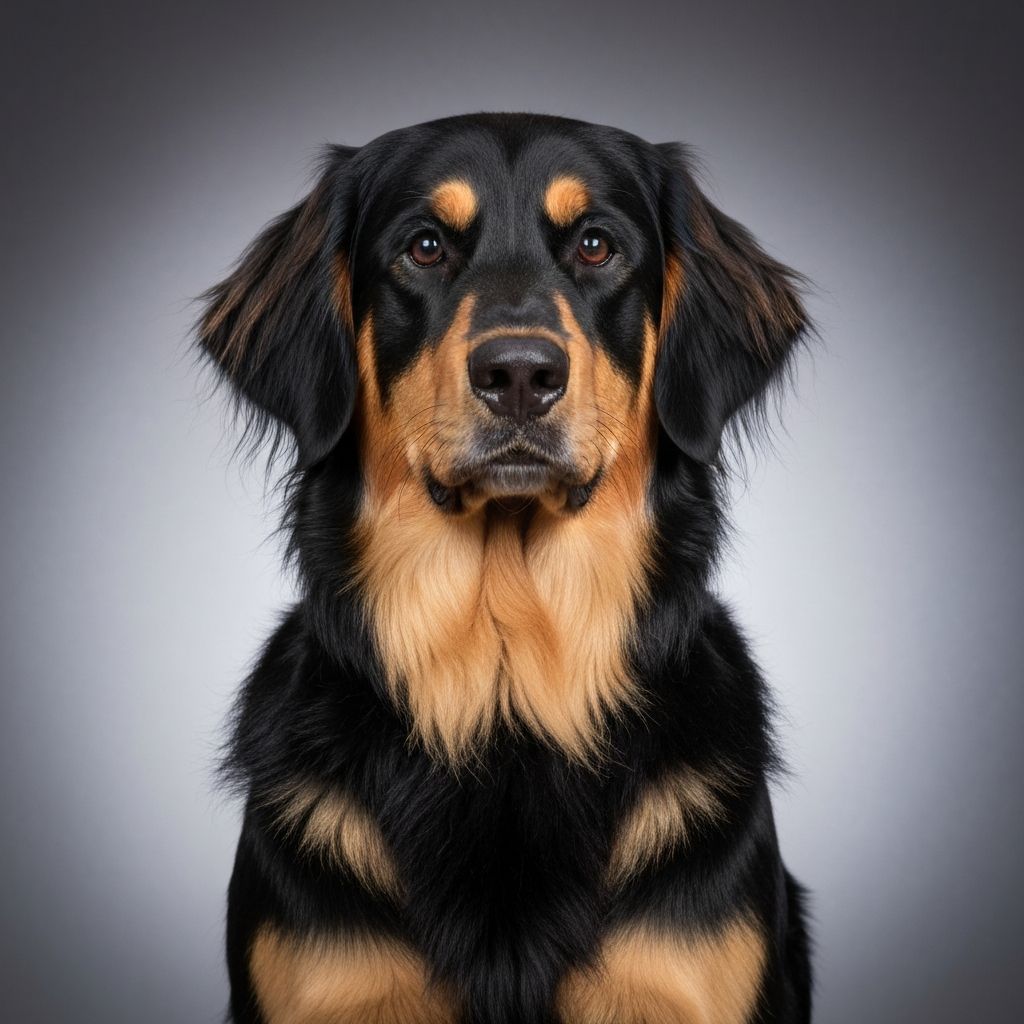
The Hovawart is one of the oldest German guard dogs, whose name means literally “guardian of the homestead” — a calm, deliberate, and boundlessly devoted protector whose whole calling is written into its name.
Some dogs get their name from their appearance, others from their coloring. The Hovawart got it directly from its task — because its name, derived from the old “Hofewart,” means literally “guardian of the homestead.” And rarely does a name suit a dog quite so perfectly, because the Hovawart is a watchdog to the marrow — except a watchdog that does not flaunt this role at all. This is one of the oldest breeds of Germany: already in the Middle Ages dogs of this type watched over farms, manors, and castles, guarding the property and family of their masters. Over the course of centuries the breed almost disappeared, and only in the 20th century did a handful of enthusiasts laboriously restore it to the world, recreating this versatile, brave dog almost from scratch. What grew out of this is a protector with a calm and self-assurance impossible to fake — a dog that carries centuries of guardian service as lightly as if it were the most natural thing under the sun.
Because the Hovawart guards without hysteria and without theater. Where other dogs erupt in spasmodic barking at the sight of a squirrel, it merely lifts its head, calmly sizes up the situation with the gaze of an experienced security guard reviewing surveillance footage, and decides for itself whether the matter deserves its attention at all. Toward strangers it keeps a polite distance, as if wanting first to form an opinion before letting anyone closer. This same deliberation applies, incidentally, to commands: the Hovawart is smart enough that it treats your command rather as a sensible proposal it is ready to accept — provided it understands what it is meant to serve. And to all this dignity it adds a disarming surprise: it matures exceptionally slowly and, over the first two or three years, without warning leaps between two incarnations. It can for a moment stand in the doorway like a statuesque defender of the household, only to a second later bring you a toy with the seriousness of someone delivering an important report, and with a puppy's enthusiasm demand that you throw it just one more, last time.
And yet the most beautiful thing about this breed is how the Hovawart loves — because it does so as quietly as it guards, and precisely for that reason so deeply. It will not shower you with an avalanche of enthusiasm or theatrical greetings; its devotion manifests differently: in that it is always somewhere nearby, that it discreetly follows you with its gaze, that it lies down exactly where it can keep the whole family in view. Once it bonds with its people, it does so for life and without reserve — it becomes their reliable, silent caretaker, giving a sense of security not with a fearsome pose but with its very calm, sure presence. There is something touchingly timeless in this: in loving and guarding its family, the Hovawart does exactly the same thing its ancestors did ages ago at the gates of castles — with the same faithfulness that the centuries have not managed to extinguish in this breed. Whoever comes to know this dog once usually stays with it forever, because to such quiet and such total faithfulness it is simply impossible not to respond in kind.
This large, hard-working dog needs feeding matched to its energy and build:
- Full-value protein (roughly 22–28%) supporting the energy and muscle mass of an active, fit dog
- A diet that cares for the joints — as a large breed the Hovawart can be exposed to hip dysplasia, so ingredients supporting the joints and sensible movement matter already from puppyhood
- Weight and portion control — a lean silhouette relieves the joints and helps keep the dog in form, especially since the Hovawart matures slowly and it is easy to overdo the feeding of a growing giant
- Attention to metabolism — with a predisposition to hypothyroidism it is worth observing the weight, coat, and energy level, and consulting any changes with a vet
Beyond diet, with the Hovawart it is worth remembering a few matters typical of large, working breeds:
- Joints: hip dysplasia is a real risk — a lean weight, sensible movement, and a reaction to limping matter greatly
- Thyroid: hypothyroidism can be a problem in the breed; symptoms such as weight gain, apathy, or changes in the coat are worth consulting and, if needed, confirming with a blood test
- Development: this is a slow-maturing dog — during the growth period it is worth avoiding overloads and strenuous exertion, to protect the developing joints
- Head and movement: the Hovawart is a thinking and hard-working dog — it needs both a considerable dose of movement and occupation for the mind, without which it can get bored and find occupations for itself on its own
The Hovawart is a breed for someone who seeks a wise, versatile dog faithful to the end — a protector that in a single moment can be a tender household member. This is not a dog for everyone: it needs an owner who will give it movement, occupation for its sharp head, calm and consistent guidance, and patience for those few years of joyful growing up. But for someone who gives it that, it becomes a companion like truly few others.
Give it movement, wise guidance, care for its joints, and the family closeness it so needs, and it will repay you with something priceless: a calm, unshakable faithfulness for a whole life. Because through all these centuries the Hovawart has not changed one jot — it is still exactly what its name records it as: the guardian of the home. And when this serious dog sets aside its duties for a moment, lays its heavy head on your lap, and sighs with quiet contentment, you understand that under its guard is not only your home but your heart too — and that it is hard to find a calmer certainty that you have entrusted both to the best possible hands.
See also: Golden Retriever, Bernese Mountain Dog, German Shepherd
Most common health issues
A congenital abnormality in which the head of the femur does not fit perfectly into the socket, over time leading to joint degeneration and pain. It mainly affects large and giant breeds, though it can occur in small ones too. Watch for reluctance to jump, a "bunny-hopping" gait, and stiffness after rest. A lean build and controlled exercise take pressure off the hips, while omega-3 fatty acids support the cartilage.
Insufficient production of thyroid hormones, which slows the metabolism. Typical signs are weight gain despite appetite, lethargy, hair loss, and dry skin; it is diagnosed with a blood test. Once stabilized with treatment, a diet with controlled calorie content and coat support with omega-3 fatty acids help.
Health issues
2 most common conditions
Health issues
2 most common conditions
A congenital abnormality in which the head of the femur does not fit perfectly into the socket, over time leading to joint degeneration and pain. It mainly affects large and giant breeds, though it can occur in small ones too. Watch for reluctance to jump, a "bunny-hopping" gait, and stiffness after rest. A lean build and controlled exercise take pressure off the hips, while omega-3 fatty acids support the cartilage.
Insufficient production of thyroid hormones, which slows the metabolism. Typical signs are weight gain despite appetite, lethargy, hair loss, and dry skin; it is diagnosed with a blood test. Once stabilized with treatment, a diet with controlled calorie content and coat support with omega-3 fatty acids help.
Nutritional needs
Proper hydration for your dog
Proper hydration is essential for a dog's health. Dogs need constant access to fresh water, especially on hot days and after physical activity. Wet food can serve as an additional source of fluids.