Giant Schnauzer
(Sznaucer Olbrzym)
Origin: Germany
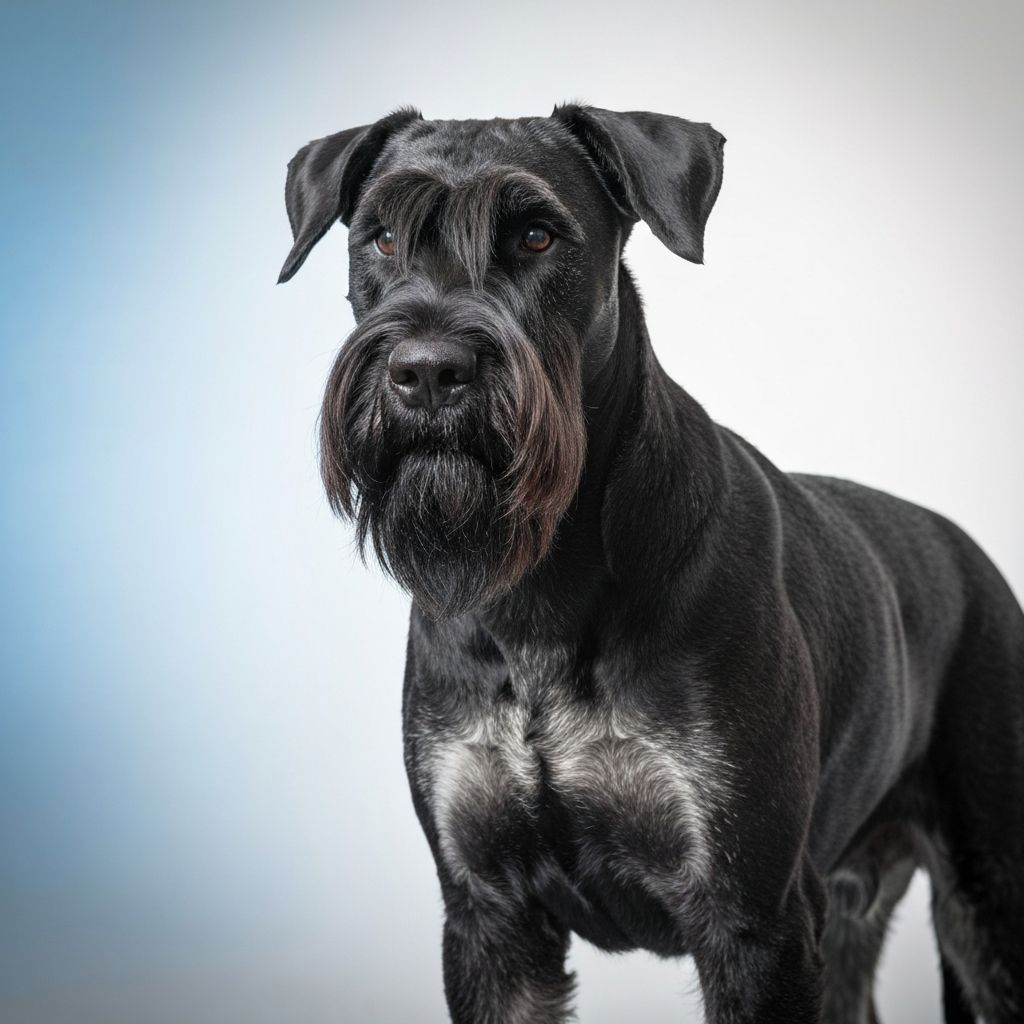
The Giant Schnauzer is a powerful black guardian whose beard and bushy eyebrows give it the expression of a stern general — a dog that takes protecting the family deadly seriously and at home turns into a great bearded mischief-maker.
The Giant Schnauzer has an expression that brooks no discussion. Dense, overhanging eyebrows, an impressive beard, and a serious, searching gaze make it look like a stern, bearded general who has just caught you in a flagrant act of insubordination and is wondering what to do with you. This dignified seriousness is not, however, a pose — it is the largest of the three schnauzers, bred in Germany as a farm dog for driving cattle, and later a prized guard of breweries, slaughterhouses, and yards, in time an excellent police and protection dog. It has behind it, then, generations of serious, responsible work and carries this within it with full awareness. Except that this general's seriousness is only a first impression — and as first impressions tend to, it does not tell the whole truth. Because the Giant Schnauzer is not only dignified and fearsome. It is also surprisingly sharp, mischievous, and — toward its people — boundlessly tender.
Let us start with that famous expression, because it can stir up quite a mess. The Giant Schnauzer most of the time looks deeply worried about something or slightly disappointed in you — the beard and eyebrows make it, even in excellent humor, present itself like a retired lecturer who did not buy a single word of your explanation. Beneath this skeptical façade, however, a first-rate brain is at work: this is a dog so sharp that it often seems a step ahead of you, and it knows perfectly well which rules really apply and which can be creatively circumvented. Bored, it will take matters into its own paws — it will learn to open doors, empty cabinets, and organize entertainments that no one assigned it. On top of this it treats the role of guard with a seriousness worthy of that beard: it scrutinizes every guest from head to toe, meticulously notes who approaches the gate and when, and by its very presence makes many a mailman feel the urge to reconsider their career. This is really a lot of dog — self-assured, vigilant, and deeply convinced that it is solely thanks to its supervision that everyone in this house is still whole and safe.
And then the doors close, the audience disappears — and the stern general vanishes somewhere. Because with its own family the Giant Schnauzer throws off all that seriousness like a too-tight uniform and shows who it really is: a great, bearded mischief-maker that brings toys, demands a shared chase around the garden, and with disarming unceremoniousness arranges its several dozen kilograms as close as possible to its beloved people. But beneath this merriment not for a moment does the deepest thing in this breed fade — the Giant Schnauzer has appointed itself your bodyguard and treats this function as a life mission. It watches over you when you rest, stands between you and anything it finds suspicious, and would without hesitation shield you with its own body. This is precisely its way of saying “I love you”: not with sweet submissiveness, but by taking you under its protection and never again letting you out of it. And being someone to whom such a dog has given its faithfulness and its mischievous, tender smile hidden from the whole world is one of the more beautiful privileges a dog can give.
Keeping such a large, hard-working dog in form requires a sensible diet — and its powerful body has a few tender points one must know about:
- Meals necessarily divided into smaller portions, served in calm and without intense movement right before eating and after — a deep chest makes this breed exposed to dangerous gastric torsion
- A good-quality food rich in full-value protein (roughly about 22–28%) — this is fuel for a large, active dog with a considerable energy expenditure
- A lean, muscular silhouette and portions matched to the real activity — they protect its hip joints, and with a tendency toward hypothyroidism help keep the weight in check
- Constant access to fresh water, but without greedy drinking of large amounts at once, especially around exertion
Beyond diet, with the Giant Schnauzer it is worth remembering a few matters:
- Stomach: gastric torsion (GDV) is, with this deep chest, a real and sudden threat to life — knowing the symptoms and a lightning-fast reaction can save it
- Joints: hip dysplasia can be a problem of large, active breeds, which is why a lean weight and sensible movement in a growing puppy matter greatly
- Thyroid: the breed can be prone to autoimmune thyroiditis (hypothyroidism), so it is worth reacting to weight gain, apathy, or a worsening of coat condition
- Head and movement: this is a sharp working dog with considerable needs for movement and occupation for the mind — without them it will quickly find its own, usually troublesome, entertainments
The Giant Schnauzer is a great deal of character in one impressive dog — it is not a companion for everyone, because it requires movement, wise guidance, and occupation for that sharp head. But for someone who understands these needs, it becomes a guardian and friend like few others: dignified, devoted, and surprisingly funny.
Give it a proper dose of movement, work for the mind, and a place at the very center of the family, and in return you will get this whole dog without reserve — its strength, its vigilance, and that mischievous glint in its eye that it hides from the whole world. Because although the Giant Schnauzer wears the expression of a stern general and guards you with a seriousness only a true watchdog can muster, deep in its soul it longs for one thing: to be by its people, watch over them, and time and again make them laugh to tears. And if it is you it has chosen, you can be sure that there is nothing in the world this bearded giant would not shield you from.
See also: Standard Schnauzer, Miniature Schnauzer, Doberman Pinscher
Most common health issues
A congenital abnormality in which the head of the femur does not fit perfectly into the socket, over time leading to joint degeneration and pain. It mainly affects large and giant breeds, though it can occur in small ones too. Watch for reluctance to jump, a "bunny-hopping" gait, and stiffness after rest. A lean build and controlled exercise take pressure off the hips, while omega-3 fatty acids support the cartilage.
Sudden distension and twisting of the stomach; a directly life-threatening condition requiring immediate veterinary care. The risk rises in large breeds with a deep chest. Warning signs include unproductive attempts to vomit, a bloated belly, and restlessness. It helps to split the daily portion into 2-3 smaller meals and to avoid intense exertion right after eating.
A disease in which the immune system attacks the thyroid, over time leading to its underactivity. Symptoms build up slowly: apathy, weight gain, coat changes; it is diagnosed with a blood test. Once stabilized with treatment, a diet with controlled calorie content and coat support with omega-3 fatty acids help.
Health issues
3 most common conditions
Health issues
3 most common conditions
A congenital abnormality in which the head of the femur does not fit perfectly into the socket, over time leading to joint degeneration and pain. It mainly affects large and giant breeds, though it can occur in small ones too. Watch for reluctance to jump, a "bunny-hopping" gait, and stiffness after rest. A lean build and controlled exercise take pressure off the hips, while omega-3 fatty acids support the cartilage.
Sudden distension and twisting of the stomach; a directly life-threatening condition requiring immediate veterinary care. The risk rises in large breeds with a deep chest. Warning signs include unproductive attempts to vomit, a bloated belly, and restlessness. It helps to split the daily portion into 2-3 smaller meals and to avoid intense exertion right after eating.
A disease in which the immune system attacks the thyroid, over time leading to its underactivity. Symptoms build up slowly: apathy, weight gain, coat changes; it is diagnosed with a blood test. Once stabilized with treatment, a diet with controlled calorie content and coat support with omega-3 fatty acids help.
Nutritional needs
Proper hydration for your dog
Proper hydration is essential for a dog's health. Dogs need constant access to fresh water, especially on hot days and after physical activity. Wet food can serve as an additional source of fluids.