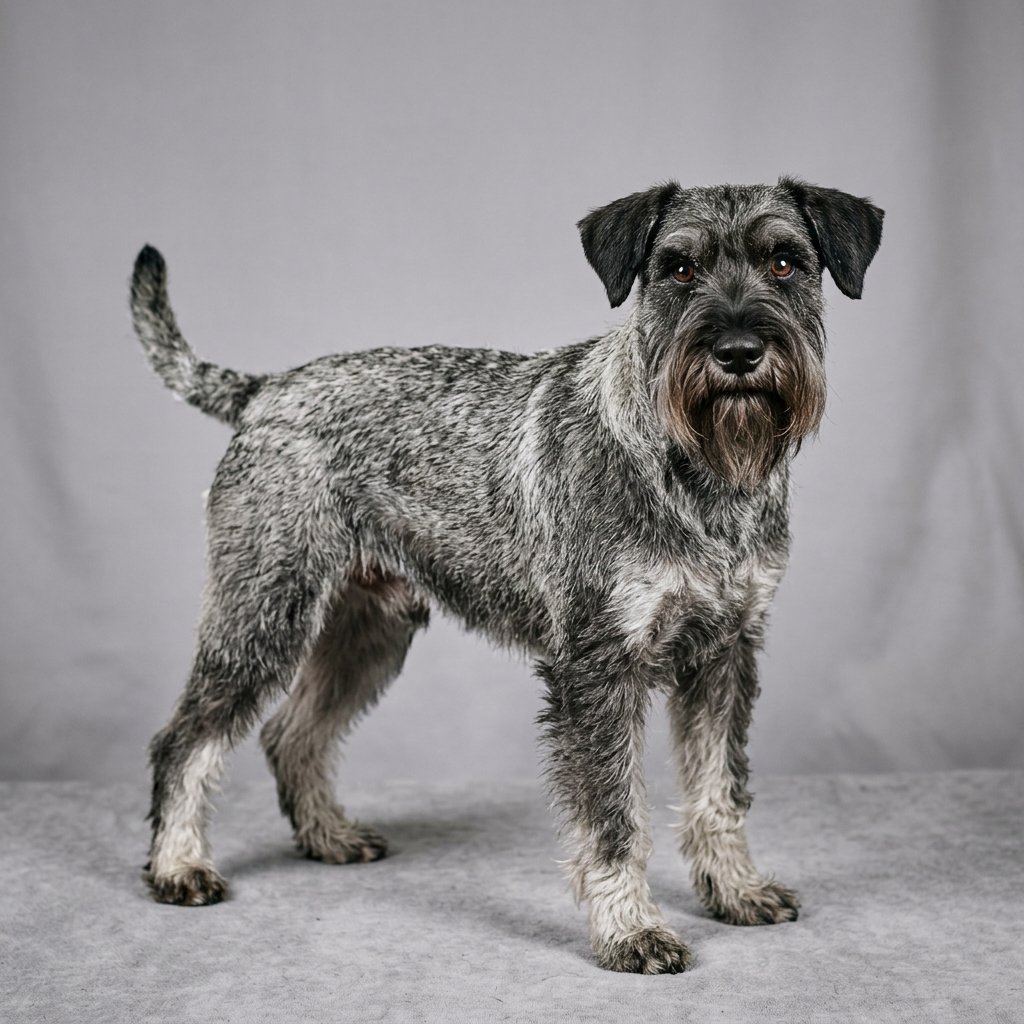
Standard Schnauzer
(Sznaucer Średni)
Origin: Germany
It looks like the middle child of the Schnauzer family, yet it is the father of the other two. The Standard Schnauzer is the first of the three: composed, incorruptible and so devoted to its own that the breed standard says so.
The Standard Schnauzer looks like the middle child of the family. The smaller brother takes the popularity, the bigger one commands respect, and hardly anyone remembers this one. Except that it is not their brother. It is their father. It came first: around the turn of the twentieth century the Miniature and the Giant Schnauzer were bred from it, one by scaling it down, the other by scaling it up. In the international breed standard it still appears with no qualifier at all, simply as the Schnauzer. “Standard” was added in everyday use to tell it apart from the two younger ones, and it happened to be a word that sounds like the basic trim level. Few names miss the truth by as much.
It started out in the stables of southern Germany. The official description of the breed records this with disarming precision: it felt particularly at home in the company of horses. It kept rodents away from the oats, and on market day it rode into town with the farmer. It was the ideal size for the job: small enough to fit on the cart and big enough that nobody uninvited came near that cart. It acquired its name in 1879, when the wire-haired pinscher class at a show in Hanover was won by a dog called Schnautzer, from the German “Schnauze”, meaning muzzle. The name stuck, and today the whole breed carries it. It is a bit as if every shepherd dog in the world were called Rex.
At home it behaves like someone who has already raised two sons and is surprised by very little. It does not make a fuss. It hears everything, but speaks up only when it decides there really is something to say. It plays with children for a long time and patiently, and when the game gets too loud it lies down in the doorway and waits for the company to cool off. It also has a father's sense of humour: one joke, repeated daily, always with the same satisfaction. It usually involves a sock. The beard is a chapter of its own. After every drink it carries roughly half a bowl of water across the kitchen in it, then carefully wipes it on your trousers. After dinner you can read the menu from it. And when it wants something, it lays the beard on your knee — warm, heavy and usually still wet — and looks up from under its eyebrows for so long that you forget what exactly you were going to refuse.
There is another side to that calm. When someone at home is having a bad day, the Schnauzer comes over and sits down beside them. It does not jump up, bring a toy or ask for attention. It sits. Generations spent among horses teach one thing: next to someone large and shaken, the best you can do is simply be there, calmly.
The Germans have a word for it that they even wrote into the breed standard: incorruptible. Beside a cart full of goods the word had a concrete value. A stranger could walk up with a sausage in his hand and would walk away with a sausage in his hand. Today the cart is gone and the word still holds, only it means more. Its devotion cannot be bought by the neighbour or by a guest with a pocket full of treats. The nice lady in the park cannot buy it. And, most important of all, you did not buy it either. You were given it for free: one ordinary day this dog decided that you were its person, and there is no appeal against that decision.
It is worth remembering this at the table, because there the incorruptible Schnauzer turns out to be surprisingly open to offers. Only you will get nothing in return. It is already yours. A treat will not make it more yours; it will only make it heavier.
At the bowl a few things are enough:
- Treats are at most one tenth of the daily calories, taken off the portion rather than added on top
- A complete food with good animal protein, chosen for a dog that needs two proper walks a day
- A portion from the kitchen scales and ribs checked by hand, because under a wiry coat excess weight stays hidden for a long time
- The beard wiped and dried after every meal. Wet and full of leftovers, it soon starts to smell strongly enough to notice from the next room
- The bowl is its territory. It can be possessive about food and toys, so children are taught from the start that a dog is left alone while it eats
The standard credits it with resistance to weather and disease, and it usually lives 13 to 16 years.
Even so, a few things are worth knowing:
- Heart: a hereditary dilated cardiomyopathy occurs in the breed and shows up already in young dogs. A DNA test exists, and a responsible breeder tests both parents
- Hips: dysplasia occurs, as in most dogs of this size. Ask for the parents' X-ray results and keep the dog lean
- Eyes: eye problems occur, cataracts among them, so a periodic eye examination makes sense
- Coat: the wiry hair is hand-stripped, that is, removed by hand, so that it keeps its harshness. The beard and eyebrows need regular trimming
- Occupation: two long walks a day and something for the mind to do. Without it, it draws up its own plan for the day, and you find out about it when you get home
Its sons went out into the world. The Miniature conquered the sofas of several continents; the Giant joined the police. It stayed where it had been from the start: with the horses, with the cart, with the children. As a reward it was labelled “standard”.
Someone in this family had to stay at home. You are lucky that it happens to be yours.
See also: Miniature Schnauzer, Giant Schnauzer, Hovawart
Most common health issues
A heart muscle disease in which the heart enlarges and pumps blood less effectively; large breeds are predisposed. Signals can include quick tiring, coughing, and rapid breathing. A healthy body weight eases the heart, and taurine, L-carnitine, and omega-3 fatty acids are indicated as support for its function.
A congenital abnormality in which the head of the femur does not fit perfectly into the socket, over time leading to joint degeneration and pain. It mainly affects large and giant breeds, though it can occur in small ones too. Watch for reluctance to jump, a "bunny-hopping" gait, and stiffness after rest. A lean build and controlled exercise take pressure off the hips, while omega-3 fatty acids support the cartilage.
Clouding of the lens, which gradually limits vision and in an advanced form can lead to blindness; it can be hereditary or accompany diabetes. A signal is a blue-gray clouding of the eye and uncertain movement. Antioxidants in the diet support eye health, while weight control reduces the risk of diabetes.
Health issues
3 most common conditions
Health issues
3 most common conditions
A heart muscle disease in which the heart enlarges and pumps blood less effectively; large breeds are predisposed. Signals can include quick tiring, coughing, and rapid breathing. A healthy body weight eases the heart, and taurine, L-carnitine, and omega-3 fatty acids are indicated as support for its function.
A congenital abnormality in which the head of the femur does not fit perfectly into the socket, over time leading to joint degeneration and pain. It mainly affects large and giant breeds, though it can occur in small ones too. Watch for reluctance to jump, a "bunny-hopping" gait, and stiffness after rest. A lean build and controlled exercise take pressure off the hips, while omega-3 fatty acids support the cartilage.
Clouding of the lens, which gradually limits vision and in an advanced form can lead to blindness; it can be hereditary or accompany diabetes. A signal is a blue-gray clouding of the eye and uncertain movement. Antioxidants in the diet support eye health, while weight control reduces the risk of diabetes.
Nutritional needs
Proper hydration for your dog
Proper hydration is essential for a dog's health. Dogs need constant access to fresh water, especially on hot days and after physical activity. Wet food can serve as an additional source of fluids.