Maltipoo
Origin: USA
Officially the Maltipoo doesn't exist: there is no standard, no pedigree and no shows. Unofficially it is lying on someone's lap during a video call right now — because this is a dog invented precisely for our times.
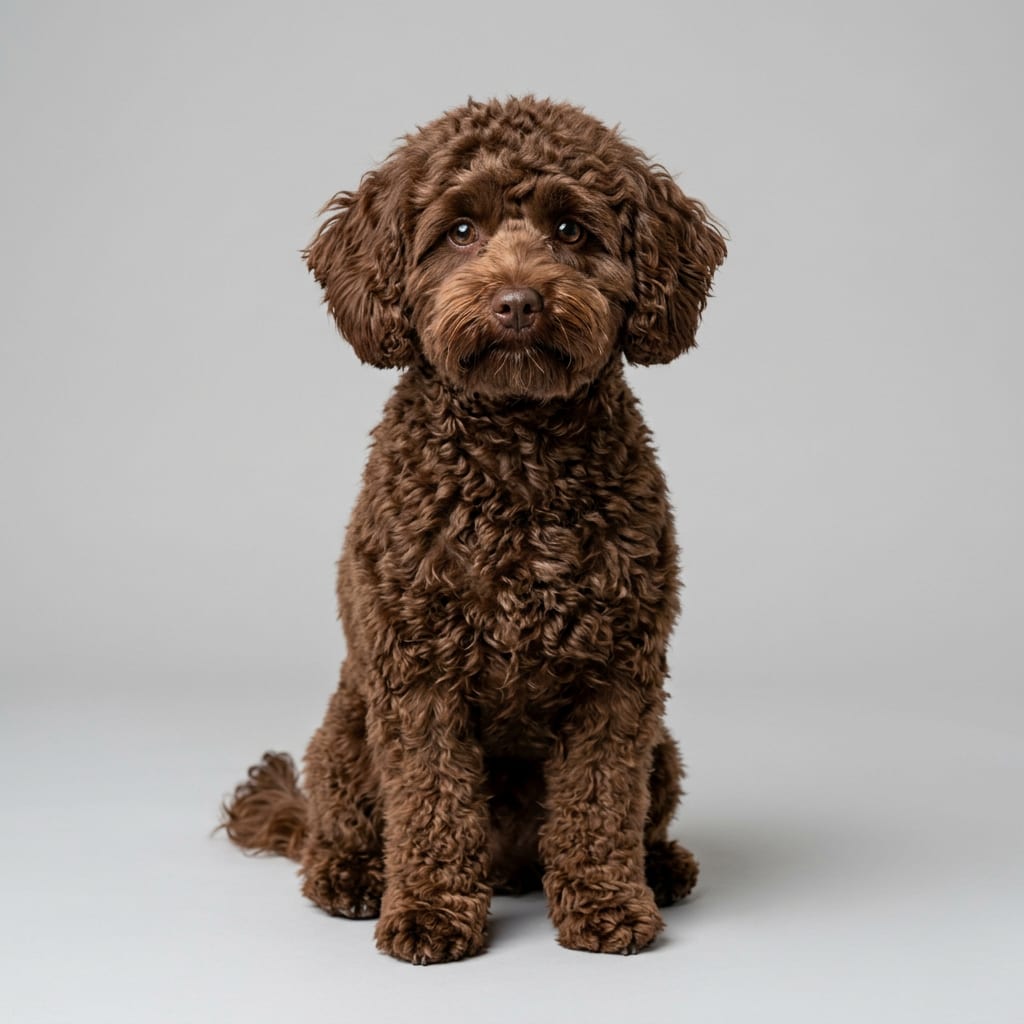
The Maltipoo is a dog that officially isn't there. The Fédération Cynologique Internationale doesn't recognise it, there is no standard to judge it by, and no judge will ever hand it a trophy. None of this stops it being one of the most wanted dogs of our times — and no wonder, because it was made especially for them. Every era has had its companion dog: antiquity carried the Maltese in its arms, royal courts were enchanted by the Poodle. Ours was born in the United States at the end of the twentieth century and took one parent from each of those eras. The Maltese gave it two thousand years of practice at being close to people. The Poodle added one of the sharpest minds in the canine world and hair that hardly sheds. The result is a dog tailored to the life we actually lead: a flat instead of a court, a laptop instead of a carriage, a sofa instead of a ballroom.
The division of labour between its ancestors shows at every turn. From the Maltese it inherited the goal: to be as close to you as possible — and then a little closer. From the Poodle it got the means: a head that will work out every obstacle on the way before you finish saying “not on the bed”. As a result, you live with a small strategist of affection. It knows your daily schedule better than you do and can tell the workday alarm from the Saturday one. It recognises the sound of a laptop closing from the next room and is standing by the lead before the lid touches the keyboard. On video calls it appears in the frame more often than the CEO, and it regards remote work as the crowning achievement of human civilisation. It is also the only dog whose looks you find out a year later: a puppy may grow to three kilos or to eight, with curls from the Poodle or a soft wave from the Maltese. It is settled by the toss of a genetic coin. It comes up a winner every time.
And now for what matters most in this story. The Maltipoo came into being in times when people have more contacts than ever and less presence than ever. Times in which you can get through a whole day among notifications and not once hear your own name. It is hard to call it a coincidence that precisely such an era invented a dog whose main occupation is noticing that you are there. And it really does. It lifts its head when you sigh over an email. It moves from room to room together with your mug. It reads tone: a raised voice, even one aimed at the television during a match, it takes personally and comes to check that everything is all right between the two of you. And your return home is the same event for it every single day — as if someone had switched the light back on.
This attentiveness has its price, and it is better to know it before you fall in love. A dog made for being together copes badly with being apart: left for long hours it may bark, destroy things and simply suffer. It has to be taught to be alone from its first weeks, patiently and a little at a time. The second matter is the promise it was born with: it was meant to be “hypoallergenic”. Honestly speaking, there are no such dogs. When researchers measured allergen in the homes of dogs “for allergy sufferers” and of all the others, they found no difference. A Maltipoo sheds very little and many allergic people really do tolerate it better — but that is something you check on a specific dog and before the decision, not in an advert.
Finally, there is one entirely practical consequence. Since there is no standard, there is no feeding table “for Maltipoos” either — and just as well, because this dog can weigh three kilos or eight.
So its portion can't be read off the packaging; it has to be worked out:
- The starting point is the bathroom scales, not the name of the breed: calculate the portion from what your Maltipoo weighs and what it should weigh, and while it is growing, check it every few weeks
- A desk companion moves moderately but begs effectively. Count the treats given “in passing” while you work into the daily allowance — for a five-kilo dog, three or four such trifles are almost an extra meal
- Small kibble and a daily toothbrush: from both parents it inherited closely set teeth on which tartar builds up in no time
- For the smallest puppies, three or four meals a day at fixed times, because long gaps risk a drop in blood sugar
- Omega-3 fatty acids for the skin and for hair that doesn't fall out but grows — continuously, like a person's
Beyond the bowl, a few things are worth remembering:
- Hair: it doesn't shed, so it mats. Brushing every day or two and a trim every 6–8 weeks is a fixed line in the budget, not a luxury
- Eyes: a light coat shows tear stains, so the area around the eyes is worth wiping daily. Progressive retinal atrophy (PRA) can be inherited from Poodles — ask about the parents' test results
- Knees: a luxating patella is common in small dogs. React to “skipping” on a hind leg and keep your dog lean
- Ears: drooping and hairy, they like moisture — look into them every week and dry them after a bath
- Origins: no kennel club watches over Maltipoo breeding, so you have to see the parents and the conditions for yourself. A good breeder will show both parents and their health test results without being asked
The Maltipoo has no centuries of history behind it, no legends and no portraits in museums. It has something no dog with a ten-generation pedigree has: it was invented for us. For people who live in flats, work at screens and sometimes go a whole day without exchanging a word with anyone.
Officially this dog isn't there. Say that to someone who closes the laptop in the evening and hears the tap of small claws coming from the hall. It has no standard, no trophies and no place in any register. It has one place in the world — beside you — and it occupies it as though that place had been made especially for it. Although it was exactly the other way round: it was made for that place.
See also: Maltese, Poodle, Havanese
Most common health issues
The kneecap slipping out of its proper groove, causing the knee to momentarily "skip" or lock. Very common in small and miniature breeds. A symptom can be periodic tucking-up of a hind leg while running and sudden, brief lameness. A lean build takes pressure off the joints, while supporting the cartilage with omega-3 fatty acids and the right calcium level promote knee stability.
Buildup of tartar and periodontal disease, which lead to gum inflammation, pain, and tooth loss, and chronically burden the whole body. It's worth looking inside the mouth and reacting to bad breath. Food with the right texture, chews, and regular brushing limit plaque buildup.
A hereditary eye disease in which the retina gradually loses function, leading to worsening eyesight — first after dark. It doesn't hurt, so the first sign is often the dog's uncertainty in the dark and bumping into objects. Antioxidants and omega-3 fatty acids support eye health (though they don't stop the disease); keeping the furniture in fixed positions at home helps.
A neurological disorder manifesting as generalized trembling of the body, most often described in small breeds with white coats. The trembling worsens with excitement and stress. Symptoms are worth consulting with a vet; a calm environment and a steady daily rhythm help reduce the intensity of the episodes.
Health issues
4 most common conditions
Health issues
4 most common conditions
The kneecap slipping out of its proper groove, causing the knee to momentarily "skip" or lock. Very common in small and miniature breeds. A symptom can be periodic tucking-up of a hind leg while running and sudden, brief lameness. A lean build takes pressure off the joints, while supporting the cartilage with omega-3 fatty acids and the right calcium level promote knee stability.
Buildup of tartar and periodontal disease, which lead to gum inflammation, pain, and tooth loss, and chronically burden the whole body. It's worth looking inside the mouth and reacting to bad breath. Food with the right texture, chews, and regular brushing limit plaque buildup.
A hereditary eye disease in which the retina gradually loses function, leading to worsening eyesight — first after dark. It doesn't hurt, so the first sign is often the dog's uncertainty in the dark and bumping into objects. Antioxidants and omega-3 fatty acids support eye health (though they don't stop the disease); keeping the furniture in fixed positions at home helps.
A neurological disorder manifesting as generalized trembling of the body, most often described in small breeds with white coats. The trembling worsens with excitement and stress. Symptoms are worth consulting with a vet; a calm environment and a steady daily rhythm help reduce the intensity of the episodes.
Nutritional needs
Proper hydration for your dog
Proper hydration is essential for a dog's health. Dogs need constant access to fresh water, especially on hot days and after physical activity. Wet food can serve as an additional source of fluids.