Havanese
(Hawańczyk)
Origin: Cuba
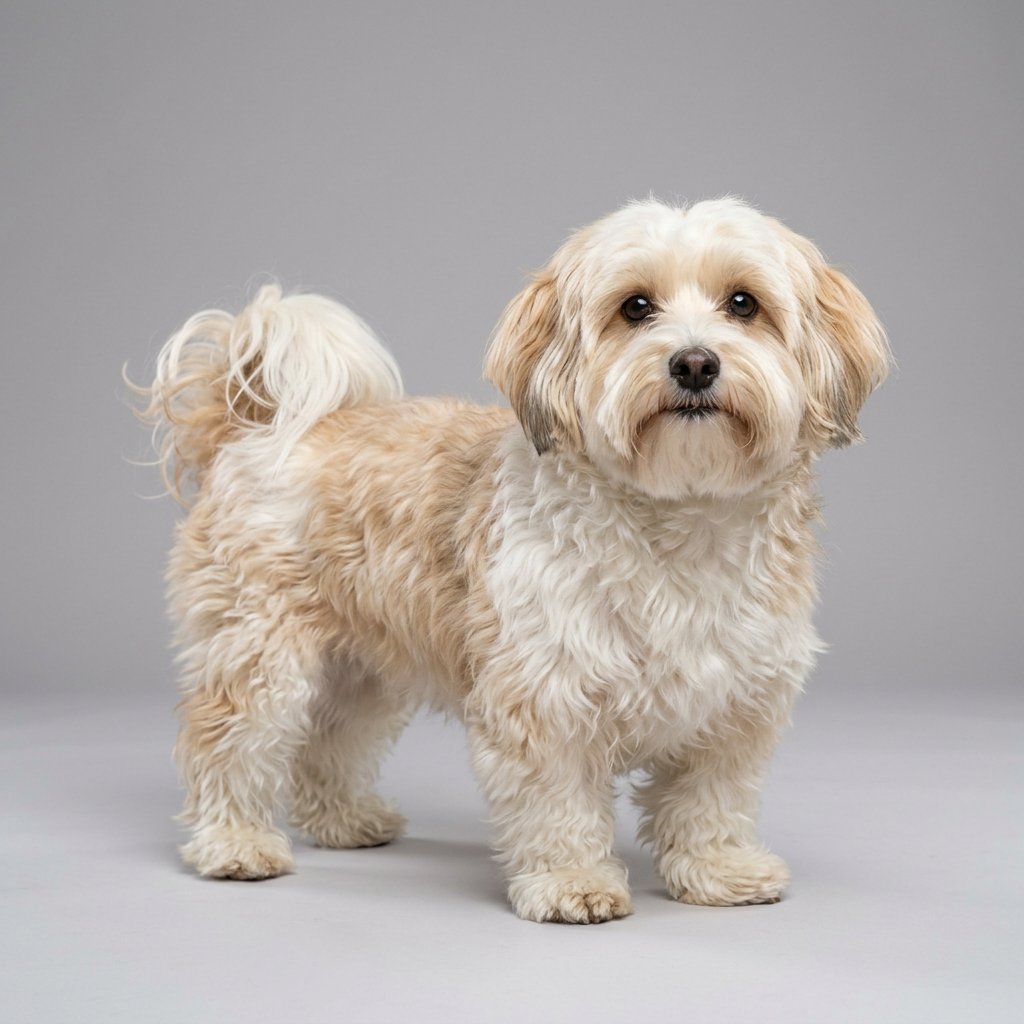
The Havanese is the national dog of Cuba, and joy is written into its breed standard in the section on how it walks. It doesn't trail after you around the house — it dances with you, half a step beside you, for fourteen or fifteen years.
In the official standard of the Havanese, in the section on how the dog should move, there is a sentence a poet would be proud of: “according to his happy nature” it has “a strikingly light-footed and elastic gait”. The people who write the rules were supposed to describe a dog's step and had to begin with joy — there was no other way. The Havanese is the national dog of Cuba. Its ancestors, small bichons from the Mediterranean, sailed to the island on board ships and made the only career they had ever dreamed of there: they became members of the household. For generations they lived in Havana's homes, and on its sun-baked streets they learned to walk the way they still walk today — as if the paving were slightly warmer than it should be. Then came the revolution and the music stopped. The world this dog lived in vanished, and when American breeders went looking for it in the 1970s, they counted eleven Havanese in the whole of the United States. Eleven dogs. That was enough for the tune to survive.
Day to day that tune never stops playing. A Havanese doesn't go for a walk — it springs along on one. Before every meal it performs a pirouette, sometimes three. It learns so fast that you run out of new tricks before it runs out of enthusiasm, and the zip on your rucksack is a two-minute puzzle to it. It watches television: really, from the sofa, with concentration, and looks like someone with firm opinions about the schedule. It also has one weakness that breeders warn you about under their breath: paper. A roll left within reach of its mouth turns into streamers, and the hall into a street the morning after carnival. Letters, receipts and instruction manuals it treats as confetti in its raw state. The standard puts it with restraint: “a charmer, playful and even a bit of a clown”.
But the most important dance is the one you don't notice straight away. People say a Havanese never leaves your side. That is true, only badly told. It doesn't tread on your heels and it demands nothing — it keeps step. You get up, it gets up. You go to the kitchen, it is half a step beside you. You sit, it sits. You slow down on a bad day — it slows down with you and doesn't ask why. Dancing is the only situation in life in which someone half a step away from you is not a nuisance but a partner. It has mastered that art to perfection: it doesn't get ahead, doesn't fall behind, and always knows where you are. That is why it does so well as a therapy dog. And why it copes so badly with an empty flat — a dancer without a partner has nothing to do with itself.
That springy step is also the best indicator of its health and the first thing excess weight takes away. A Havanese weighs between three and six kilograms, so half a kilo too much is a tenth of its body and a noticeably heavier landing on knees which in small dogs tend to be delicate anyway. When the spring in the step fades, it usually isn't age. It is the bowl. And there is something worth looking after, because this is one of the longer-lived breeds: a well-cared-for Havanese dances with its person for fourteen or fifteen years.
So that it keeps its lightness through all those years, a few rules at the bowl are worth sticking to:
- A portion measured on kitchen scales. The long hair hides the figure superbly, so judge it with your hand, not your eye: the ribs should be felt at once
- Treats are the currency of learning, and it learns a lot and gladly — cut them into pea-sized pieces and count them into the daily allowance
- It can be fussy. Don't rescue the bowl with ever better extras: fixed times, a quarter of an hour to eat, and the bowl disappears until the next meal
- Omega-3 and omega-6 fatty acids for the skin and that silky hair, which can be well over ten centimetres long
- Small kibble and a daily toothbrush, because tartar builds up quickly in a small mouth
Beyond the bowl, a few things matter for this breed:
- Liver: a congenital portosystemic shunt occurs in Havanese more often than in other dogs. A puppy that grows poorly, seems dull after eating or drinks unusually much should have a blood test
- Knees: a luxating patella is common in small breeds — react to “skipping” on a hind leg, because a dancer without knees doesn't dance
- Eyes: hereditary cataracts occur in the breed, so it is worth asking the breeder about the parents' test results and seeing an eye specialist from time to time
- Hair: light and with almost no undercoat. It needs brushing every day or two, and in frost it is less warm than it looks — a winter coat is common sense for this dog, not fashion
- Being alone: teach it from puppyhood, a few minutes at a time, before it becomes a problem
A Havanese demands nothing of you. It doesn't need a garden, special tasks or great expeditions. It needs a partner: someone whose step it can keep.
Two hundred years ago it sprang along the sun-warmed paving of Havana. Today it does the same in your hall, in the middle of a Polish November — with the same step and the same joy that someone once had to write into the standard, because without it the description would have made no sense. You don't have to know how to dance. It is enough to get up from the sofa. And then, just this once — let it lead.
See also: Bichon Frisé, Maltese, Shih Tzu
Most common health issues
A congenital blood-vessel defect in which blood from the intestines bypasses the liver and is not cleansed there. It occurs clearly more often in Havanese than in other dogs. Signs usually appear in puppies: poor growth, dullness or unsteadiness after a meal, excessive thirst. It is diagnosed with blood tests and imaging, and treatment is supported by an easily digestible diet with carefully chosen protein, set with a vet.
The kneecap slipping out of its proper groove, causing the knee to momentarily "skip" or lock. Very common in small and miniature breeds. A symptom can be periodic tucking-up of a hind leg while running and sudden, brief lameness. A lean build takes pressure off the joints, while supporting the cartilage with omega-3 fatty acids and the right calcium level promote knee stability.
Clouding of the lens, which gradually limits vision and in an advanced form can lead to blindness; it can be hereditary or accompany diabetes. A signal is a blue-gray clouding of the eye and uncertain movement. Antioxidants in the diet support eye health, while weight control reduces the risk of diabetes.
Buildup of tartar and periodontal disease, which lead to gum inflammation, pain, and tooth loss, and chronically burden the whole body. It's worth looking inside the mouth and reacting to bad breath. Food with the right texture, chews, and regular brushing limit plaque buildup.
Health issues
4 most common conditions
Health issues
4 most common conditions
A congenital blood-vessel defect in which blood from the intestines bypasses the liver and is not cleansed there. It occurs clearly more often in Havanese than in other dogs. Signs usually appear in puppies: poor growth, dullness or unsteadiness after a meal, excessive thirst. It is diagnosed with blood tests and imaging, and treatment is supported by an easily digestible diet with carefully chosen protein, set with a vet.
The kneecap slipping out of its proper groove, causing the knee to momentarily "skip" or lock. Very common in small and miniature breeds. A symptom can be periodic tucking-up of a hind leg while running and sudden, brief lameness. A lean build takes pressure off the joints, while supporting the cartilage with omega-3 fatty acids and the right calcium level promote knee stability.
Clouding of the lens, which gradually limits vision and in an advanced form can lead to blindness; it can be hereditary or accompany diabetes. A signal is a blue-gray clouding of the eye and uncertain movement. Antioxidants in the diet support eye health, while weight control reduces the risk of diabetes.
Buildup of tartar and periodontal disease, which lead to gum inflammation, pain, and tooth loss, and chronically burden the whole body. It's worth looking inside the mouth and reacting to bad breath. Food with the right texture, chews, and regular brushing limit plaque buildup.
Nutritional needs
Proper hydration for your dog
Proper hydration is essential for a dog's health. Dogs need constant access to fresh water, especially on hot days and after physical activity. Wet food can serve as an additional source of fluids.